
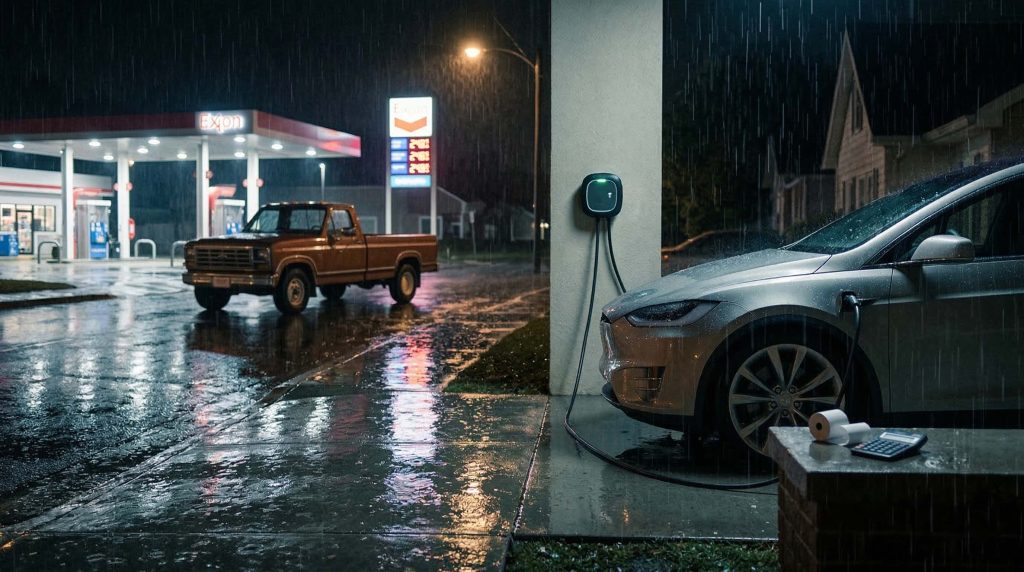
Daily-Driving a Classic in 2026: The Real Cost (and When an EV/Hybrid Actually Makes Sense)
You love the noise. You love the shape. You do not love the fact that your fuel gauge moves like a stopwatch.
Here’s the deal: daily-driving a classic can be financially defensible — but only if you stop thinking in “mpg vibes” and start thinking in total ownership cost.
This is a snappy, numbers-first guide to:
- what a classic actually costs to run in 2026,
- when a hybrid beats it (and when it doesn’t),
- when an EV is the smart move (and when it’s just a very expensive moral victory).
TL;DR (print this)
- Fuel is the obvious pain. A thirsty classic (12–15 mpg) can burn $2.6k–$4.1k/year in gas, depending on mileage and price.
- The twist: if you already own the classic, “buying efficiency” (new hybrid/EV) often loses on total cost once you include purchase price + depreciation + higher insurance.
- Hybrids make sense if you need reliability, drive a lot, and are going to buy a newer daily anyway.
- EVs make sense if you drive a lot, can charge at home, and plan to keep it long term. If you barely drive, the payback is slow.
The setup (the classic-car owner moment)
You’re standing in your garage staring at a classic — say a 1971 Chevy C10 with a small-block V8. It’s beautiful. It sounds like freedom. It also turns fuel into noise at a heroic rate.
So the question becomes:
Is it cheaper (or greener) to keep running the classic — or to replace it with a modern hybrid or EV?
Let’s run the math without the cope.
1) Fuel: the part that hurts every week
We’ll use simple assumptions to keep this usable:
- Annual driving: 12,000–15,000 miles
- Gas price baseline: ~$3.25/gal (US) — adjust for your reality
- Home EV charging: ~$0.12/kWh (US) — again, adjust
Quick fuel math (annual)
- Classic V8 (12–15 mpg): roughly $2,600–$4,100/year
- Modern hybrid (50–58 mpg): roughly $700–$1,000/year
- EV (mostly home charging): roughly $400–$650/year (depends heavily on your electricity + DC fast charging use)
Translation: fuel savings can be real. But fuel is only one line item.
2) The “classic isn’t expensive” myth — maintenance & repairs
Classic ownership is a weird combo:
- Some things are cheap and DIY-friendly (fluids, belts, ignition basics).
- Other things are random and time-consuming (old rubber, wiring, cooling issues, parts availability).
A realistic annual range (if you actually daily it)
- Classic: $1,500–$3,000+/year (high variance; depends on how sorted it is and how much you DIY)
- Modern ICE/hybrid: $600–$1,200/year
- EV: $300–$600/year (usually lower routine service; tires can still be a thing)
Rule of thumb: if your classic is already “sorted,” costs stabilize. If it isn’t, the first year is basically a paid tutorial.
3) Insurance: the surprising twist
People hear “classic insurance is cheap” and think it’s a cheat code. It can be — but only if your use case fits.
- Collector policy: often $400–$1,000/year… but usually limited mileage and requires another daily.
- Normal daily-driver insurance: often much higher (varies wildly by region/driver).
- EV insurance: can be higher than you expect (repair costs, parts, sensors, etc.).
If you’re truly daily-driving the classic, assume you’re not getting the “10k miles/year in a bubble” collector-policy magic.
4) The part everyone forgets: purchase price + depreciation
This is where the “just buy a hybrid” argument usually faceplants.
- If you already own the classic, your purchase cost today is effectively $0.
- A modern car comes with depreciation (often the biggest single cost), plus financing cost if applicable.
- Many classics have flat or positive depreciation if maintained — not guaranteed, but it’s a real factor.
Translation: fuel savings can be erased by “new car math.”
5) So… when does a hybrid or EV actually make sense?
Hybrid makes sense if:
- You drive 10k–15k miles/year
- You want boring reliability and low drama
- You were going to buy a newer daily anyway
- Your classic is becoming a second job
EV makes sense if:
- You drive a lot (especially highway commuting)
- You can charge at home most of the time
- You plan to keep it 7+ years
- You’re optimizing for low day-to-day running cost and don’t mind higher upfront cost
Keeping the classic makes sense if:
- You already own it, and it’s reasonably sorted
- You drive <10k miles/year
- You can DIY (or you have a trustworthy shop)
- You value the experience (because yes, that’s a real value)
6) Environmental reality check (short version)
EVs usually win on lifetime emissions — but the timing depends on:
- your electricity mix (clean vs dirty grid),
- how much you drive,
- and how long you keep the EV.
Practical takeaway: if you barely drive, the “greener” move is often to keep the existing car running rather than manufacturing a brand-new one for low mileage.
The bottom line
- If you already own the classic, it’s often cheaper to keep it — unless it’s unreliable enough to cost you time, missed work, and stress.
- If you’re shopping for a daily anyway, hybrids and EVs are great. Just don’t pretend the classic is “free” if it’s actually a rolling restoration.
- Best real-world strategy: keep the classic as the fun car, and run a cheap, efficient commuter if you do big miles.
Assumptions (so you can swap in your numbers)
- Gas: ~$3.25/gal (US baseline)
- Electricity: ~$0.12/kWh home charging (US baseline)
- Annual miles: 12,000–15,000
- Classic V8: 12–15 mpg
- Hybrid: 50–58 mpg
- EV: mostly home charging (DC fast charging increases cost)
Sources (starting points)
- AAA gas prices: https://gasprices.aaa.com/
- EPA automotive trends: https://www.epa.gov/automotive-trends
- ICCT lifecycle analysis (Europe): https://theicct.org/
- Hagerty ownership cost context: https://www.hagerty.com/media/
8ravens Analog Modern — practical analysis for the car-curious.