
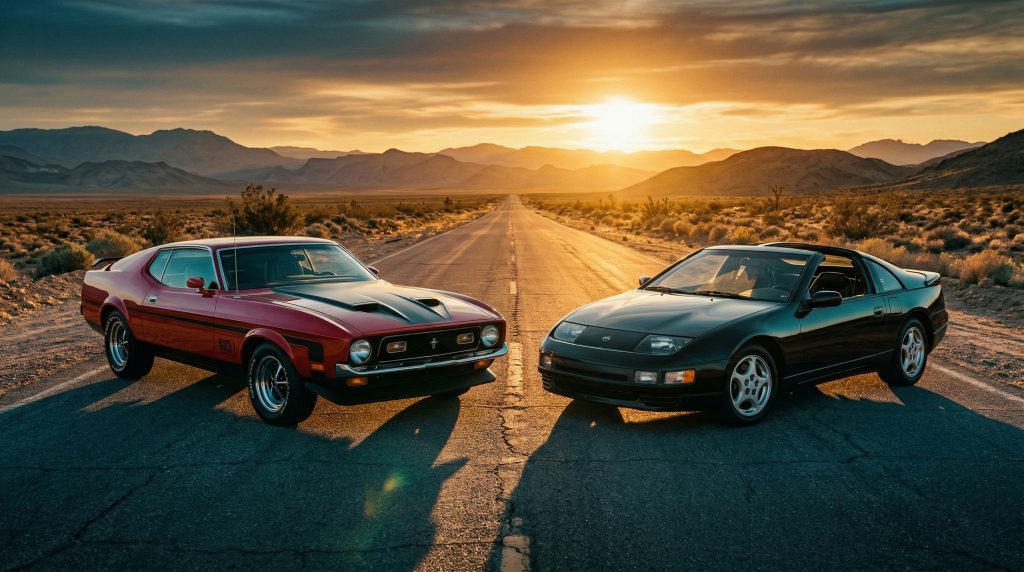
The Dream vs. The Reality
Picture this: You’re cruising down a sun-drenched coastal highway in a cherry-red ’67 Mustang, the V8 rumbling like thunder, wind in your hair. Heads turn. Phones come out. You’re not just driving—you’re traveling through time.
Sounds amazing, right?
Here’s the deal: That scene is absolutely real, and it’s achievable. But before you drain your savings account on the first beautiful hunk of metal that catches your eye, let’s get real about what classic car ownership actually looks like in 2026.
The Big Question: Is Now the Right Time?
One Reddit enthusiast captured the internal conflict perfectly: “I used to never be a big fan of cars… just annoyed by everyone using cars as a status thing. That is, until I ventured into classic cars. Classics just feel strangely special to me, like an old friend you can’t really forget.“
That’s the magic right there. Unlike modern cars that feel like a pit of new and improved glowing buttons, classics offer something increasingly rare in our digital world: an analog soul.
But here’s why this matters: 2026 is a unique moment in classic car history. The market is shifting. Younger buyers (Millennials and Gen Z) are now the fastest-growing segment of classic car owners. Hagerty’s own data shows interest among these generations actually exceeds Gen X and Boomers. The classic car community is getting younger, more diverse, and more excited.
Even better? According to Hagerty’s CEO McKeel Hagerty, the strength in the classic-car market is expected to continue in 2026. Translation: Your timing isn’t just good—it’s great.
Your Two Paths: True Classics vs. Youngtimers
Let’s break down what you’re actually signing up for. Classic car ownership splits roughly into two camps:
The True Classics (1960s-1970s): Analog Soul, Maximum Drama
What to Expect:
These are the poster cars. The Mustangs and Firebirds and Chargers that starred in every movie about Americana. They represent peak mechanical simplicity—before computers, before sensors, before “check engine” lights became sentient.
The Pros:
– Pure mechanical simplicity – If you can turn a wrench, you can fix most things yourself. One Reddit user put it perfectly: “They seem so much more alive than modern vehicles.“
– Parts are often surprisingly cheap – When available, anyway. No proprietary software locks, no “dealer-only” diagnostics.
– Unmistakable presence – These cars turn heads. Period.
– DIY-friendly – “I’ve heard they’re much easier to work on yourself” noted the same Reddit enthusiast, highlighting the appeal for hands-on learners.
– Strong appreciation potential – Hagerty’s 2026 Bull Market List includes 1960s-70s icons for a reason.
The Cons (Let’s Be Real):
– Parts scarcity is real – Finding an obscure trim piece or a correct carburetor can become your new part-time job.
– Rust, rust everywhere – These cars are 50+ years old. Unless you’re buying from Arizona or Southern California, budget for rust remediation.
– Safety? What’s that? – Drum brakes, no airbags, no ABS, no stability control. You’re driving a very fast battering ram.
– No AC (usually) – Hope you like sweating. Or you could restomod with modern climate control (old body, modern guts—see where we’re going with this?).
– Constant maintenance – They don’t just work. They require attention, adjustment, and love.
The Youngtimers (1980s-1990s): The Perfect Middle Ground
What to Expect:
“Youngtimers” is the European term for modern classics from the 80s and 90s, and they’re having a moment. As Hagerty notes, these cars are seeing “increased interest among collectors” and represent “the perfect entry point” for newer enthusiasts.
Why This Category Is Exploding in 2026:
Millennials grew up with these cars. They’re nostalgic. They’re daily-drivable. They’re technically old enough to be classic but new enough to have fuel injection and working air conditioning.
The Pros:
– Actually drivable daily – EFI means they start in the cold. AC means you arrive not dripping. It’s luxury!
– Parts still exist – Not abundant, but not impossible either. The sweet spot.
– Community is growing fast – These are the cars of the future collector market.
– Rising values – Buy now, thank yourself later. The 2026 Hagerty Bull Market specifically called out 80s-90s gems as appreciating assets.
– Restomod potential – Old-school cool with modern reliability? That’s the Analog Modern dream.
The Cons:
– EFI complexity – It’s not carburetor-simple, but it’s not Tesla-complicated either.
– Electrical gremlins – 30-year-old wiring and plastic connectors love to betray you.
– Not classic enough purists – Ignore them. They’re wrong, and this category is going mainstream.
– Plastic degradation – Vacuum lines, interior trim, gaskets—they’re all getting brittle.
The Honest Pros and Cons List
The Good Stuff
– Skills you’ll actually learn – Mechanical competence, troubleshooting, and patience.
– Community – Classic car people help each other. It’s like a secret club, but everyone’s invited.
– Satisfaction of hands-on ownership – There’s nothing quite like diagnosing your own problem and fixing it.
– Appreciation potential – Unlike a new car that loses 30% driving off the lot, classics often gain value.
– Unplugged driving experience – No screens, no distractions. Just you, the machine, and the road.
– Time capsule effect – You’re preserving history. Future generations will thank you.
The Reality Check
– No warranty – When something breaks, it’s on you.
– Everything breaks eventually – Plan for it. Budget for it. Expect it.
– Space requirements – You’ll need a garage or dedicated parking (street parking a classic car is asking for heartbreak).
– Time commitment – Weekend projects become every weekend.
– Tool investment – You’ll buy tools you never knew existed.
– Research becomes a second job – What carburetor fits what manifold? Which version of this part was used in ’72 vs ’73? You’ll learn.
Real Talk: The Challenges Nobody Wants to Admit
Let’s get brutally honest for a moment.
You WILL get stranded. Not often, maybe, but it will happen. That character everyone talks about? It’s code for occasionally unreliable. You need either a AAA membership or a very patient significant other with a pickup truck.
You WILL spend more than planned. That $12,000 Mustang that just needs a little work? Budget $5K-10K more for the work you don’t see yet. Hidden rust, deferred maintenance, and while I’m in there syndrome add up fast.
You WILL become insufferable at parties. Did I tell you about my carburetor? Yes, you did. We remember.
And here’s the thing: It’s still worth it.
As one Reddit commenter wisely advised: “See what riding/driving in one is like, first.” Smart. But don’t use research as procrastination. At some point, you have to leap.
The Restomod Question: Old Body, New Guts
We have to talk about this because it’s the perfect expression of what we (and presumably you) might call the Analog Modern aesthetic.
Restomodding—keeping the classic looks but upgrading the guts with modern reliability—isn’t cheating. It’s evolution. Disc brakes instead of drums? Modern fuel injection instead of finicky carburetors? Air conditioning that actually works?
This is where classic car ownership in 2026 gets really interesting. Technology from the 2010s is now old enough to be affordable donor material. You can have that 1967 silhouette with 2025 reliability. That’s not selling out—that’s engineering smart.
Conclusion: Here’s Why 2026 Matters
Yes. Absolutely. But with eyes wide open.
2026 is shaping up to be a banner year for classic car ownership because:
1. The market is strong but not yet insane – Hagerty’s 2026 Bull Market List shows enthusiasm without the bubble mentality of previous years.
2. Youngtimers are hitting their stride – The 80s and 90s cars you actually want to drive are becoming recognized collectibles.
3. The community is younger and welcoming – New blood means new resources, new forums, new energy.
4. Restomod technology is mature – You no longer have to choose between classic soul and actually works reliably.
5. There’s still time to get ahead of the curve – Some segments haven’t fully appreciated yet.
Here’s the final truth bomb: Classic car ownership isn’t about having the nicest car on the road. It’s about having *your* car. The one you chose, the one you wrench on, the one that breaks your heart and then makes you fall in love all over again when you finally get it running.
That sense of connection—that “old friend” feeling a Reddit user described—is real. And in 2026, it’s more accessible than ever.
Start with a youngtimer if you want daily usability. Go for the true classic if you want maximum soul. Restomod if you want the best of both worlds. But whatever you do, don’t wait for “the perfect time.” The perfect time is now.
Get out there. Find your ride. Join the cult.
Just… maybe keep that AAA card tucked in your glovebox. You know. Just in case.