
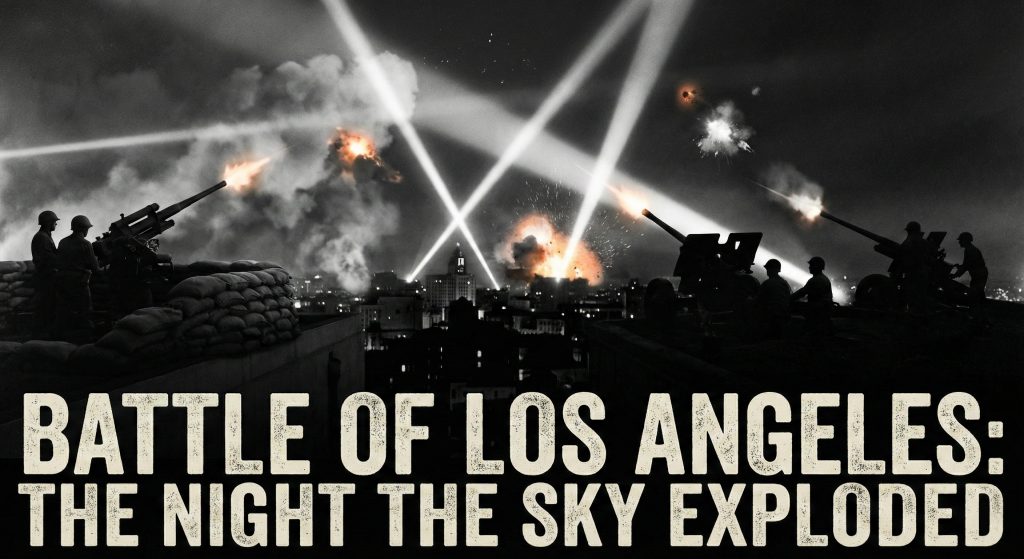
It’s 2:25 in the morning. You’re asleep.
Then the sirens start.
Not a test. Not a drill. The real thing — the sound every Los Angeleno has been dreading since December 7th, when smoke was still rising over Pearl Harbor, and the world cracked open. You stumble to the window. Outside, the streets are flooding with people. Your air raid warden neighbor is already in his helmet, blowing his whistle. Searchlights are slicing open the sky. And from somewhere to the south, you can hear the guns.
They’re here. The Japanese are here.
You are certain of this. Everyone is certain of this.
Everyone is wrong.
A City That Hasn’t Slept Since Pearl Harbor
To understand what happened in Los Angeles on the night of February 24–25, 1942, you have to understand what it felt like to live there in those first bruised months of the war.
The oceans, which Americans had always trusted like castle walls, had turned predatory. Japanese submarines were prowling the Pacific coast, picking off merchant ships. The SS Cynthia Olson. The SS Larry Doheny. Gone. On February 23rd — just 36 hours before the sirens screamed — a Japanese submarine surfaced off Santa Barbara in broad daylight and shelled the Ellwood Oil Field. Thirteen shells. The first enemy attack on the continental United States since 1812. Damage was minimal. Terror was not.
Naval intelligence had warned that another strike on California could come “within the next ten hours.”
So when radar operators detected something approximately 120 miles west of Los Angeles in the dead of night, and when the phone calls began racing up the chain of command, nobody stopped to ask the obvious question: Are we sure?
They were sure. They were absolutely, catastrophically sure.
3:16 AM: The Sky Catches Fire
The order came at 3:16 a.m. The 37th Coast Artillery Brigade opened fire.
What followed was not a measured, cautious response. It was an eruption. Over the next hour, anti-aircraft crews pumped more than 1,400 rounds into the darkness — 12.8-pound explosive shells, plus streams of .50 caliber tracers that scratched orange lines across the black sky. Searchlights pinned their beams on targets. More guns opened up. Then more. One Army report later described it simply: “the air over Los Angeles erupted like a volcano.”
A million people stood in their doorways and watched.
And here’s the thing about what they saw: they all saw something different.
Some counted a dozen planes. Others swore it was 25, flying in tight formation. A reporter heading toward the guns from downtown said he watched aircraft “peeling off in individual attacks.” Someone in Hollywood claimed to have seen a Japanese plane crash. One man — a five-year-old at the time, in Redondo Beach — would spend the rest of his life describing a massive, silent, elliptical object descending slowly toward his backyard, so enormous and close that his father thought it was coming in to land.
What they had in common: certainty. Absolute, unshakeable certainty.
The Ground Collapses
While the guns roared overhead, the city below was tearing itself apart in the dark.
Shell fragments — all 18,000 pounds of what goes up must come down — rained across Los Angeles. A couple’s bed was pierced by shrapnel moments after they leapt from it. A farmer’s cow was killed in a field. A garage demolished. A tire shredded on a parked car.
On the blacked-out streets, air raid wardens ran at full tilt into the night. One fell off a wall. One jumped a fence and sprained his ankle. Another tumbled down his own front stairs. A radio announcer ran headlong into an awning. A police officer kicked in a storefront window and sliced his leg to the bone.
Three people died in car crashes — terrified drivers navigating lightless roads with their faces turned skyward. Two more suffered fatal heart attacks.
Five Americans, dead. Zero enemy aircraft engaged.
Dawn. Silence. Nothing.
At 4:14 a.m., the guns went quiet.
Los Angeles waited.
They waited for wreckage. For craters. For confirmation that the night had meant something.
It never came.
No enemy planes had been shot down. No bombs had fallen. No fleet waited offshore. The Japanese, when asked after the war, stated flatly that they had not flown a single aircraft over Los Angeles. Not one.
The recriminations were instant and savage. Secretary of the Navy Frank Knox went in front of the press that same day and called it “a false alarm due to anxiety and war nerves.” Secretary of War Henry Stimson contradicted him, insisting that unidentified aircraft had appeared — perhaps commercial planes flown by enemy agents from secret Mexican airfields. A Congressman called it “complete mystification.” Twenty Japanese-Americans had been arrested on suspicion of signaling the enemy with mirrors and flashlights. The charges evaporated along with everything else.
So What Was It?
The most durable explanation, assembled from years of investigation, goes like this:
Weather balloons had been launched that night — lit, for tracking purposes. Primitive radar detected them, or perhaps detected nothing at all and simply produced the blips that exhausted, frightened operators expected to see. At 3:06 a.m., a balloon carrying a red flare drifted over Santa Monica. Someone fired. Then everyone fired.
And once the shells began exploding in the searchlight beams, the explosions themselves became the enemy. Clouds of smoke and fire, caught in the light, looked exactly like aircraft to a city that knew, knew, the aircraft were coming.
“Can you imagine a more powerful prior framework?” psychologist Matthew Sharps wrote of the incident in 2024. The mind, primed for invasion, reaches into the chaos and finds exactly what it’s looking for.
A 1983 U.S. Air Force history concluded that “anti-aircraft shell bursts, caught by the searchlights, were themselves mistaken for enemy planes” and that the hours of battle produced “some of the most imaginative reporting of the war” — swarms of aircraft numbering from one to several hundred, flying at speeds ranging from very slow to over 200 miles per hour, at altitudes from a few thousand feet to 20,000.
None of it was there.
The Photograph
One artifact of that night became famous decades later, for reasons that have nothing to do with the war.
The Los Angeles Times ran a photograph on February 26th: multiple searchlight beams converging on a single bright point in the sky, surrounded by white puffs of shell bursts. It’s a striking image. It looks, unmistakably, like something is up there.
UFO researchers have cited it for decades.
But in 2011, Times photographer Al Humphreys examined the original negatives. What he found was that the published photograph had been heavily retouched — beams painted wider and brighter, other beams removed entirely. The original negative was, in his words, “very flat, the focus is soft and it looked underexposed.” The iconic image was, in large part, an artifact of a darkroom, not of the night sky.
The mystery had been manufactured along with everything else.
What Fear Does
The Battle of Los Angeles killed no enemy soldiers. It won no ground. It accomplished nothing.
But it happened six days after Executive Order 9066 — the order that sent 120,000 Japanese Americans, citizens among them, into internment camps. The same fear that made a million people stare up at an empty sky and see squadrons of bombers was the fear that tore families from their homes and locked them behind wire.
That’s the real legacy of February 25, 1942. Not the comedy of it — though Spielberg made a comedy out of it, 1941, with Belushi and Aykroyd. Not the mystery of it. The lesson of it.
Given enough fear, enough sleeplessness, enough prior certainty that the enemy is coming, we will find the enemy. In the sky. In our neighborhoods. In the faces of people who look different from us.
We will open fire on shadows.
And the shells will fall back down on our own heads.
The Fort MacArthur Museum in San Pedro commemorates the battle every February. The guns are silent now. The searchlights are dark. But somewhere over the Santa Monica Bay, if you squint hard enough and want badly enough to see something — you might just see it.
Sources: Los Angeles Times archives (1942, 1992, 2011, 2017); U.S. Office of Air Force History, The Army Air Forces in World War II (1983); United States Coast Artillery Association (1949); Psychology Today, Matthew Sharps (2024); C. Scott Littleton eyewitness account; Military.com (2025)