
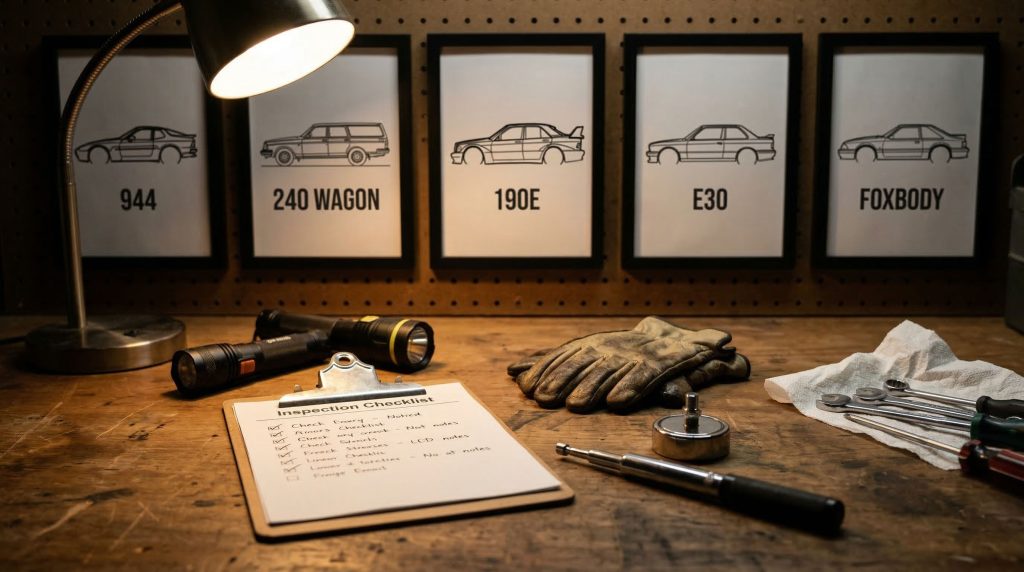
Under $20K Classic Cars Buyer’s Guide: 5 High‑Signal Picks + What to Check Fast
Under $20K classics still exist. The trick is buying the right category of car — and skipping the ones that look cheap until you price out the first month of reality.
This is a buyer’s guide you can actually use:
- 5 models that still show up under $20K
- the gotchas that turn ‘good deal’ into ‘project’
- a 15‑minute inspection routine you can run on any viewing
Where to browse (and how to use it)
- Bring a Trailer auctions homepage: https://bringatrailer.com/auctions/
How to search on BaT:
1) Open the auctions page
2) Tick Projects and No Reserve (deal radar + reality check)
3) Search each model by name: “944”, “240 wagon”, “190E”, “E30”, “Foxbody 5.0”
4) Also open completed auctions: the comments and photos will teach you what “good” looks like
- eBay searches (under $20K ceiling):
- Porsche 944
- Volvo 240 Wagon
- Mercedes 190E (W201)
- BMW E30
- Foxbody Mustang 5.0
Rapid-fire rules (print these):
Receipts > stories. Rust is a multiplier. Budget a baseline refresh. Buy the seller.
1) Porsche 944 (1983–1991): The “Sports Car That Doesn’t Hate Corners” Pick
1) Why it’s great
- Balance for days: front engine + rear transaxle = stable, confidence-inspiring handling
- Real driver’s car under grown-up money (steering + chassis feel are the point)
- Practical-ish hatchback, strong community support, lots of how-to knowledge
2) Known pain points / expensive gotchas
- Timing belt + water pump: not optional, not “maybe later.”
- Cooling system neglect: old hoses/radiators/thermostats → overheating risk
- Oil leaks: common older German-car reality; can be minor or “why is everything wet.”
- Transaxle/clutch/driveline noise: can mean real labor bills
- Sun-baked interior (dash cracks, seats, trim) gets expensive fast if you want it right
3) What to check in 15 minutes (at a viewing)
- Ask: “Show me timing belt + water pump receipts.” Invoice > memory.
- Cold start: smooth idle? Any knocks/ticks that don’t settle quickly?
- Look underneath: fresh oil sheen = active leak (or a fresh wash hiding one)
- Coolant: level + crusty deposits around reservoir/radiator
- Short drive: watch temp gauge; listen for rear whine; feel for clutch slip
4) Who it’s for
- You want a classic that drives like a sports car, and you’re willing to be a maintenance adult about it.
5) “Good deal vs bad deal” heuristic
- Good deal: documented belt/water pump service + stable temps + tight driveline
- Bad deal: no history + overheating hints + transaxle noise + “priced to move” optimism
If belt/water pump history is vague, price it like you’re doing it immediately (because you are).
2) Volvo 240 Wagon (1975–1993): The “Brick That Refuses to Die” Wagon
1) Why it’s great
- Legendary durability when maintained (and forgiving even when not)
- Wagon practicality: dogs, gear, IKEA runs, and “I found a chair on the street” moments
- Tons of DIY guides, good parts availability, huge community support
2) Known pain points / expensive gotchas
- Rust (rear quarters/floors and structural spots) can turn “cheap” into “scrap”
- Tired suspension makes them drive like a soggy mattress
- PCV system neglect → crankcase pressure and oil leaks
- Modified cars can have wiring gremlins (especially “creative” stereo/lighting jobs)
3) What to check in 15 minutes (at a viewing)
- Rust scan: rear quarters, floor edges, under mats, spare tire well, jacking points
- PCV hint: with engine idling, check for excessive crankcase puffing at oil cap area
- Bounce test: pogoing = worn shocks/springs/bushings
- Wiring look: twisted wires, household connectors, mystery switches = red flags
- Short drive: clunks over bumps, vague steering, pull under braking
4) Who it’s for
- You want classic vibes + maximum usefulness and prefer reliability to speed.
5) “Good deal vs bad deal” heuristic
- Good deal: solid body + honest maintenance + stock-ish wiring
- Bad deal: rust + mystery mods + “it just needs…”
With 240s, body condition beats everything. Mechanical fixes are usually cheaper than rust surgery.
3) Mercedes-Benz 190E (W201, 1984–1993): The “Small Benz, Big Quality” Sedan
1) Why it’s great
- Classic Mercedes bank-vault feel in a smaller, easier-to-live-with footprint
- Comfortable, stable, and surprisingly modern in basic usability
- Great gateway drug to old Mercedes ownership without full flagship complexity
2) Known pain points / expensive gotchas
- Deferred maintenance: they’ll run “kinda fine” while quietly stacking bills
- Vacuum systems: can cause weird, annoying failures (door locks, HVAC controls, etc.)
- Old rubber everywhere (bushings, mounts, seals): ride quality and reliability suffer
- Rust: yes, it matters—don’t assume the badge is a forcefield
3) What to check in 15 minutes (at a viewing)
- Vacuum behavior: do door locks and HVAC controls act consistently?
- Idle quality: smooth and steady, or hunting/stalling?
- Underhood scan: brittle hoses, crusty connectors, wetness around valve cover area
- Quick rubber reality check: cracked bushings/mounts = future spend
- Short drive: straight tracking, smooth braking, no alarming clunks
4) Who it’s for
- Someone who wants a mature classic daily vibe and doesn’t mind patiently sorting small systems.
5) “Good deal vs bad deal” heuristic
- Good deal: consistent function (locks/HVAC), smooth idle, evidence of recent maintenance/rubber work
- Bad deal: lots of “quirks,” multiple systems inop, wet leaks, “probably just a sensor.”
Many small failures usually mean years of maintenance debt—price accordingly or walk.
4) BMW E30 (1982–1994): The “Analog Fun” Icon (and Yes, Prices Get Weird)
1) Why it’s great
- Light, communicative chassis; steering feel that makes modern cars feel like a video game
- Massive community knowledge + strong parts ecosystem
- Enjoyable at sane speeds; a genuine “driver’s car” even when stock
2) Known pain points / expensive gotchas
- Rust (varies by region, but never ignore it)
- Cooling system: if it’s original-ish, it’s living on borrowed time
- Front control arm bushings: wear = vague steering, shimmy under braking
- Rear subframe mounts: when tired, can be a bigger job than you want on a “cheap” car
- The classic: “I know what I have” pricing—great cars, sometimes unrealistic sellers
3) What to check in 15 minutes (at a viewing)
- Cooling: coolant smell/wetness; temp stability on a short drive (no creeping heat)
- Steering/brakes: shimmy or wobble under braking = suspension/bushing clues
- Rear-end noises: clunks over bumps can hint at mounts/bushings
- Body/rust scan: floors, arches, typical moisture traps
- Mods check: clean installs vs cut corners (wiring/fuel/“race parts” with no documentation)
4) Who it’s for
- Someone who wants maximum driving feel and is okay paying more for a clean, honest car (cheap E30s often invoice you later).
5) “Good deal vs bad deal” heuristic
- Good deal: stock-ish, cooling refreshed, tight suspension feel, honest body condition
- Bad deal: runs hot, clunks, rusts, and is priced like it’s already restored
If the seller says “just needs a thermostat” but it runs hot, assume real cooling work until proven otherwise.
5) Foxbody Mustang (1979–1993): The “V8 Noise per Dollar” Legend
1) Why it’s great
- Simple, loud, and endlessly supported: the aftermarket is basically its own economy
- 5.0 cars deliver big smiles with straightforward wrenching
- Easy to personalize (just… do it responsibly)
2) Known pain points / expensive gotchas
- Rust still happens (floors, strut towers, rear areas, trunk)
- Hacky mods: wiring, fuel system, ignition, “custom” everything
- “Built motor” with no paperwork is basically fan fiction
- Interiors vary wildly; a clean interior is worth real money/time
3) What to check in 15 minutes (at a viewing)
- Wiring audit: under dash and underhood—splices, melted insulation, random toggles = nope
- Start quality: does it start cleanly, idle stably, and no scary smoke?
- Fluids/leaks: oil, coolant, or power steering fluid evidence on the ground and in the bay
- Driveline feel: clutch slip, harsh engagement, weird auto shifts
- Body/rust scan: floors, trunk, strut towers, door bottoms
4) Who it’s for
- Someone who wants a classic performance platform and can spot the difference between “tasteful upgrades” and “electrical arson.”
5) “Good deal vs bad deal” heuristic
- Good deal: clean wiring, documented engine/trans work, uncut structure, consistent behavior
- Bad deal: mystery “build,” sketchy wiring, questionable fuel setup, “trust me bro” tune
With Foxbodies, mod quality is everything. A clean stock-ish car often beats a cheap “built” one.
Closing: The 1‑Page Inspection Checklist (Print This, Don’t Wing It)
0) Before you even drive it
- Title/ownership matches seller’s ID
- VIN tags/plates present and consistent
- Ask: “What did you fix in the last 12 months?” Then: “Show me receipts.”
1) Walkaround (2 minutes)
- Uneven panel gaps, mismatched paint, and overspray
- Rust hotspots: floors, arches, jacking points, spare tire well, structural mounts
- Tires: uneven wear = alignment/suspension issues
2) Underhood (3 minutes)
- Coolant level and signs of crusty leaks
- Oil level/condition; look for wetness around typical seal areas
- Brittle hoses, cracked belts, hacked wiring
3) Startup (2 minutes)
- Cold start if possible
- Idle: stable? hunting? misfiring?
- Smoke check:
- Blue = oil burning
- White with a sweet smell = possible coolant
- Black = running rich
4) Short drive (5–7 minutes)
- Temperature stays normal (no creeping)
- Brakes straight, no violent shake
- Steering: no scary wander, no excessive play
- Listen for clunks over bumps and drivetrain whining
5) After the drive (1–2 minutes)
- New leaks are appearing under the car
- Coolant smell / steam
- Fans cycling normally (if applicable)
Budget Breakdown: Under $20K Doesn’t Mean “Under Maintenance”
Even a good classic usually needs a baseline refresh unless it’s been obsessively sorted.
Target purchase price range (so you still have money for reality)
- Aim to buy: $12,000–$18,000
- Keep $2,000–$6,000 reserved for the first month (depends heavily on condition and model)
First-month baseline refresh (typical categories)
Use this as a planning template (not a guarantee):
- Fluids & filters (oil, coolant, brake, trans, diff): $300–$900
- Rubber & ignition basics (belts, hoses, plugs/wires where applicable): $200–$1,200
- Cooling system triage (thermostat/hoses/radiator bits as needed): $200–$1,800
- Brakes & tires (if neglected): $600–$2,500
- Suspension “makes it feel new” refresh (bushings/shocks/steering bits): $500–$3,000
Model-specific baseline “don’t skip this” notes
- Porsche 944: if timing belt/water pump history is unknown → budget meaningful money immediately
- BMW E30: vague cooling history → budget a cooling refresh before it budgets you
- Foxbody: if it’s heavily modified → budget time/money for wiring and fuel/tune cleanup
- 190E: expect small vacuum/rubber issues to add up; lots of little fixes = real totals
- Volvo 240: rust remediation can exceed the car’s value fast—avoid structural rust cars unless you want welding as a lifestyle
The play: buy the best-maintained example you can afford, then spend the first month making it boringly reliable. That’s how you end up with a classic you actually drive instead of a “project” you keep pushing around your driveway.
Quick pick: which one should you buy?
- Want a true sports car feel without the 911 tax? Porsche 944.
- Want maximum usefulness and zero ego? Volvo 240 wagon.
- Want ‘small Benz, big quality’ and calm daily vibes? Mercedes 190E.
- Want the iconic analog driver’s car (and you’ll pay a little for it)? BMW E30.
- Want cheap V8 noise with infinite parts support (and you can spot bad mods)? Foxbody Mustang.