
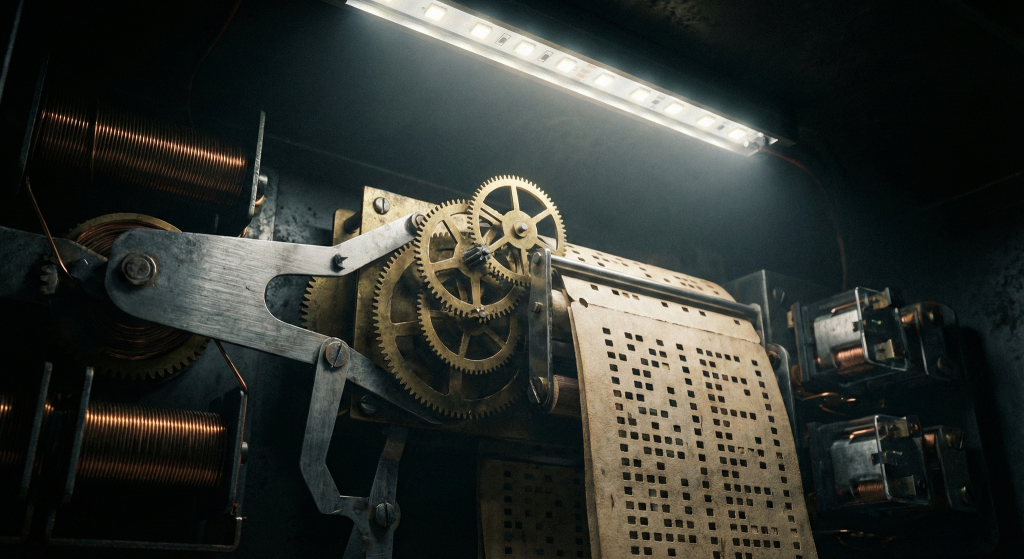
Ever wonder what “Big Tech” looked like before the silicon?
Picture this: It’s 1924. You’re Thomas J. Watson, the head of a company called the Computing-Tabulating-Recording Company (CTR). It’s a clunky, mouthful of a name that sounds like a dry accounting firm. You’ve got a solid business making punch-card machines and meat slicers, but you’ve only got a single office outside the US—up in Canada.
What do you do? You manifest!
On February 14, 1924, CTR officially became International Business Machines. It was the ultimate “fake it till you make it” move. Watson wasn’t just changing the letterhead; he was declaring war on the limits of mechanical calculation.
The Tech: From Gears to “Business Logic”
The shift wasn’t just branding—it was a technical pivot. Before the rebrand, CTR was focused on recording (think time clocks and scales). But the “International Business Machine” was different. We’re talking about the Hollerith Tabulator—a beast of electromechanical engineering that used 80-column punch cards to process data at speeds that would make a 1920s clerk’s head spin.
The Spec: Electromechanical logic. No transistors, no software. Just brushes completing circuits through holes in paper cards.
The Goal: To move from simply “storing” data to “processing” it.
Watson saw a world where every business needed a “machine” to think for them. He branded a global empire into existence before the first trans-Atlantic cable was even a thought.
Legacy:
IBM didn’t just survive the transition to digital; they defined it. By the time the System/360 mainframe arrived in the 60s, the “International” part of the name was no longer a boast—it was a fact. Every time you tap a credit card or check a bank balance today, you’re interacting with the descendant of Watson’s 1924 ambition.