
A story Hollywood never told
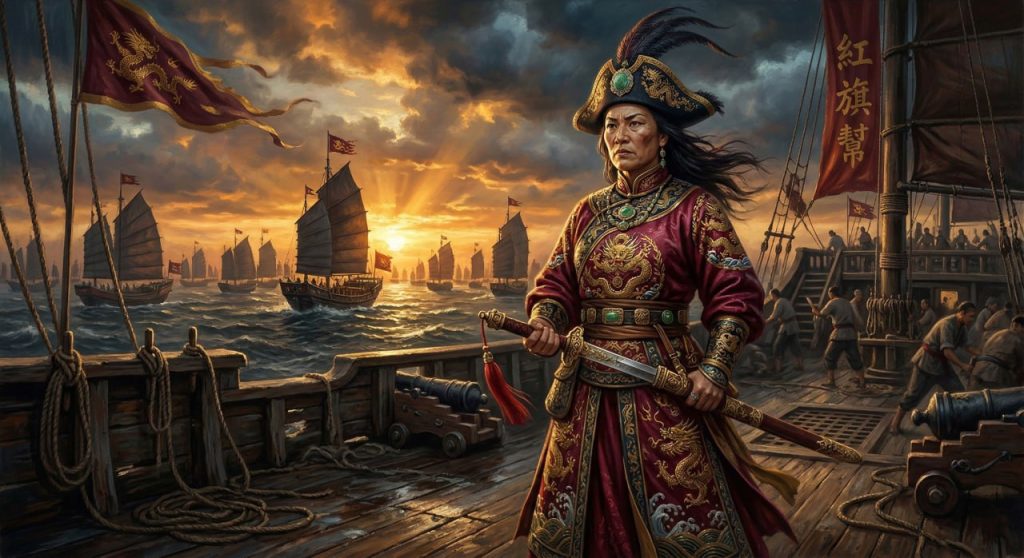
Imagine, for a moment, a fleet of four hundred ships. War ships. Raiding ships. Merchant ships under protection. Imagine seventy thousand men — some say sixty thousand, others say forty, but no one doubts it was tens of thousands — answering to a single person. That person was a woman. Now imagine that this woman, two hundred years ago, controlled the most profitable trade routes in the world. And when she decided to retire, she wasn’t captured. She wasn’t executed. She negotiated her retirement with the government she had fought for years… and won. Her name was Cheng I Sao. And if you’ve never heard of her… well, that’s kind of the point.The World That Forged Her
To understand Cheng I Sao, you first have to understand the world that made her possible. And that world was Guangdong, the coastal province of southern China, in the early 19th century. It was a …different place. While the rest of China was anchored in rigid Confucian traditions — women sequestered, feet bound, marriages arranged by parents — the coast had its own rules. Here, everyone worked on the water. Women piloting small boats. Vendors hauling cargo from the ships to shore. Sea people who spent their entire lives without touching land. And at the center of all this: Canton. The only port in China where foreigners were allowed to trade. Where British, Dutch, and American merchants bought silk, porcelain, and tea… with profit margins of four hundred, five hundred percent. It was a world of easy money, legal and illegal, where opium came in smuggled, and officials looked the other way for the right price. In this crucible of opportunism, Cheng I Sao found her opening.From Flower Boat to Flame
Details of her childhood are a mystery. Not her birth name, not her parents. Everything we know begins in 1801, when she worked on a flower boat — those floating brothels that served sailors and merchants on the Pearl River. She married a pirate named Cheng I. The romantic story goes that he kidnapped her, she attacked him like a banshee, and he was so impressed that he offered her half his empire. But that story comes from unverified sources. The reality was more strategic: she became his wife, and together they united the pirate bands of the coast into a confederation. Seven sub-fleets. Seven colored flags. Cheng I as the supreme commander. It worked for two years. Until Cheng I died. And here’s where things get interesting.The Widow Who Ruled
When Cheng I died in 1807, everyone expected the confederation to fall apart. Rival bands. Settling of scores. A return to chaos. But Cheng I Sao had other plans. She took control. How? In the maritime culture of that coast, a widow could take over her deceased husband’s business. She took that cultural norm — barely a formality in other contexts — and applied it at a revolutionary scale. The pirates didn’t just accept her: they followed. Her first move was to appoint her adopted son, Chang Pao, as captain of the red flag fleet. And then she married him. The couple built something bigger than ever before: seventy thousand men. A parallel maritime economy. Protection tax in exchange for safety. Fishing boats and merchant ships pay for safe passage, and receive exactly that. The Qing government sent ships. They sent blockades. Cheng I Sao destroyed them. The British loaned a ship. The Portuguese sent six warships. Nothing worked.The Red Flag Code
But seventy thousand outlaws need rules. And here’s where Cheng I Sao’s code gets… interesting. – Disobeying a superior officer: death. – Going ashore without permission: death. – Stealing from the common plunder before it was divided: death. – Raping a female captive: death. – Sexual relations with a captive without marrying: him, beheaded; her, thrown overboard with weights tied to her legs. Sex? Regulated. Plunder? Regulated. Discipline? Absolute. It was a floating state. A constitution for outlaws. Note: The earliest Chinese sources attribute the code to Chang Pao, not Cheng I Sao. But she was the one who enforced it. That’s what matters.The Surrender That Shouldn’t Have Worked
And then… she retired. In 1810, the Qing government offered amnesty. The leader of the second-largest fleet accepted. Cheng I Sao saw her confederation crumbling. So she did what any brilliant strategist would do: she negotiated. She arrived UNARMED at the governor general’s headquarters. Only pirate women and children as her entourage. This destroyed the image that the governor had of her as a warlord. She came as a stateswoman seeking peace. And from that position of strength — because let’s be clear, she had the strength — she negotiated terms that no government should ever have accepted: – Full amnesty for everyone. – They could keep all accumulated plunder. – Military integration into the Chinese army. – Chang Pao: naval position and private fleet. – Government money for transition to civilian life. Never in the history of piracy has there been a surrender like this. One person negotiating for thousands. And winning.The Final Question
Cheng I Sao died in 1844, at age sixty-nine, peaceful, wealthy, and relatively forgotten. Why? China always looked inward, not to the sea. Chinese historians marginalized maritime figures. Many of her achievements were attributed to Chang Pao, her adopted husband. And the West… had no cultural framework for a pirate queen. While Blackbeard and Captain Morgan become legends, she remains a footnote. Her story isn’t just that of a successful pirate. It’s that of a political and military genius who built an empire, conquered peace, and stands as an uncomfortably brilliant testament to how many formidable women have been relegated to the margins of history. And that, friends, is really a shame.If you like the part where authority fails to contain a larger-than-life figure, continue with Joan of Arc becoming more powerful after death, the fragility of trust inside a human system, and the Battle of Los Angeles as another episode of panic colliding with narrative.