
Footloose Wasn’t the Weird Part: The West’s Long War on Dancing
There is a particular kind of modern smugness reserved for Footloose. We remember the premise — a town so repressed it effectively bans dancing — and file it under 1980s pop melodrama, somewhere between montage logic and Kevin Bacon’s hair. The joke writes itself: nobody in the modern West was ever really that frightened of teenagers, music, and a school dance.
Except, of course, plenty of people were.
The real story behind Footloose begins in Elmore City, Oklahoma, where a fight over a high-school prom in 1980 helped inspire Dean Pitchford’s screenplay. But the more interesting story is what sits behind Elmore City: a much longer Western habit of treating dancing as socially explosive. Sometimes authorities banned it outright. Sometimes they made it licensable, taxable, or permit-bound. Sometimes they left the law vague and let clergy, school boards, police, or “community standards” do the work. Either way, dancing kept attracting control long after modern societies had supposedly outgrown that impulse.
That is what Footloose captured. Not a weird one-off, but the end of a whole moral regime.
Elmore City: the real conflict, minus the legend
The documented core is straightforward. Elmore City had a longstanding prohibition on public dancing dating back to the town’s early history. In March 1980, national newspapers picked up the story when local students pushed for the town’s first junior-senior prom with actual dancing. A New York Times archive item from March 16, 1980, drawing on UPI, described a town where high-school dances had been banned for more than 80 years and where local ministers were dismayed that a prom was finally being prepared.
Later Oklahoma reporting fills in the social mechanics. Students including Mary Ann Temple and Leonard Coffee pushed to replace the school’s old junior-senior banquet format with a real prom. Local churches and some residents opposed the plan on moral grounds. A school-board vote deadlocked. The tie was broken in favor of the prom.
That already tells you something important. Elmore City was not simply a case of one dusty ordinance sitting untouched in a law book. The real force was the coalition behind it: clergy, custom, and local respectability. The legal rule mattered because people still believed in the social logic behind it.
That logic was not subtle. One quoted opponent, Rev. F.R. Johnson, warned that dances led to “women and booze” and sexual arousal: the familiar old formula in which rhythm quickly becomes vice, and vice becomes social breakdown. The students and some parents argued almost the opposite. If teenagers were not allowed a supervised prom, they would simply leave for unsupervised, riskier spaces. This was not really a dispute about music. It was a dispute about who gets to manage youth, desire, and public behavior.
That is also where the mythology needs trimming. Elmore City did not literally become the town in Footloose. The film heightened the conflict, changed the setting, and turned a local school-board fight into operatic civic repression. Better to say that Elmore City provided the spark. Dean Pitchford later used the reporting as inspiration and reportedly traveled to Oklahoma for research. In other words: real event, real influence, heavily fictionalized result.
By 1980, Elmore City was unusual — but not absurdly alone
The usual retelling makes Elmore City sound like an anthropological outlier, a tiny museum of frontier puritanism accidentally left running into the Reagan era. That is too neat.
By 1980, an outright small-town anti-dancing rule was certainly old-fashioned. But the broader impulse to regulate dancing was still very much alive. Oklahoma alone produced other anti-dancing headlines. A 2022 retrospective in 405 Magazine noted that Elmore City’s ban became the most famous in the state, but not the only one. Ames and Rush Springs also became news stories when dancing restrictions collided with school or community life. The forms varied; the instinct was familiar.
That matters because it shifts the frame. The real question is not whether Elmore City was the last place to fear dancing. It plainly was not. The real question is why modern societies kept reinventing ways to control dancing even after older religious bans started to look embarrassing.
The afterlife of anti-dancing law
The answer is that outright bans often gave way to administrative ones.
Consider New York City. Nobody thinks of Manhattan as a latter-day Elmore City, yet the city’s Cabaret Law survived from 1926 to 2017. In practice, the law meant that a venue serving food or drink could not legally allow dancing without a special cabaret license. Critics argued that the license was expensive, difficult to obtain, and selectively enforced. Across the decades, the law became entangled with nightlife policing, nuisance enforcement, and suspicion of scenes that were too working-class, too Black, too queer, too noisy, or simply insufficiently domesticated.
That is a different style of control from a church-led town ban, but it belongs to the same family. Dancing was tolerated only when properly contained, supervised, and administratively legible.
Ireland offers another version. The Public Dance Halls Act of 1935 introduced a licensing regime for public dance halls and was deeply shaped by the moral panic of the period, including alarm over sexuality and youth behavior. This was not a ban on all dancing. It was, in some ways, more modern than that: a system of permissions, courts, oversight, and conditions. But its purpose was unmistakable. Dancing was treated as an activity requiring moral surveillance. Remarkably, the law has never entirely disappeared; it remains in force in amended form.
Sweden, famously rational and secular, kept its own odd relic for much longer than outsiders expect. Public dance events required a permit. The rule was ridiculed for years, yet survived well into the twenty-first century. Swedish lawmakers voted in 2016 to abolish the requirement, but the actual legal change only took effect in 2023. Even after that, dance events still had to be notified to the police in advance. Again: not Elmore City. But not exactly “just dance whenever you like,” either.
Germany, meanwhile, preserves one of the clearest examples of surviving dance restriction in plain view: Tanzverbot, the ban on dancing during Good Friday and other “silent holiday” periods, depending on the state. In some places the restrictions are partial; in others they are broader and can carry fines. The rationale is openly solemn and religious, but the mechanism is legal. You can call it ceremonial rather than puritanical if you like. It still means the state can tell adults not to dance on certain days because public joy is deemed inappropriate.
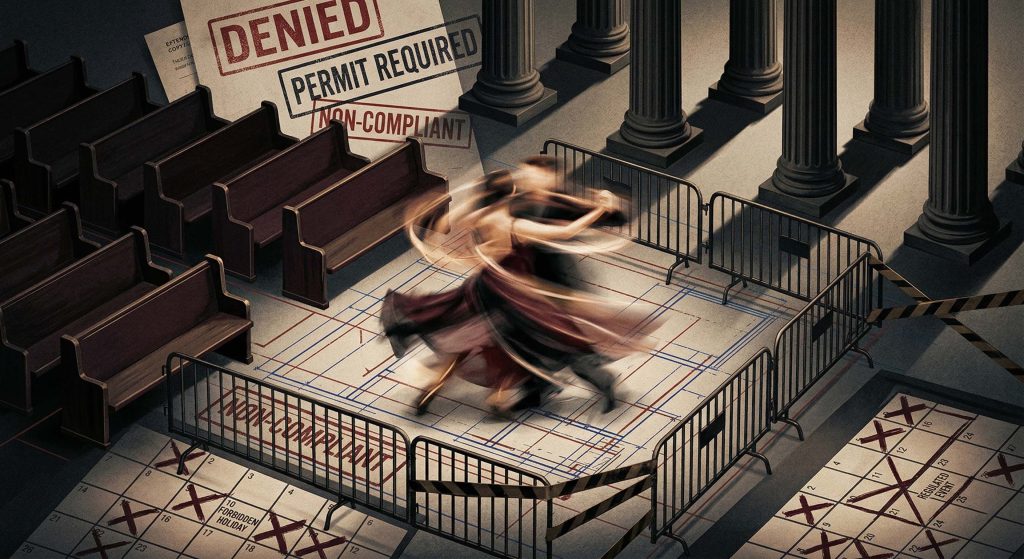
The pattern repeats: outright prohibition becomes licensing; licensing becomes public-order management; public-order management preserves a moral judgment while pretending merely to administer space.
Why dancing, specifically?
Dancing attracted control because it sits at an awkward crossroads of everything anxious authorities worry about.
It is embodied without being fully reducible to speech. It mixes sexes, classes, generations, and strangers. It blurs the line between art, pleasure, courtship, intoxication, and disorder. It can be collective without being obviously political, which often makes it more threatening, not less. A speech can be answered. A crowd moving to the same beat feels like another kind of power.
Historically, dancing also frustrated respectable categories. Was it culture or temptation? Recreation or seduction? Commerce or vice? Religion had one answer. Police had another. Municipal clerks found a third: make it a permit category.
That is why anti-dancing rules often appear at the edges of other anxieties. In small towns, the language was usually blunt: sex, alcohol, ruin, scandal. In big cities, the language tended to become bureaucratic: licensing, zoning, nuisance, occupancy, safety. But the object remained strangely constant. Dancing was never just dancing. It was a proxy battle over what kind of bodies could gather, how visibly pleasure could appear in public, and who had the right to decide.
Outright bans, licensing systems, and social enforcement are not the same thing
It helps to separate the layers.
Outright bans are the cleanest and rarest form: Elmore City’s old anti-dancing rule, or holiday bans in Germany for specific periods.
Permit and licensing systems are subtler. New York’s cabaret regime and Ireland’s dance-hall law did not always say “no.” They said: not unless approved, not unless supervised, not unless you fit the administrative mold.
Moral and customary enforcement is murkier still. A town can stop dancing without arresting anyone if pastors preach against it, respectable adults shame it, and school boards know which side of town opinion they serve.
School and community controls are the most familiar surviving version. Even where the law is gone, institutions still regulate dancing through dress codes, curfews, approved formats, off-site venues, parental-monitoring rituals, and endless debates over what counts as an acceptable prom, party, or youth event.
That distinction matters because modern societies often congratulate themselves for abolishing bans while quietly preserving controls.
The bigger story is better than the trivia
The smallest version of this story is cute: a real Oklahoma town helped inspire Footloose.
The larger version is better, and stranger. Western modernity did not simply move from repression to freedom. It also learned how to repackage old anxieties in newer forms. The sermon became the ordinance. The ordinance became the license. The license became the compliance category. The moral judgment remained, but it started wearing municipal clothes.
That is why Elmore City still matters. Not because it was the one place absurd enough to fear a prom, but because it was one of the last places where the old logic showed itself plainly, without euphemism. The ministers said the quiet part out loud. Dancing threatened order because bodies in public are hard to govern once they stop behaving like paperwork.
Footloose turned that into a pop fable about liberation. Fair enough. Pop culture likes a clean villain and a clean victory. Real history is messier. The ban fades, but the administrative reflex lingers. The town modernizes, yet the urge to supervise pleasure survives.
And maybe that is why the premise still works. Not because we believe every town has a dancing ban, but because we recognize the species of authority immediately. Somewhere, always, someone is explaining that this is not about morality at all. It is about safety, order, licensing, appropriateness, solemnity, standards.
Just a few forms to fill out before the music starts.
This story becomes even sharper next to Amy Grant entering the mall through Christian pop respectability, Madonna turning outrage into distribution, the Zoot Suit Riots as another case where culture itself became the target, and Stonewall as a reminder that policing movement and policing identity usually belong to the same moral machine.
Sources
- The New York Times archive, March 16, 1980: “After 80 Years, Proms Return to Oklahoma Town; 9 Earlier Attempts Failed”
- The Oklahoman, April 19, 2024
- 405 Magazine, February 10, 2022
- Dean Pitchford official site, biography page
- New York City Cabaret Law source map
- Ireland’s Public Dance Halls Act 1935 source map
- Sweden’s dance permit regime source map
- NPR, January 16, 2023: “Sweden to end a decades old dance ban”
- IamExpat Germany, March 15, 2024: “Why is dancing banned on Good Friday in Germany?”
Pingback: Stonewall Inn History: Mafia Ties, Blackmail, Pride, and the Real Story