
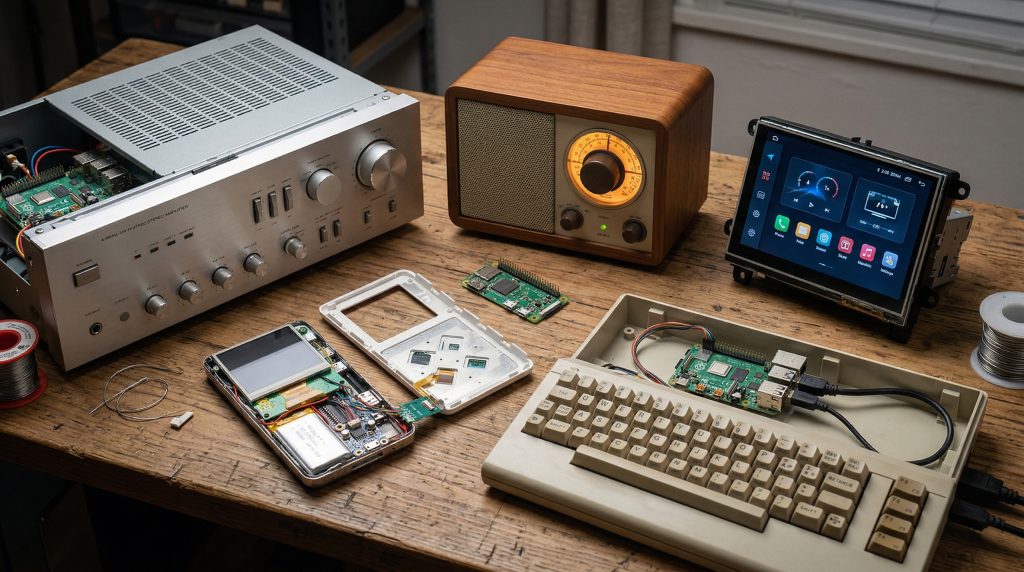
Sometimes the smartest way to preserve an object is to stop pretending its original internals still deserve loyalty.
Jeff Geerling recently posted a video titled “Apple Abandoned It. I Saved It with a Raspberry Pi.” That title is doing a bit of YouTube work, but the underlying idea is dead-on. Once you notice the pattern, it’s hard to unsee it:
The Raspberry Pi has become the LS swap of dead consumer tech.
That’s the whole thesis.
In car culture, the LS engine became the default answer to a very specific problem: you had something old, cool, broken, unsupported, underpowered, or just too interesting to scrap. You wanted modern guts without losing the machine’s identity. So you used the drivetrain with the best ecosystem.
That is exactly what the Raspberry Pi became for electronics.
Dead radio? Pi.
Orphaned car screen from the early navigation era? Pi.
iPod shell too iconic to throw away? Pi.
Shelf stereo that still sounds good but has no idea what Spotify is? Pi.
Retro computer case worth saving even if the motherboard is toast? Pi.
At this point, the Raspberry Pi is less a computer than a universal transplant donor for beloved hardware.
Why the analogy actually holds up
There are faster boards. Cheaper boards. More powerful boards. Boards with better specs on paper.
That doesn’t really matter.
The Pi won the same way the LS won: ecosystem beats perfection.
To become the default swap platform, hardware doesn’t have to be the best in every category. It has to be good enough, compact enough, cheap enough, and documented enough that people keep reaching for it.
That’s the Pi playbook:
- small enough to hide inside old enclosures
- efficient enough for always-on retrofits
- flexible enough to talk to both modern and ancient hardware
- supported by a gigantic software ecosystem
- documented so thoroughly that almost any weird idea already has a forum thread, GitHub repo, or half-finished prototype behind it
That last part matters most. The Raspberry Pi is not just a board. It’s a knowledge base with GPIO pins.
Old body, new guts
The best Pi conversions are not really about novelty. They’re about deciding what part of an object is still worth preserving.
Usually, it’s not the original board-level logic.
It’s the shell.
The dial.
The speaker enclosure.
The pop-up screen.
The clickwheel.
The keyboard.
The weird little ritual of how the thing is used.
That’s what makes the LS comparison more precise than it first sounds. An LS swap is not museum restoration. It’s not stock-correct preservation. It’s a restomod move: keep the body and the character, replace the fragile unsupported guts with something serviceable.
That is exactly what the best Raspberry Pi projects do.
The iPod that refused to stay dead
One of the cleanest examples is Guy Dupont’s Pi Zero-powered iPod Classic, covered by Hackaday.
This wasn’t just “put a board in a shell and call it a concept.” The project kept the spirit of the iPod intact while swapping in hardware that could actually live in the streaming era. Inside went a Raspberry Pi Zero W, battery hardware, power management, a vibration motor, and a new display. The result could handle modern playback and streaming in a device shape Apple itself walked away from.
That’s peak LS-swap logic.
The point isn’t that a Pi Zero is spiritually identical to the original iPod internals. The point is that the object still deserved a future even if the original ecosystem didn’t.
Vintage radios are practically begging for this
Old radios might be the most natural Raspberry Pi transplant candidates on earth.
Hackaday highlighted a 1937 Philco 37-11 rebuild where the original electronics were replaced with modern amplification, Bluetooth, and a Raspberry Pi. The clever part wasn’t just the streaming support. It was the way the experience was preserved: the tuning dial still mattered, the radio could simulate movement across stations, and static between channels helped keep the illusion intact.
That’s the difference between a gimmick and a proper restomod.
Another strong example is SpotifyRadio, a documented GitHub project that converts a vintage SABA Mainau transistor radio into a Spotify Connect device using a Raspberry Pi 4 and Pi Pico. It preserves the original amplifier and physical controls, which is exactly the right move. Don’t destroy the old machine’s personality. Upgrade its brain.
Old stereos don’t need replacement. They need translation.
A lot of old hi-fi gear didn’t fail because the hardware was bad. It failed because the standards moved on.
The amp still works. The speakers still work. The physical controls still feel better than most modern budget gear. What died was compatibility.
That’s where the Pi becomes devastatingly useful.
Hackaday covered a Yamaha shelf stereo converted into a modern streamer with internet radio, Spotify Connect, AirPlay, USB playback, and auxiliary input. Same stereo. Same footprint. Same basic identity. Just no longer trapped in a pre-streaming world.
There’s also a more infrastructure-minded version of the same idea in pi_hifi_ctrl, a GitHub project that adds modern networked control to older Cambridge Audio hi-fi amplifiers through a Raspberry Pi. Less flashy, maybe, but very pure in concept. You keep the analog muscle and update the control plane.
That’s one of the most genuinely useful Pi moves there is.
The car dashboard examples make the metaphor unavoidable
This is where the LS comparison becomes almost too perfect.
Hackaday covered Luuk Esselbrugge’s Volvo S60 project, where an early-2000s OEM motorized navigation display was repurposed with a Raspberry Pi 3 running Android Auto via OpenAuto. An ESP32 on the CAN bus handled steering wheel controls, and the original serial-controlled display behavior was preserved.
That is not a toy. That is a proper transplant.
It keeps the dashboard looking like Volvo intended, preserves the original choreography of the screen, and quietly drags the car’s functionality into the present.
There are more direct versions too. Projects like RasPiCarStereo and Caracas effectively replace obsolete head units with Pi-powered systems handling playback, connectivity, navigation, Bluetooth, GPS, and modern UI behavior. Same problem, same answer: the old system died first, not the whole car.
CRTs and dead screens keep getting one more life
The Raspberry Pi also keeps showing up in old CRT and TV retrofits because it speaks both modern and ancient video languages unusually well.
Hackaday covered a project turning a CRT/DVD combo into an all-in-one retro console with a Pi embedded inside. That kind of thing only works when the replacement brain is compact, cool-running, and comfortable dealing with composite-era realities.
Again, the pattern matters more than the novelty. A lot of consumer electronics become useless long before they become aesthetically irrelevant. The Pi lives in that gap.
The respectful computer transplant
Retro computer conversions are controversial for obvious reasons. A lot of people hate seeing old machines butchered, and fair enough.
But there is a right way to do it.
Hackaday’s coverage of a Commodore 64 to Raspberry Pi conversion shows the standard: reuse original screw holes, preserve the keyboard, preserve the port layout where possible, and avoid doing irreversible violence to the case. That’s the difference between respectful modernization and vandalism with a parts list.
When done right, the Pi doesn’t erase the machine’s identity. It preserves the part people still care about: the desk presence, the typing feel, the silhouette, the physical ritual.
Why this keeps happening
Because consumer tech is full of products that only died at the logic-board level.
Their industrial design is still good.
Their controls still make sense.
Their speakers are still decent.
Their enclosures still have more character than most current mass-market hardware.
What they lost was software relevance, protocol compatibility, storage, wireless support, or replacement parts.
The Raspberry Pi became the default fix because it speaks enough modern language to restore usefulness without demanding that the whole object be discarded.
That’s why the LS metaphor works so well. It’s not about purity. It’s about giving worthy shells a second mechanical life with the most practical transplant available.
The real lesson
The most interesting thing about Raspberry Pi culture is not that people keep putting boards into weird old objects.
It’s that they keep proving a point most consumer electronics companies would rather you ignore:
a lot of dead hardware isn’t actually dead — just abandoned.
And once you accept that, the Pi stops looking like a toy for hobbyists and starts looking like what it really is:
the default restomod drivetrain for the discarded physical world.
Sources
- Jeff Geerling — Apple Abandoned It. I Saved It with a Raspberry Pi
- Hackaday — Raspberry Pi Zero Powers Spotify Streaming iPod
- Hackaday — Vintage Philco Radio Looks Stock, Contains Modern Secret: A Raspberry Pi
- GitHub — SpotifyRadio
- Hackaday — Raspberry Pi Radio Streaming Guts Yamaha Shelf System
- GitHub — pi_hifi_ctrl
- Hackaday — Raspberry Pi Takes Over Volvo’s Integrated LCD
- GitHub — RasPiCarStereo
- GitHub — Caracas
- Hackaday — From CRT TV To All-In-One Console
- Hackaday — Commodore 64 To Raspberry Pi Conversion Is Respectful, Complete
If your brain likes old hardware getting a second life, this runs straight into Windows XP and FrontPage 98 refusing to stay dead, the Sega Genesis compatibility fight with modern televisions, and the absurdly charming fake-vinyl Spotify controller.
For the broader case against ecosystem dependence and managed obsolescence, keep going with Why Buying Things Feels Like a Fight Now.