
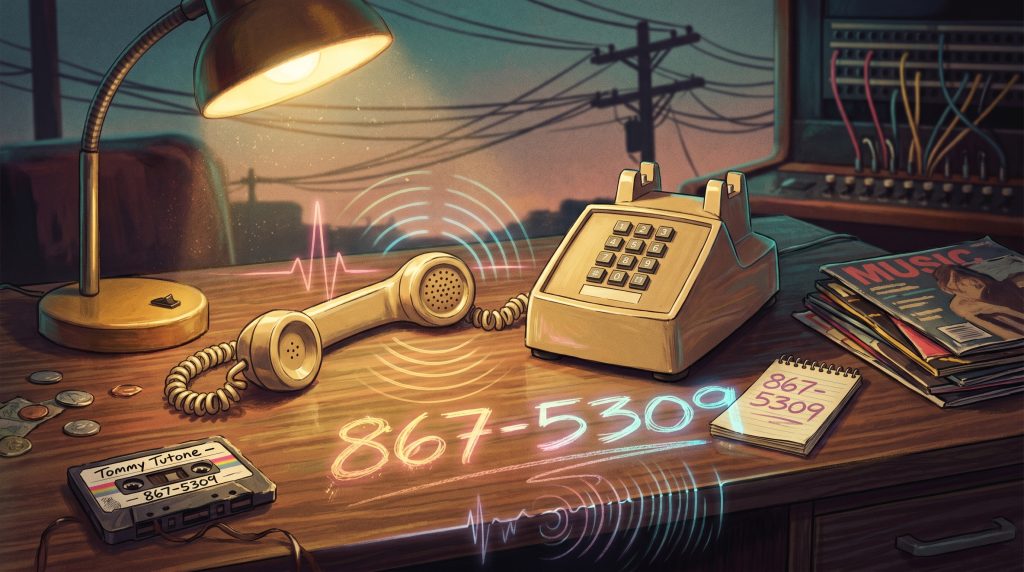
How Tommy Tutone’s “867-5309/Jenny” escaped the radio and became one of the strangest telecom folklore stories of the analog era
In 1982, a catchy little pop-rock single did something most songs never do: it slipped out of the speakers, landed in real infrastructure, and started causing problems for strangers.
Tommy Tutone’s “867-5309/Jenny” sounded disposable in the best possible way — a bathroom-wall hook, a simple melody, a name just specific enough to feel real, and a phone number that seemed generic enough to be fake. It wasn’t. Once the song hit, the digits stopped being a lyric and became an instruction. People dialed them. A lot of people dialed them.
That is what makes “867-5309/Jenny” such a clean 8ravens story. On paper, it is just a radio hit. In practice, it became one of the weirdest little folklore engines of the pre-internet era: a pop song that turned the landline network into part of the gag.
A throwaway hit with real-world consequences
The song’s origin was ordinary enough to be almost boring, which is exactly why the afterlife is so fascinating. Songwriter Alex Call later said he invented both the name and the number in 1981 while trying to write a simple rock song. Guitarist Jim Keller helped shape it into the final track. Call has also said that Tommy Tutone’s later mythology — the idea that Jenny was a real woman tied to a recording studio — was more legend than fact.
That matters. “867-5309/Jenny” was not born as a carefully engineered concept. It was built like a piece of pop craft. Then it accidentally latched onto a public system that millions of people already understood how to use.
And the system answered back.
Billboard later placed the song at No. 4 on the Hot 100. People magazine, covering the phenomenon while it was still fresh, said the single had sold more than 500,000 copies and was sitting in the Top 5. Those numbers matter because a song with a phone number behaves differently from a normal earworm. Most choruses live in your head. This one lived in the switching network.
Why the prank worked so well in the landline era
The beauty — and cruelty — of the joke was its portability. If 867-5309 existed in your area code, the song was suddenly local. It was not just a lyric anymore. It was a destination.
That only really works in the analog phone world. Before caller ID became standard, before spam filters trained people to distrust unknown numbers, phone numbers were oddly social objects. People wrote them on walls, remembered them, passed them along, and dialed them by hand. A memorable number carried a different kind of cultural weight because it was immediately usable.
That is why “867-5309/Jenny” crossed the line from pop song to folklore.
People magazine reported that a New York office worker named Jennifer Gray received hundreds of obscene calls because her number matched the song. The same piece said a Chicago listener surrendered the number to WLS radio, which then received 22,000 calls in four days. The station eventually leaned into the madness by using a taped message from Tommy Heath.
That is the analog-era version of virality: not likes, reposts, or quote tweets, but ringing phones, wasted staff time, annoyed households, and a growing public joke nobody could quite control.
Today, memes spread through platforms. In 1982, this one spread by making somebody’s phone ring during dinner.
The number became bigger than the song
The strangest part of the story is that “867-5309/Jenny” did not stay trapped in its own decade. The number outgrew the single and turned into a durable piece of American shorthand.
That endurance is what pushes the song out of novelty territory. Once a number becomes famous enough, it stops belonging entirely to the artist who sang it. It becomes cultural infrastructure of its own: a reference point, a prank device, a marketing gimmick, a private joke that strangers can still recognize.
Later reporting tracked the number’s afterlife in ways that feel almost too perfect. Snopes rated the basic flood-of-calls story True and noted that the number remained active in some area codes while unassigned in others. A 2003 Cingular ad used the song to sell number portability. In 2014, Joe Maddon famously arranged a baseball lineup to mirror the digits 8-6-7-5-3-0-9. A Hudson Reporter story followed one later owner of the number, who said people still called and sometimes sang the song into voicemail.
That is when a pop hook becomes folklore: when people no longer need the full explanation.
Say “867-5309,” and the culture does the rest.
Why this could only happen in the old networked world
The song’s real subject is not Jenny. It is system leakage.
A catchy chorus collided with the blunt mechanics of the old telephone network, and the network could not protect itself from the joke. Numbers were reassigned. Area codes made the prank reproducible. Human beings had to answer the calls. The friction was physical. The annoyance was real.
That is why the story still feels richer than a normal one-hit-wonder retrospective. It captures a moment when infrastructure was public-facing in a much more intimate way. You could hear it ringing in the next room. You could accidentally become part of it. You could inherit a number and inherit the joke with it.
Phone numbers are supposed to be neutral. “867-5309/Jenny” proved they can also become haunted.
Why it still matters
The song survives because it reveals something bigger than chart success. Culture does not only travel through media; sometimes it travels through systems.
“867-5309/Jenny” sounded like a throwaway pop single, but it behaved like a folklore machine. It turned a bathroom-wall fantasy into a minor telecom crisis, then kept echoing through ads, sports, and phone lore long after the original hit faded.
That is the enduring charm of the story. It is small, funny, slightly absurd — and almost impossible to imagine working the same way now.
In the pre-internet world, if you gave millions of people a memorable number, eventually they were going to call it.
If you enjoy songs misbehaving like infrastructure, this is a natural companion to our history of communication scams from Bell to AI, the weird afterlife of “Bohemian Rhapsody” in 1992, and Rockwell’s paranoia anthem as the sound of pre-digital surveillance culture.