
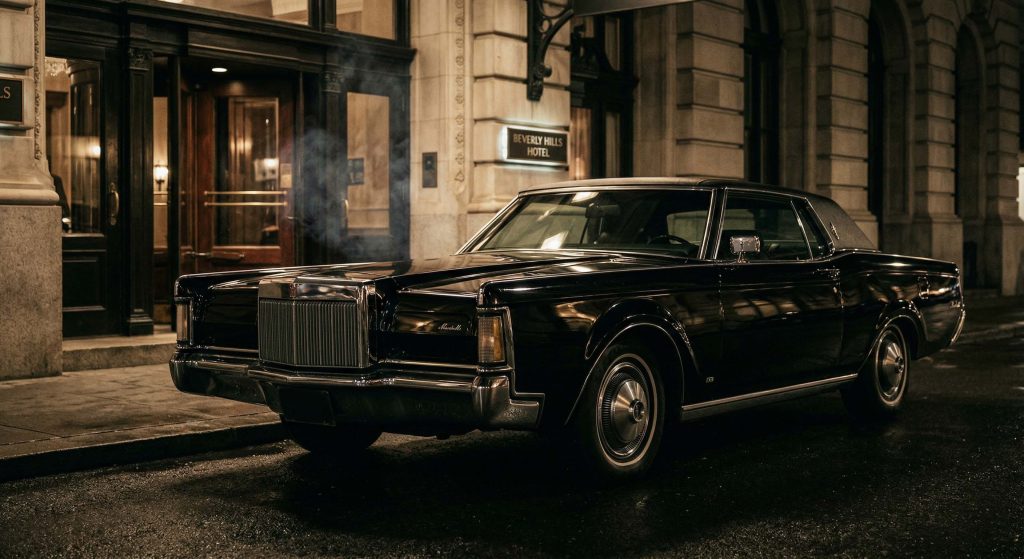
The most revealing old luxury cars are not just collectible objects. They are preserved operating systems from a world where status, comfort, and sophistication had to be expressed physically.
The internet has trained us to recognize a certain kind of car story on sight. A blurry photo surfaces. Somebody claims a near-mythical survivor still exists. A few people insist it must be fake. Then comes the hunt: weak leads, abandoned clues, strange coincidences, and finally the object itself, sitting there with the eerie calm of something that somehow slipped through time without being properly used up.
That structure still works because it is older than car culture. It is detective fiction with better sheet metal.
There is always a missing object. There is always a witness who remembers almost nothing useful. There is always one person who becomes irrationally and magnificently overcommitted to finding the truth.
A recent Dave’s Garage video follows exactly that arc through the pursuit of a remarkably preserved 1970 Lincoln Continental Mark III. On paper, the hook is simple enough: a rare spec, ultra-low mileage, a survivor so clean it almost sounds invented. But the deeper interest of the story is not just whether one specific Lincoln still exists. It is why a car like this exerts such force on the imagination in the first place.
Because the 1970 Mark III is not merely an old luxury coupe. It is a preserved artifact from a dead design philosophy.
It comes from a moment when American luxury was still performed through steel, chrome, vacuum mechanisms, sound insulation, formal proportions, branding, and ritualized physical controls. It belongs to an era before software absorbed the job description. Before “premium” became a submenu. Before the interface swallowed the machine.
The Mark III matters because it shows what luxury looked like when it still had to happen physically.
A survivor is not a trophy. It is evidence.
Collector culture tends to flatten every unusual car into the same short list of labels: rare, original, matching numbers, time capsule, investment grade. Some of that language is useful. Most of it is incomplete.
The real value of a true survivor is not simply that fewer people have tampered with it. The value is that it preserves intent.
A restoration can rebuild appearance. In the best cases, it can even reconstruct a feeling. But a survivor preserves the things restoration often edits out, softens, or rewrites entirely: the exact resistance of a switch, the density of the factory seat padding, the way the doors close when the original tolerances and materials are still negotiating with each other, the visual logic of the dashboard, the quality of the brightwork, the way the cabin presents itself before anyone “improves” it for modern taste.
That matters even more in a car like the Mark III, because this was not a machine designed around sporting purity or engineering austerity. The whole point was curation.
A Mark III was supposed to feel staged. It was supposed to create an atmosphere around the driver. It was not minimalist transportation. It was a rolling private environment — a carefully arranged set for American success.
When a survivor from that world turns up intact, what survives is not just sheet metal. A whole script survives with it.
Lincoln’s practical prestige reboot
To understand why the Mark III matters, you have to place it in the moment that produced it.
The Continental Mark II of the 1950s had already defined one version of the formula: exclusivity, dignity, and near-coachbuilt prestige at a cost that made business sense optional. It was an extraordinary object, but not a scalable strategy.
By the late 1960s, Lincoln needed something else: a halo car that still felt special, but could be built and sold without becoming an act of financial self-harm.
The Mark III was the answer.
It took the idea of American prestige and translated it into something more industrial, more repeatable, and more legible to the expanding personal luxury market. This was Detroit at its most strategically fluent: shared platform logic underneath, highly distinctive bodywork outside, a curated luxury cabin inside, and a product designed to sell aspiration at a healthy margin.
The personal luxury coupe was one of the smartest species Detroit ever created. It was not the most practical car in the driveway, or the sharpest, or the cheapest. It was a reward object. Something bought not because a family needed it, but because a buyer wanted a machine that looked like arrival.
That was the contest.
Cadillac’s Eldorado and Lincoln’s Mark III were rival answers to the same national question: what should success look like in a country that still believed in visible prosperity?
Cadillac often leaned toward technological headline-making and front-wheel-drive futurism. Lincoln’s answer was more ceremonial. Less “tomorrow,” more “permanent present.” The Mark III did not look like it wanted to join the future. It looked like it wanted the future to slow down, clear its throat, and enter the room properly.
Luxury as staging
Seen from a distance, the Mark III almost feels overcomposed, and that is part of the point.
The long hood. The formal grille. The hidden headlamps. The exaggerated rear deck with the Continental hump. The sheer effort expended to make the car look expensive before it has moved an inch. It is a machine built around visual authority.
And then you get inside.
This is where modern eyes can miss what older luxury cars were doing. Today, luxury often advertises itself through reduction: cleaner surfaces, fewer visible controls, larger screens, more hidden functions. Modern premium systems try to disappear into smoothness. They want the user experience to feel frictionless, almost abstract.
The Mark III came from the opposite school.
It wanted you to notice the environment. It wanted luxury to announce itself through objects, materials, and carefully measured gestures. This was the era of the Cartier-branded dashboard clock, the thickly insulated cabin, the sense that everything substantial should feel heavy, damped, and deliberate. Controls were not meant to vanish. They were meant to reassure. Buttons, switches, trim, and brightwork all did part of the same job: they translated money into tactile confidence.
The result was less interface than stagecraft.
That is not an insult. In the best luxury cars, theater is part of the point. You do not spend extra money merely to arrive somewhere five percent more efficiently. You spend it to change the quality of the experience on the way there.
In a Mark III, even the proportions participate in that illusion. You sit in a car that seems to extend forever ahead of you. The grille leads the procession. The cabin edits the outside world. The body makes a statement before the powertrain ever gets its turn.
Modern luxury still performs, of course. It just tends to perform invisibility.
The Mark III performed presence.
The forgotten technology inside the chrome
This is where the story gets better.
American personal luxury cars are often remembered in caricature: all size, all trim, all soft ride and swagger, as if they were little more than rolling cigar lounges with large engines. That memory is lazy around the edges.
Because cars like the Mark III also carried a surprising amount of technical ambition — not expressed through software or displays, but through systems trying, in their own electromechanical way, to civilize mass and complexity.
The Mark III deserves to be read as more than a style object. Underneath the formalwear, there was real interest in using engineering to refine the luxury experience. Ford-era Sure-Track anti-skid braking developments, the adoption of Michelin radial tires, ride isolation strategies, concealed headlamp systems, automatic convenience features, climate control hardware, and countless small refinement details all belonged to a broader effort to make a big prestigious coupe feel composed rather than merely imposing.
That distinction matters.
Today, “smart” has become the default adjective for any premium product containing code. But Detroit had been trying to make luxury cars smarter long before the software age — only it was doing so with relays, sensors, hydraulics, vacuum systems, logic modules, and elegantly concealed mechanism design.
The ambition was familiar even if the tools were different:
- reduce effort
- improve control
- hide complexity
- elevate the experience
That is why features from this era still generate the same double-take effect when rediscovered. Early anti-skid logic in an American luxury coupe. Automatic dimming systems. High-end convenience hardware disguised as calm, conventional prestige. The surprise is not just that these features existed. It is that they were folded into a design language so thoroughly physical that many people no longer associate it with innovation at all.
That may be the most interesting misconception these cars carry. They are remembered as relics of excess when many were also experiments in control.
Not digital control. Not adaptive software. Not cloud-linked intelligence.
But control nonetheless — mechanical, analog, bounded, and often ingenious.
Before software, luxury had to be credible in the hand
One reason old luxury hardware still feels compelling is that it had to persuade the user without fallback.
There was no screen animation to imply sophistication. No startup sequence. No ambient lighting choreography set by a user profile called “Executive.” If a luxury feature was going to feel luxurious, it had to do so physically. The switchgear had to feel convincing. The action had to be smooth. The concealment had to be clean. The silence had to feel earned.
That older standard makes survivor cars especially revealing. In a preserved cabin, you can see exactly how much effort was being spent on the non-essential things that make ownership feel ceremonial.
The Cartier signature on the clock is an obvious example — not because a clock changes the mechanical quality of the car, but because branding inside the cabin helped construct a world around the owner. Hidden headlamps were not about necessity. They were about controlled reveal. Sound deadening was not just comfort. It was social editing. Thick doors, plush surfaces, carefully isolated ride behavior: all of it existed to make the outside world feel less immediate.
That is why the phrase mechanical theater fits so well.
Theater is not fake. It is designed experience. It is the deliberate arrangement of perception.
Cars like the Mark III arranged perception using matter. Steel, chrome, leather, trim, glass, springs, vacuum motors, relays, and electrical logic all collaborated to produce a specific emotional result. The driver was not expected to admire the process diagram. He was expected to feel the outcome.
And that is exactly what makes these machines newly legible in an exhausted digital age. The older logic is easier to trust because it is easier to see. The system may be complex, but its intentions remain embodied. The car shows you what it is trying to do.
Why the hunt feels bigger than the car
This is where the Dave’s Garage pursuit becomes more than a collector anecdote.
A story like that works because modern people are drawn to preserved analog objects with almost forensic intensity. We live inside systems that update themselves invisibly, flatten identity into interchangeable UI, and make luxury feel increasingly detached from craftsmanship. Against that background, the preserved luxury coupe becomes more than transportation history. It becomes cultural evidence.
The hunt, in other words, is not just about possession. It is about recovery.
To chase down a survivor Mark III is to chase down a surviving specimen of a worldview: a moment when American industry believed luxury should be large, formal, tactile, and technologically ambitious without becoming clinically futuristic. A moment when prestige lived in proportion and detail. A moment when sophistication could be hidden under chrome rather than translated into code.
That helps explain why a rumor about an ultra-original Lincoln can feel so magnetic. The object is scarce, yes. But scarcity alone is not enough. Plenty of rare things remain emotionally dead. What gives a car like this its pull is that it preserves a logic modern life no longer produces very well.
It makes aspiration concrete. It makes complexity visible in fragments. It makes comfort feel constructed instead of algorithmic.
And because so few survive untouched, every true survivor feels less like a collectible and more like a witness.
The Mark III as a clue
The strongest old-car stories are never just about the car. They are about whatever idea the car preserves better than a museum label ever could.
The 1970 Lincoln Continental Mark III preserves an era when Detroit still understood that luxury did not have to be subtle to be sophisticated. It could be formal. It could be dramatic. It could be loaded with hidden hardware and still present itself with old-money calm. It could borrow from aerospace-age optimism without surrendering its taste for ritual. It could make the owner feel not like a software user, but like the central character in a deliberately staged environment.
That entire operating system is mostly gone now.
The market moved on. Fuel shocks, regulation, packaging changes, electronics, cost pressure, changing taste, and eventually software-defined everything pushed luxury in other directions. Much of that evolution brought real benefits. Modern cars are safer, cleaner, often faster, and objectively better tools. But they rarely offer the same type of experience. They do not turn engineering into pageantry in quite the same way. They do not trust chrome, mass, silence, and hidden mechanisms to carry as much meaning. They do not ask a clock to help tell the story.
That is why one old Lincoln can still feel like a clue.
The detective story is only the opening move. The deeper case is what the object reveals once it has been found. A preserved Mark III shows us a period when luxury was not yet software performing thoughtfulness on our behalf. It was hardware performing confidence, drama, insulation, and status in full public view.
It was mechanical theater.
And in its best moments, it was brilliant.
The hunt is interesting because the car is rare.
The car matters because the world inside it is rarer still.
Sources
- Dave’s Garage — video discussion / survivor hunt for a preserved 1970 Lincoln Continental Mark III
- Lincoln — brand / historical context
- Hagerty — collector-market context for Lincoln Continental Mark III
- Conceptcarz — model specifications and historical reference for the 1970 Lincoln Continental Mark III
- Automobile Catalog — technical reference for period Lincoln specifications
If the appeal here is old luxury as visible engineering, keep going with our piece on the Mercedes 300SD and the idea of slow prestige, The New Guard and the mechanical soul of analog modern machines, and the W220 S500 as a later, cheaper version of the same authority-through-design logic.