
Windows XP, FrontPage 98, and the Machines That Refuse to Die
A few days into 2026, somebody posted a small miracle to Reddit: made a website with Microsoft FrontPage 98.
Not a mockup. Not a nostalgia filter. Not one of those fake “what if the old web came back” concept renders. A real site, built with a 1998 Microsoft web editor, published live on the modern internet. You can click it right now. It has the default page structure, the old FrontPage navigation, the quietly deranged spacing, the stock tutorial copy, the whole thing. It looks less like retro design than an object excavated intact.
That is why it lands. Not because FrontPage 98 was secretly great. It mostly wasn’t. It lands because it exposes a rule the tech industry keeps pretending not to know: software does not die when support ends. It dies much later, if at all, after the habits, workflows, hardware, and institutions built around it finally let go.
FrontPage 98 is the hobbyist version of that story. Windows XP is the industrial version.
Microsoft gave XP a clean death certificate. Support ended on April 8, 2014. The company said it plainly. CISA said it plainly too. No more security patches, no more technical support, no more polite fiction that this was still a current platform. The machine would still boot. The software would still open. But officially, XP had crossed the line from supported product to orphan.
That date was supposed to be a burial.
Instead, it turned into an X-ray.
Because the moment Microsoft stopped supporting XP, the world got a clearer picture of how much critical infrastructure had quietly settled on old Windows and never really moved on.
FrontPage 98 is not nostalgia. It is a systems clue.
The Reddit post matters because it shrinks the larger legacy-systems problem down to human scale. One person used an ancient tool to make a site in the present tense. Why? Because it still works. Because HTML is forgiving. Because the workflow is understandable. Because the output can sit on modern hosting even if the authoring environment belongs to another century.
That last part matters.
The site is not living in 1998. It is living in 2026 with a 1998 production chain attached to it. That is the real pattern. Old tool, new surroundings. Sometimes old software survives because someone loves it. More often, it survives because the world around it became flexible enough to keep carrying it.
That is exactly how a lot of legacy infrastructure persists. Not as pristine time capsules, but as strange hybrids: obsolete operating system, modern network perimeter; ancient HMI, newer backend; old workstation image, new virtualization wrapper; unsupported control software, heavily defended segment.
XP did not disappear. It changed job titles.
When people talk about Windows XP now, they usually do it in consumer terms. Bliss wallpaper. Luna blue. Startup chime. A better Start menu. That is the museum version.
The working version is less romantic.
XP did not survive because millions of institutions were emotionally attached to the desktop theme. It survived because, in the places that matter, operating systems are often not separate products. They are components inside larger machines.
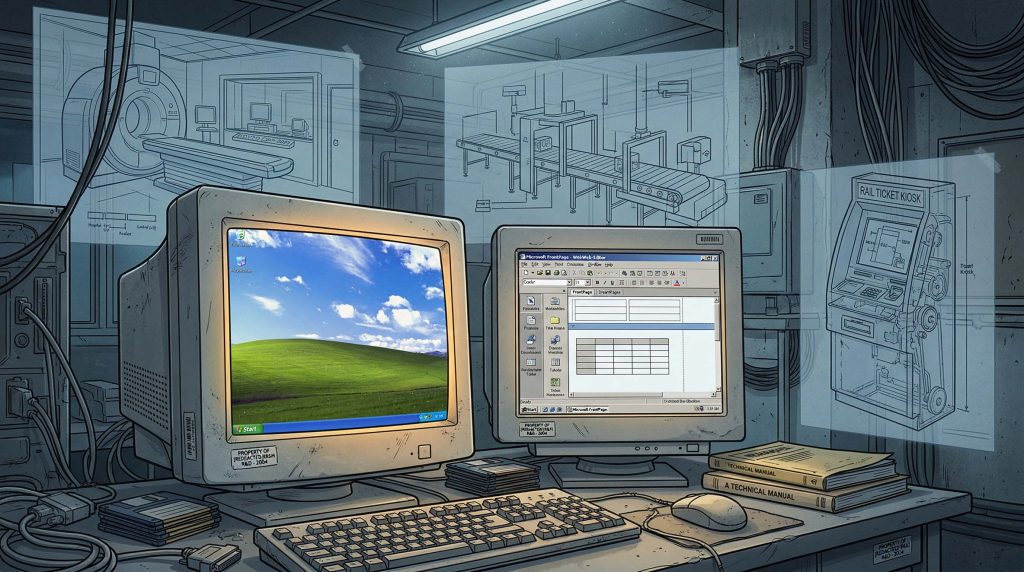
A hospital does not buy “a Windows XP computer” in the abstract. It buys an imaging system, a lab instrument, a clinical viewer, a diagnostic workstation, an embedded vendor stack. A factory does not keep “an old PC” around for vibes. It inherits an HMI, a control station, a production line dependency, a vendor image that only talks properly to one exact hardware-and-software combination.
By the time XP reached end of life in 2014, a lot of it had already stopped being desktop software and become infrastructure.
That distinction explains why legacy Windows keeps surfacing in places that should, on paper, be long since upgraded.
Where the old systems still show through
The cleanest evidence is healthcare. Palo Alto Networks’ Unit 42 reported that unsupported operating systems remained common in medical imaging environments, with 83% of imaging devices in its observed dataset running unsupported operating systems and Windows XP still present on 11% of imaging devices. That does not mean 11% of all hospital computers still run XP. It is narrower than that, and more useful. The problem clusters around specialized equipment and the workstations tied to it.
That pattern matches what medical device experts have been saying for years. MedTech Dive quoted experts describing hospitals still operating older equipment on XP, and in some cases even Windows 98, because replacing a million-dollar scanner or a critical clinical device is not like replacing an office laptop. If the machine still performs medically, the software underneath becomes a secondary crisis until it suddenly isn’t.
Industrial systems tell the same story in a different accent. OT security vendors still talk openly, in 2024, about factories relying on Windows XP-era systems because replacement means downtime, retesting, compatibility work, and sometimes rewriting the relationship between machine, operator, and line. In industrial environments, “just update it” is often another way of saying “pause production, revalidate everything, and pray the vendor still exists.”
Public kiosks are the most visible leaks in the wall. In 2026, a rail ticket machine in Portugal was caught exposing Windows 2000 Professional behind the touchscreen. In 2019, a vulnerability disclosure described Deutsche Bahn ticket vending machines running Windows XP. These are not proof that every rail operator is frozen in amber. They are better than that. They are field sightings. They show that old Windows is not confined to collectors and labs. It still appears in customer-facing public systems in developed countries when the casing slips or the kiosk throws an error.
Why replacing these systems is genuinely hard
There is a lazy version of this story where institutions keep XP because everybody in charge is asleep at the wheel. That version is emotionally satisfying and technically incomplete.
Legacy systems survive for at least five different reasons.
Consumer nostalgia is real, but mostly small-scale. Hobbyists keep XP alive because they like it, or because the software is fun, or because the machine feels coherent in a way modern systems often do not.
Institutional inertia is larger and colder. Big organizations do not upgrade single machines. They upgrade procurement cycles, training documents, maintenance plans, vendor contracts, and risk models.
Hardware lock-in is where things get serious. A diagnostic device, industrial controller, or ticketing terminal may depend on drivers, I/O boards, or vendor software that only works on one narrow stack.
Certification and compliance friction turns upgrades into paperwork and liability. In healthcare especially, changing the software environment around a device can trigger validation work, regulatory review, or a chain of testing nobody wants to start unless absolutely necessary.
Vendor abandonment is the final trap. Sometimes the manufacturer no longer supports the product. Sometimes the supplier is gone. Sometimes the software cannot be migrated without effectively rebuilding the system from scratch.
So the problem is not only technical. It is contractual, regulatory, operational, and financial.
Myth vs. reality
The internet’s favorite legacy-Windows line is that 95% of ATMs run Windows XP.
That claim was powerful because, in 2014, it captured a real migration crisis. NCR and others warned that the ATM fleet was heavily exposed as XP support ended. But repeating that line in 2026 as if it were fresh evidence is sloppy. It tells you something true about the 2014 panic. It does not automatically tell you what today’s ATM estate looks like.
That is the broader correction worth making: legacy-system stories age badly. A dramatic stat from one migration window can get repeated for a decade after the underlying fleet changes. If you want the honest version, you have to separate confirmed current persistence from famous old anecdotes.
The confirmed current picture is still interesting enough. Hospitals still show legacy-Windows dependence around specialist devices. OT vendors still design around factories that cannot rip out old Windows overnight. Public kiosks still occasionally reveal long-dead Microsoft versions to anyone standing nearby. We do not need to launder old myths to make the case.
Support does not end the machine. It changes the burden.
CISA said the quiet part out loud in 2014: XP systems would continue to work after support ended. That line is the whole story in miniature.
The machine keeps doing its job. The scanner still scans. The kiosk still sells tickets. The HMI still talks to the line. The old website still renders HTML. What changes is who carries the risk. Once vendor support is gone, the burden shifts outward: to hospital IT, to factory engineers, to compensating controls, to segmented networks, to procurement teams stretching replacement cycles, to whoever still remembers how the thing is wired together.
That is why these systems feel undead. Not because they are impossible to kill, but because killing them cleanly is often more disruptive than keeping them alive badly.
And that is the part consumer-tech history usually misses. We talk about operating systems like fashions. The real world treats them like plumbing. By the time a platform is deeply embedded, it stops being software you choose and becomes infrastructure you inherit.
Which is why that little FrontPage 98 site matters more than it should. It is funny, yes. Charming, absolutely. But it is also a neat, harmless specimen of the same rule that keeps old Windows buried inside medical devices, factory floors, and ticketing machines. Once a stack becomes part of how people work, buy, diagnose, or move through the world, it can outlive its official death by decades.
We do not really decommission technology when support ends.
We just move it into the walls.
If you like obsolete systems that stubbornly outlive the future, this sits in the same family as our argument that the Raspberry Pi became the LS swap of dead consumer tech, the Sega Genesis vs modern TV compatibility mess, and the much older story of the first international communications network before the internet had a name.
Sources
- Reddit thread
- Live FrontPage-built site
- Microsoft blog, 2013 warning
- Microsoft Lifecycle page for Windows XP
- CISA alert on XP end of support
- Palo Alto Networks Unit 42 on legacy Windows in medical/IoT environments
- MedTech Dive on legacy medical devices
- TXOne Networks on legacy Windows in OT, 2024
- The Register on Windows 2000 rail ticket machine in Portugal, 2026
- Full Disclosure advisory on Deutsche Bahn ticket vending machine running XP, 2019
- Historical ATM migration claim, 2014