
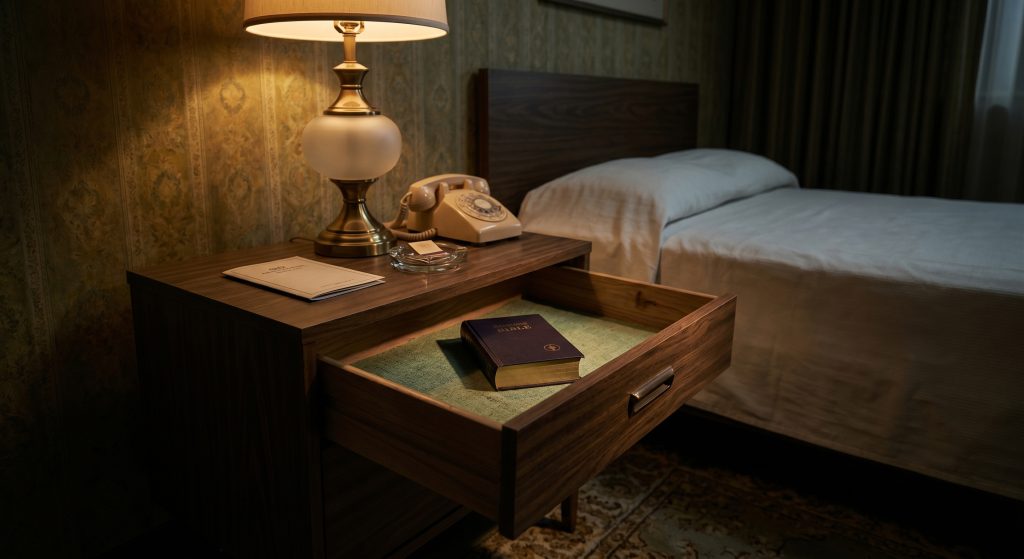
Imagine checking into a hotel after a long day on the road in the early 20th century.
You are tired. You are alone. You are in a room that is not yours, in a town that may not matter, in an age before television glow, before the little blue narcotic of a phone screen, before even the reassuring hum of central sameness that modern hotel chains perfected. You pull open the nightstand drawer and there it is: a Bible, waiting for you as if it had always belonged there.
That is how the story is usually told. As if the hotel Bible emerged naturally, almost anonymously, like wallpaper or stationery or the little wrapped soap by the sink. A quaint tradition. A harmless relic. A piece of American hospitality folklore.
But once you start pulling at the thread, the story gets stranger.
Not because it turns into a conspiracy, exactly. It does not. There is no hidden cabal here, no smoky room of hoteliers and ministers plotting the spiritual occupation of every motel in America. The reality is both less cinematic and, in a way, more interesting. The hotel Bible was not an ancient custom. It was a system. It was organized. It was scaled. And even its origin story does not quite stay put.
That may be the first real mystery.
Most people remember the legend as one neat beginning. Two Christian traveling salesmen. One crowded hotel. A shared room. A conversation about faith. The birth of a movement. That part appears to point back to Boscobel, Wisconsin, where John H. Nicholson and Samuel E. Hill are said to have shared a room at the Central House Hotel in 1898. That is the founding-encounter story — the seed crystal of what would become The Gideons International.
But the hotel Bible itself seems to enter history somewhere else.
The strongest secular trail points not to Wisconsin, but to Superior, Montana, where the Superior Hotel is identified as the first place in the nation where Gideons placed Bibles in hotel rooms in 1908. So the popular memory compresses two beginnings into one: one hotel gives you the origin of the organization, another gives you the origin of the practice. It is not exactly a contradiction. It is more like a historical double exposure. Two images laid on top of each other until later retellings mistake them for one.
That alone gives the subject a slightly uncanny quality. The story everyone thinks they know is true in outline, but blurry in detail. The tidy legend survives because tidy legends are easier to remember than distribution history.
And distribution history is what this really is.
The familiar Bible-in-the-drawer was never just an object. It was the visible endpoint of a machine built to move belief through ordinary infrastructure. The Gideons were founded in 1899 by traveling businessmen, and that background matters. These were not monks, mystics, or revival-tent performers. They were organizers. Network builders. Men who understood roads, routes, rooms, and the value of meeting people where they already were. Once the movement adopted hotel-room placement as a mission, the hotel itself became a delivery system.
That is the key shift.
A Bible in a church is obvious. A Bible in a hotel room is strategic.
It arrives in a place of vulnerability: travel, solitude, dislocation, crisis, boredom, insomnia. Not every guest will open the drawer. Not every guest who opens it will care. But the point of mass distribution is not that everyone responds. The point is that the text is there when the right person, in the right hour, in the right state of mind, reaches for something.
This is where the myth of quaintness breaks down.
The hotel Bible sounds passive. It is anything but. It is one of the most successful examples of religious distribution piggybacking on commercial space in modern America. By the early 20th century, Gideons had found a near-perfect partnership: the organization supplied the book; the hotel supplied the room; the guest supplied the moment. No sermon required. No conversion pitch in person. Just a printed presence embedded in a temporary private space.
That was elegant. Maybe a little unsettling, depending on your point of view. But elegant.
And it worked.
Within a few decades, the practice scaled so successfully that it became part of the visual grammar of American lodging. Not every hotel did it, not every country copied it equally, and there were always local variations. But in the United States especially, the hotel Bible achieved that rare status reserved for cultural installations that stop looking installed. It became normal enough to disappear into the furniture.
That disappearance may be its greatest triumph.
Because once something feels default, people stop asking who put it there, when it started, what purpose it served, and who objected.
And yes — people did object. Just not always where you expect.
If you go looking for dramatic early public fights over hotel-room Bibles specifically, the trail is surprisingly thin. That is one of the more revealing parts of the research. The strongest documented early resistance to Gideon distribution does not come from hotel rooms at all. It comes from public schools. By the early 1950s, Gideon Bible distribution in schools had generated enough legal and civic pushback to produce Tudor v. Board of Education of Rutherford (1953), a case that treated the practice as a serious church-state issue.
That matters because it changes the emotional geometry of the story.
The deeper controversy was not initially about what adults found in a hotel nightstand. It was about where religious distribution crossed into public institutions, children, and state space. The hotel room, by comparison, sat in a murkier zone: private business, temporary privacy, cultural Christian default. Easy to normalize. Harder to litigate. Easier to treat as harmless even when it was clearly doing ideological work.
Only later does the hotel-room version become easier to see as contested.
By the late 20th and early 21st century, the old consensus had begun to crack. America was more secular than it had been. Hotels served a more visibly plural public. Some guests found the Bible comforting; others found it presumptuous. For some, it symbolized moral reassurance. For others, exclusion. In one modern objection, the presence of the Bible was framed not as hospitality but as a kind of ambient proselytizing in a space the guest had paid to occupy.
That is when the hotel Bible stopped looking invisible.
And then, as often happens with old traditions, the numbers themselves got a little murky. One of the most widely repeated modern decline statistics suggested a dramatic collapse in hotel-room religious materials by 2016 — down to 48% of hotels. But that figure was later corrected. The more accurate number was 79%. Which is still a decline from the 95% figure cited for 2006, but not the near-extinction event the bad stat seemed to announce.
That correction matters.
Because it tells you something about the way decline stories work. People love a clean narrative of collapse. They love the idea that an old moral fixture suddenly vanished from the landscape. But the real history is slower, messier, less theatrical. The hotel Bible did not disappear in one dramatic cultural overturn. It faded unevenly, under a combination of pressures: secularization, branding changes, digital substitution, owner discretion, and organized objections from nonreligious groups.
In other words, the same modernity that once helped the Gideons scale their books through the nation’s travel infrastructure is now helping dissolve the assumption that every room should contain one.
And that may be the final irony.
The hotel Bible was always a product of systems thinking. It rode the infrastructure of mobility. It understood standardized rooms before standardized rooms became one of the dominant experiences of modern life. It knew that private moments could be reached through public networks. It was, in its own way, a brilliantly modern invention disguised as a moral antique.
Which is why it makes sense that its story is not really about belief alone.
It is about packaging. Placement. Access. Repetition. It is about what happens when an organization figures out how to insert itself so deeply into everyday life that later generations forget the insertion ever happened.
So if you want the spiciest truthful version of the hotel Bible story, it is probably not that there was a conspiracy in the drawer.
It is that the drawer itself was part of a larger machine.
And for a very long time, that machine worked so well it became invisible.
This sits in the same broader conversation as Joan of Arc becoming more powerful after execution, the West’s long habit of treating music and movement as threats, Stonewall as a reminder that ordinary gathering can become criminalized infrastructure, and our piece on what happens when trust stops feeling invisible and starts becoming the whole story.
Sources
- Britannica — Gideons International: https://www.britannica.com/topic/Gideons-International
- Montana History Portal — Superior: https://www.mtmemory.org/nodes/view/128216
- First Amendment Encyclopedia — Tudor v. Board of Education of Borough of Rutherford (N.J.) (1953): https://firstamendment.mtsu.edu/article/tudor-v-board-of-education-of-borough-of-rutherford-n-j/
- Los Angeles Times correction on STR hotel religious-materials survey: https://www.latimes.com/local/corrections/la-a4-correx-20161208-story.html
- Sarasota Herald-Tribune / More Content Now — Marriott religious books shift: https://www.heraldtribune.com/story/lifestyle/faith/2016/12/15/religion-news-new-hotels-wont-carry-religious-books/24252017007/
- Santa Barbara Independent — modern objection example: https://www.independent.com/2010/06/24/bible-every-hotel-room-or-not/
Pingback: The Handshake Economy: How One Man Broke a Communitys Trust - 8ravens.com