
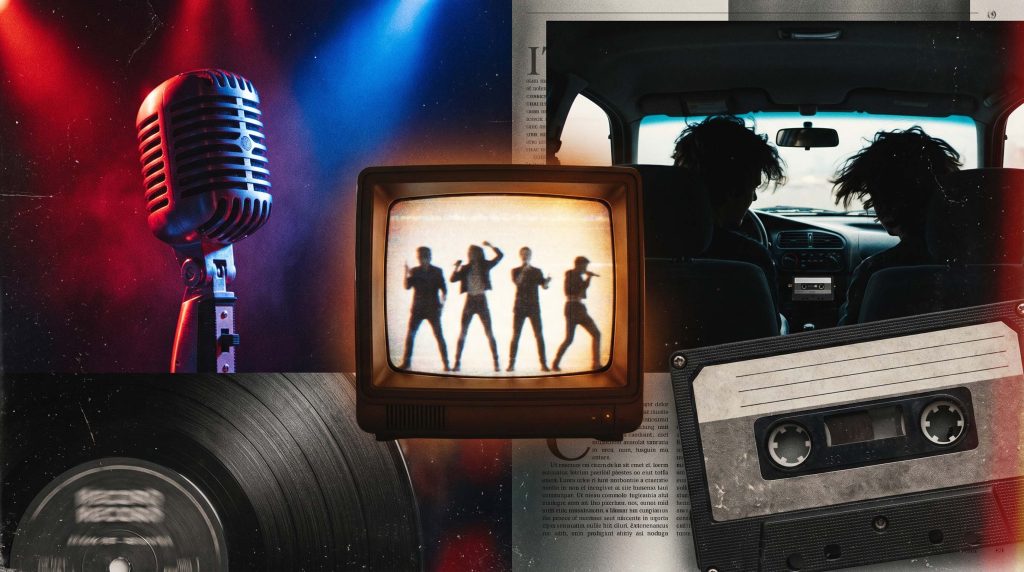
Deck: In May 1992, Queen’s “Bohemian Rhapsody” was sitting at No. 3 on the Billboard Hot 100. That chart fact is more than a curiosity. It is a clean little proof that some cultural objects do not merely survive their era. They come back, absorb new meaning, and start working again.
This week in 1992, “Bohemian Rhapsody” was back in the Billboard top five.
That should not have happened. A six-minute 1975 Queen single — part piano confession, part mock opera, part hard-rock detonation — is not supposed to be behaving like current pop in spring 1992. Yet there it is, moving through the same chart system as Kris Kross, En Vogue, Vanessa Williams, and Joe Public.
That No. 3 peak is the hook. The real story is what it reveals: “Bohemian Rhapsody” may be one of the best examples in pop history of a song designed for recurrence. Not just endurance. Recurrence. A second life.
A hit built to misbehave
Even in 1975, the song did not obey normal pop logic. It opens like a ballad, drifts into operatic delirium, crashes into guitar violence, then evaporates. No tidy chorus. No efficient structure. No attempt to hide its own excess.
On paper, songs like that become cult objects. They do not become durable mass-pop machinery. But Queen understood something most acts do not: if the form is audacious enough, the form becomes the hook. “Bohemian Rhapsody” is memorable because it commits to its contradictions instead of smoothing them out.
That gave it unusual flexibility. You can hear it as melodrama, virtuoso composition, camp spectacle, communal singalong, parody-proof anthem, or emotional release. Very few songs can survive that many readings without collapsing. This one got stronger from them.
Freddie Mercury changed the charge
Its 1992 return did not come out of nowhere. When Freddie Mercury died in November 1991, “Bohemian Rhapsody” stopped functioning only as a famous Queen song. It became one of the clearest public vessels for Mercury himself — his theatricality, vulnerability, precision, and appetite for scale.
Plenty of songs spike after an artist dies. Most of those spikes feel like memorial traffic. This felt bigger. The song was already mythic; now it also carried mourning. By April 1992, after the Freddie Mercury Tribute Concert at Wembley, Queen’s catalog had become active public memory rather than sealed rock history.
Then Wayne’s World made it social again
Then came the second accelerant: Wayne’s World.
The famous car scene worked because it understood the song perfectly. It did not try to tame the track’s absurd scale. It treated the excess as the point. The joke and the tribute were the same move.
That matters. The scene did not rescue “Bohemian Rhapsody” from being too dramatic, too segmented, too sincere, or too ridiculous. It proved those qualities were renewable. It turned the song from an inherited classic into a shared performance again — something you could shout, mime, headbang, and pass to the next audience.
The best revivals do not simply replay an old object. They find the format that lets the object circulate again. Wayne’s World did exactly that.
Why the 1992 chart position matters
Most old hits are locked to their original moment. Later audiences can admire them, but not really reactivate them. They become memory. “Bohemian Rhapsody” became infrastructure.
That is what the 1992 chart run tells us. On the Billboard chart dated 1992-05-16, the song is sitting at No. 3, after climbing as high as No. 2 during the return cycle. That is not symbolic nostalgia. It is commercial behavior. People were not just remembering the record. They were choosing it.
And that choice reveals something structural. “Bohemian Rhapsody” is built to survive reframing. It can absorb grief. It can absorb comedy. It can absorb generational transfer. It can be canonical without becoming inert.
The lesson inside the comeback
This is why the song feels so clean for us at 8ravens. It is an analog-modern object before the phrase existed: lavishly crafted, structurally eccentric, old-world in ambition, but weirdly future-proof in how it travels.
Old body, new guts usually describes a restomod. Here the trick is stranger. The guts were already weird enough that every new era found another use for them. In 1975, the song sounded like a glorious violation of radio rules. In 1992, it sounded like a classic that could still hijack the present. Those are two different achievements. The second one may be harder.
Queen did not just make a hit. They made a cultural machine flexible enough to survive new emotional contexts and new delivery systems without losing its identity.
Why it still matters
“Bohemian Rhapsody” matters because it shows that pop history is not only about first impact. Sometimes the more revealing story is the second impact — the moment when a work returns and forces everyone to ask what, exactly, survived.
What survived here was not just melody, or Mercury’s voice, or Queen’s prestige. What survived was usability. The song could still carry feeling, spectacle, communal performance, and irony without being destroyed by irony. That is incredibly rare.
Its real genre was never just rock, opera, novelty, or anthem.
Its real genre was recurrence.
If you like pop songs with strange second lives, this sits comfortably beside Snow’s “Informer” as the strangest No. 1 hit in America, “867-5309/Jenny” escaping the record and entering the phone system, and our broader argument that formats and artifacts get weird second acts.
Sources
- Wikipedia — Bohemian Rhapsody
- Local chart dataset — https://www.billboard.com/charts/hot-100/1992-05-16/
- Wikipedia — Wayne’s World
- Wikipedia — The Freddie Mercury Tribute Concert