
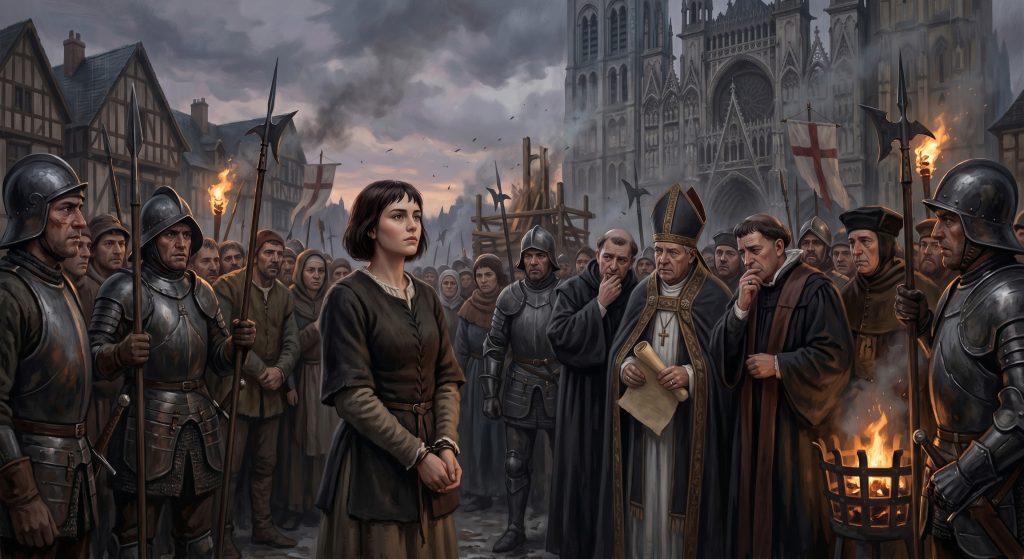
They Burned Joan of Arc to End the Story. It Made Her Immortal.
A few days ago marked the 595th anniversary of Joan of Arc’s execution on May 30, 1431, and that date still lands with the force of a cannon shot. Because Joan’s death was not simply an execution, it was an attempt at narrative control on a medieval scale: a public, legal, theological, political effort to tell Europe that this girl from Domrémy had not been sent by God, had not helped save France, had not helped legitimize Charles VII, and should be remembered not as a deliverer but as a fraud, a heretic, a mistake. And it failed so completely that the flames meant to erase her ended up forging one of the most indestructible legends in Western history.
That is the thing worth sitting with.
Not merely that Joan of Arc died young. Not merely that she was brave, but that powerful men—English authorities, Burgundian allies, church judges working in a political orbit that was anything but neutral—did not just want her dead. They wanted her discredited. They wanted the meaning of her life broken apart and displayed as a warning. The execution was supposed to be the final proof that heaven had never been on her side.
Instead, it became the beginning of her afterlife.
Before the fire, there was the crisis
To understand why Joan had to be destroyed so thoroughly, you have to put yourself back inside the strategic panic of the late Hundred Years’ War.
France in the 1420s was not simply losing. It was unraveling. The English claim to the French crown was not some theatrical side dispute; it had teeth. The Burgundians were aligned with England. The French monarchy looked compromised, unstable, half-legitimate even to many of its own people. The Dauphin—later Charles VII—was not yet securely enthroned in the political imagination of the kingdom. That matters, because monarchy in this period was not just administration. It was sacramental theater. It was bloodline, ritual, divine sanction, and perception all fused.
Then enters Joan.
A peasant girl, probably born around 1412, claimed that saints had instructed her to aid Charles, lift the siege of Orléans, and see him crowned at Reims. On paper, this is the kind of thing serious people are supposed to dismiss. And yet history has a habit of becoming dangerous precisely when somebody improbable starts winning.
Joan did not just appear and give speeches. She arrived in a moment of exhaustion and somehow changed the temperature of the war. In 1429, the siege of Orléans was lifted. French morale, which had been sagging toward fatalism, snapped violently upward. The campaign that followed helped clear the road to Reims, where Charles was crowned king. That is the key fact. Joan was not merely useful on the battlefield. She became entangled with the legitimacy of the crown itself.
That made her intolerable.
Because if she really had been guided by God—or if enough people believed she had—then the French cause gained something far more dangerous than a military win. It gained providential momentum. It gained the sense that history itself had chosen a side.
Why killing her was not enough
Joan was captured in 1430 at Compiègne by Burgundian forces and eventually handed over to the English side for 10,000 francs. That transaction alone tells you how people around her understood the stakes. This was not the disposal of a random prisoner. This was the transfer of a living symbol.
And here is where the story gets darker and more sophisticated.
If the English and their allies had simply killed Joan as a prisoner of war, they would have risked creating a martyr immediately. A battlefield death or a straightforward execution could have confirmed the French popular image of her: God’s maid, murdered by the enemy.
So what was needed was something more devastating.
She had to be judicially broken.
She had to be made into a heretic.
The trial at Rouen, running from January to May 1431, was therefore not just about Joan’s soul. It was about retroactively poisoning her meaning. If she could be shown to be false in spiritual terms, then her victories became suspect. If her visions were demonic or delusional, then Charles’s coronation at Reims was tainted by association. If the maid was corrupt, the miracle became contamination.
That was the real target.
And that is one reason Joan’s story still feels so modern. The men prosecuting her understood something we usually pretend belongs to the media age: if you cannot just destroy the person, destroy the frame around the person. Seize the interpretation. Own the archive. Define what future generations are allowed to think happened.
Rouen: the machine comes down on one nineteen-year-old girl
This is the part that gives the story its real pressure—because once you sit with the mechanics of it, it becomes unnerving.
Joan was about nineteen years old.
She was imprisoned not in an ecclesiastical prison appropriate to a church trial, but under English military guard. She faced a pro-English court led by Pierre Cauchon, Bishop of Beauvais. The charges orbited around her visions, her clothing, her obedience, her claims of divine guidance, and above all, the threat she represented to established authority.
Read the shape of that, and you can feel the trap closing.
The point was not to refute a military commander in the field. The point was to grind down a symbolic threat through procedure. Make her answer question after question. Corner her in theology. Force contradiction. Produce signed submissions. Extract an abjuration. Then, if she returns to the condemned behavior—especially the wearing of male dress, one of the trial’s obsessive points—declare her a relapsed heretic. At that point, the machine can proceed to execution with the tidy satisfaction of legality.
There is something almost chillingly bureaucratic about it. Not rage. Not frenzy. Paper.
And this is often how institutions do their most frightening work. They do not always shout. Sometimes they annotate.
Joan did sign an abjuration under pressure. She was sentenced to life imprisonment. But then came the hinge point: she resumed wearing male clothing in prison, under circumstances historians still debate in detail but which were bound up with prison conditions, coercion, vulnerability, and the practical realities of being guarded by men. That gave the court what it wanted. She was declared a relapsed heretic.
And so on May 30, 1431, in the Old Marketplace at Rouen, they burned her.
The authorities understood the danger of relics, memory, and spectacle
One of the grimmest details in the whole story comes after the fire.
Her remains were reportedly cast into the Seine.
That detail matters because it shows an awareness of the afterlife of execution. The people overseeing Joan’s death were not fools. They knew bodies become shrines. Ashes become relics. Places become pilgrimage routes. If you are trying to destroy a legend, you do not leave convenient fragments behind for the faithful.
So even in death, there is this obsessive effort to deny permanence.
- No relic.
- No tomb.
- No saint’s remains.
- No focal point.
But here is the hard lesson of history: once a person has crossed a certain symbolic threshold, destruction itself becomes material. The absence becomes part of the myth. The violence becomes part of the proof.
Joan had reached that threshold.
The execution backfired for the deepest possible reason
If you want the cleanest modern summary, here it is: Joan of Arc’s execution was a catastrophic failure of suppression.
Not because it failed immediately. The people who killed her got their short-term result. She was dead. She was silenced physically. The court had produced its verdict. The English regime could claim that this dangerous visionary had been exposed, judged, and removed.
But history is not a courtroom transcript.
The larger project failed because Joan’s death did not diminish her. It made her harder to discredit.
The trial was supposed to prove that she had been false. Instead, generations of observers came away with the opposite impression: that a frightened political order had needed all the machinery of church law, military power, and public execution to extinguish one teenage girl. That is not the look of confident authority. That is the look of a regime that senses symbolic danger and overreacts.
And overreaction has a way of canonizing its enemies.
That is the real backfire. Once Joan was dead, the argument changed. While she was alive, critics could say she was reckless, manipulated, deluded, useful, dangerous, or lucky. Once she died in that way—publicly, judicially, under the sign of heresy—the moral optics began to shift. She could now be remembered as the girl who would not betray what she believed God had told her, even when the price was fire.
That is almost impossible to compete with.
The retrial is where the original verdict starts collapsing
The story becomes even more brutal for Joan’s judges when you follow it past 1431.
In 1455–1456, a rehabilitation trial reexamined the case at the request of Joan’s family and under authority from Pope Callixtus III. On July 7, 1456, the original condemnation was declared invalid, compromised by procedural abuse, deceit, and fraud.
That is devastating.
It means the very system that had once processed her into heresy later came back and admitted, in effect, that the case had been poisoned.
And the political implications were obvious. Joan’s original condemnation had always cast a shadow over Charles VII, because if Joan had been a heretic, what did that say about the king whose coronation she had helped make possible? The retrial did not merely help a dead woman’s reputation. It helped repair the legitimacy of the French monarchy that had outlived her.
That alone should tell us how large her story remained. Twenty-five years after her death, Joan of Arc was still not a closed file. She was still strategically alive.
That is not what successful erasure looks like.
From condemned heretic to patron saint of France
Then comes the final historical humiliation for the people who killed her.
Joan was not remembered merely as a tragic victim. She became a national heroine. Then a religious heroine. Then, in 1920, she was canonized by the Catholic Church.
Think about that arc for a second.
The authorities at Rouen tried to freeze her in history as a condemned heretic. The long arc of memory turned her into Saint Joan of Arc.
That is not just a reversal. That is the obliteration of the original intention.
The attempt to control her meaning failed so thoroughly that the title assigned to her by enemies became almost irrelevant beside the titles later granted by history: savior of Orléans, heroine of France, martyr, saint.
When people say her death “backfired,” that phrase almost feels too small. This was not a PR mistake. This was one of the great strategic own-goals in the history of power.
Why Joan still feels modern
This is where the article loops back to that modern lens without cheapening the history.
We live in an age obsessed with censorship, takedowns, deplatforming, suppression, and the weird law that says some attempts to bury a thing only make it spread. The phrase “Streisand effect” is modern, but the underlying logic is ancient. Joan of Arc is one of its clearest pre-digital forms.
Not because medieval authorities were trying to hide her. They were doing something more ambitious: trying to define her permanently as false.
And they failed because the punishment itself revealed the fear underneath it.
That is what power can miss when it acts theatrically against a symbolic enemy. The violence may solve the immediate problem while creating a much larger one in memory. Kill the person, and you may release the story from the limitations of the living human being. Strip away the compromises, ambiguities, and ordinary flaws of life, and what remains can become elemental.
- A banner.
- A warning.
- A legend.
- A saint.
Joan of Arc is not unforgettable simply because she fought or because she died. She is unforgettable because the institutions that tried hardest to crush her ended up helping manufacture the scale of her immortality.
They built the pyre. History built the pedestal.
If the real fascination here is how power fails to control symbols, the strongest companion pieces are our look at how the hotel Bible became normalized infrastructure, the Zoot Suit Riots as a war over clothing, identity, and public order, Stonewall as a messier but equally revealing fight over symbolic control in public, and the Pirate Queen as another story of authority failing to contain a mythic figure.