
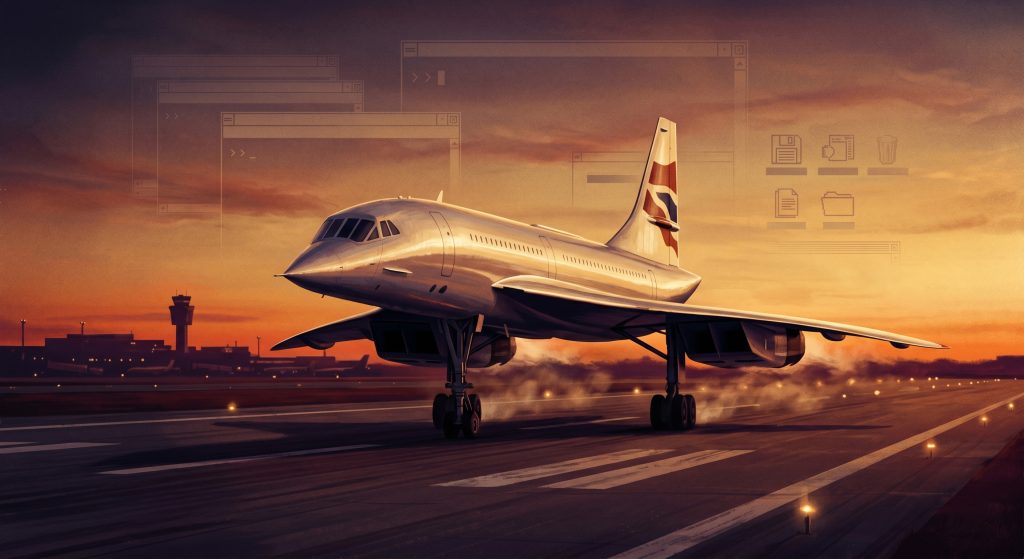
On the anniversary of Concorde’s shutdown, it is worth remembering that the world’s only truly iconic supersonic airliner did not fade away like an outdated machine. It was discontinued like a beloved operating system: mourned by power users, missed by devotees, and never properly replaced.
There are machines people admire, and there are machines people grieve. Concorde belongs in the second category. Its retirement still follows the emotional script of a beloved OS being killed off: the loyalists insisting the replacement solved the wrong problem, the endless nostalgia posts, the refusal to accept that newer systems may be objectively better while still feeling spiritually inferior.
That is why Concorde still lingers in the culture. It did not merely move people faster. It made distance feel negotiable. Modern premium aviation has become quieter, flatter, more private, and more efficient. But it has not restored the one feature Concorde made unforgettable: breakfast in Europe, morning in New York, and the eerie feeling that geography had briefly been hacked.
Air France flew its final commercial Concorde service on May 30, 2003, with its public farewell following on May 31, while British Airways kept the type alive until October 24, 2003 (Wikipedia). However you date the real goodbye, we are now 23 years into the post-Concorde era, and the replacement still has not shipped.
When Europe decided to build the future
Concorde was born in the optimistic decades when aerospace still believed speed was the natural direction of progress. Supersonic transport studies began in the 1950s, but the project became real in 1962, when Britain and France signed a treaty to share the cost and risk of developing an SST—an unusually bold multinational bet for the time (Britannica, Wikipedia).
The first flight took off from Toulouse on March 2, 1969. Scheduled passenger service began on January 21, 1976. In service, Concorde cruised at roughly Mach 2—about 1,350 mph / 2,170 km/h—and turned the North Atlantic from an all-day commitment into a journey of roughly 3.5 to 4 hours (Wikipedia, Simple Flying).
That was the real product. Concorde did not simply sell luxury, and it did not merely sell status. It sold time in the most dramatic way civil aviation has ever managed. It let rich people buy back half a day. It let celebrities, executives, musicians, and diplomats behave as if the Atlantic were an inconvenience rather than a barrier. It made the world feel smaller in a way no lie-flat suite ever could.
What Concorde meant in its day
In the 1970s and 1980s, Concorde represented something aviation no longer even tries to promise: the idea that flying could still feel like a leap forward instead of a better-managed compromise. Yes, it was loud. Yes, the cabin was tight. Yes, it burned fuel with almost aristocratic indifference. None of that hurt the myth. If anything, it strengthened it.
Concorde felt engineered rather than optimized. You noticed the drooping nose. You noticed the climb profile. You noticed the afterburners on departure and the absurdity of crossing an ocean faster than some people finish breakfast. The aircraft did not hide its mechanics from the passenger. It invited you to participate in them.
That distinction matters. Modern premium travel is about insulation: less noise, more privacy, better bedding, better menus. Concorde was about sensation. It made passengers feel like they were buying access to a machine that changed the rules.
Why it died
Concorde did not die because of one single flaw. It died because too many costs, restrictions, and shocks stacked up at once. The decisive trauma was the crash of Air France Flight 4590 on July 25, 2000, the only fatal Concorde accident. The fleet was grounded, modified, and returned to service, but the spell had broken. Then came the post-9/11 collapse in premium travel, rising maintenance costs, and the reality that Concorde’s customer base had always been tiny (Wikipedia, Britannica).
By 2003, Air France and British Airways were done. The world lost the only sustained, visible, commercially operated supersonic passenger service it had ever known.
The market that has been missing for 23 years
This is the most important part of the story, because it is the part most retrospectives glide past. For 23 years, one specific market has gone functionally unserved: ultra-premium, time-saving supersonic passenger travel.
Business class improved. First class became more cocooned. Lounges, bedding, wine lists, and cabin privacy all got better. But those upgrades addressed comfort, not velocity. Concorde’s original use case was not “the nicest seat across the Atlantic.” It was “make the Atlantic behave like a short-haul nuisance.”
- It removed the only mainstream civilian option for cutting certain long-haul journeys roughly in half.
- It pushed premium aviation toward comfort and away from speed.
- It trained airlines to sell refinement instead of technical audacity.
- It left behind a symbolic gap too: the sense that commercial flying should keep getting faster, not just more efficient.
The desire never disappeared. The industry simply stopped being able to serve it at acceptable levels of cost, noise, and political friction.
What it cost to fly Concorde—and how long you got for the money
Concorde was never cheap, but its fares make more sense when paired with the thing passengers were really buying: a radically shorter trip.
- 1977: London to Washington, one way — about £431, which works out to roughly £2,300–£2,500 today. In return, passengers got a North Atlantic trip that landed in roughly under four hours, instead of the far longer subsonic schedules of the era (Simple Flying, Simple Flying).
- 1996: New York to London, round trip — $7,574, or about $15,500 in 2025-era dollars. A typical Concorde crossing on that flagship route took about 3.5 to 4 hours each way, with the record run dropping to 2 hours, 52 minutes, 59 seconds on February 7, 1996 (Britannica, Simple Flying, Wikipedia).
- Late 1990s to end-of-service era: New York to London, one way — around $6,000, or roughly $11,500–$12,000 today, again for a journey of about 3.5 to 4 hours rather than the roughly seven hours now typical on subsonic schedules (Simple Flying, Simple Flying).
That is the cleanest modern shorthand for Concorde economics: by its mature years, it was basically a five-figure transatlantic product in today’s money. Not billionaire-only, but unmistakably executive, celebrity, financier, or once-in-a-lifetime territory.
What is trying to replace it now
Boom Overture
The most visible direct successor attempt is Boom Supersonic’s Overture. Boom says the aircraft will cruise at Mach 1.7, carry roughly 60–80 passengers, fly routes up to 4,250 nautical miles, and target fares comparable to today’s business class rather than Concorde-level scarcity pricing (Boom Supersonic).
That pitch is telling. Overture is basically the Concorde reboot rewritten by people who spent years studying why Concorde failed: smaller cabin, better economics, lower political risk, sustainable aviation fuel compatibility, and a premium product positioned as practical rather than theatrical.
NASA’s X-59 and the overland problem
NASA’s X-59 Quesst is not a commercial airliner, but it may end up being just as important. Its purpose is to demonstrate supersonic flight with a far quieter sonic signature, producing a “thump” rather than the classic disruptive boom. NASA hopes the data will help regulators rethink overland supersonic rules that helped trap Concorde’s route map over oceans (NASA).
That may be the real unlock. Concorde’s problem was never only engineering. It was also politics, geography, and noise law. If those barriers soften, a true successor becomes easier to imagine as something more than a rich person’s nostalgia project.
A few bits of Concorde trivia that explain the cult
- Only 20 Concordes were built, and only 14 entered airline service (Wikipedia).
- It cruised at roughly twice the speed of sound, making it the fastest passenger airliner to achieve real long-term scheduled service (Wikipedia).
- Its distinctive droop nose was not styling drama but a practical visibility solution for takeoff and landing.
- Its fastest transatlantic passenger crossing—2:52:59 from New York to London in 1996—still feels absurd even now (Wikipedia, Simple Flying).
- It remains one of the rare machines that can honestly be called both a commercial struggle and a cultural triumph.
Concorde’s real legacy
Concorde did not fail in the way a bad product fails. It failed in the way a beautiful, overambitious, brutally expensive engineering moonshot fails when the rest of the world refuses to reorganize itself around it.
That is why the retirement still stings. Concorde made a promise that commercial aviation has not kept since: that the future would be not only smoother and cheaper, but faster in a way civilians could actually buy if they were willing to pay enough.
For 23 years, the industry has offered better seats, better screens, better lounges, and better yield management. What it has not offered is a real substitute for leaving Europe after breakfast and touching down in New York before the morning feels fully underway.
That is the hole Concorde left behind. Like the best discontinued operating systems, it still has a cult because the replacement solved the wrong problem.
Concorde also lives in the same emotional neighborhood as slow prestige in the Mercedes 300SD, the futures fair that scattered its own vision across everyday objects, and the Citroën ZX restomod as a recovered version of a future that got interrupted.