
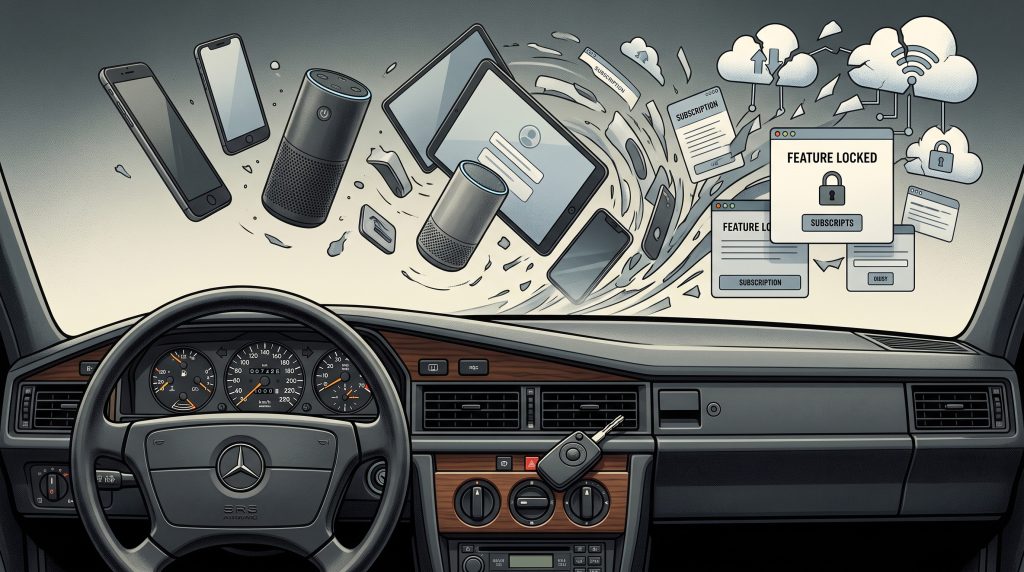
There is a reason buying things feels more exhausting than it used to.
Not just more expensive. Not just more complicated. More adversarial.
You see it in the frictionless sign-up and the labyrinthine cancellation. In the price that mutates at checkout. In the app that nudges, conceals, preselects, and delays. In the product that breaks too soon, or survives physically but loses key functions because a company shut down a server, withdrew support, or decided that your perfectly good hardware had reached the end of its usefulness to them.
This Is Bigger Than a List of Annoyances
We talk about this decline in fragments. Junk fees here. Subscriptions there. Right-to-repair battles over there. Smart-home horror stories in another corner. Appliances that die young. Software that can no longer really be bought. Cars whose dashboards increasingly feel like licensing agreements with cupholders.
But these are not separate annoyances. They are expressions of the same shift.
The modern consumer market has become increasingly hostile to the consumer.
That sounds melodramatic until you look at the evidence. The Federal Trade Commission has spent the last few years documenting what it calls dark patterns: manipulative interface designs that can trick, pressure, or trap users. In 2024, a coordinated review by international consumer-protection authorities examined 642 subscription websites and apps and found that nearly 76 percent used at least one possible dark pattern, while nearly 67 percent used multiple such tactics. In 2024, the FTC finalized a “click-to-cancel” rule requiring sellers to make cancellation as easy as sign-up — a rule whose very existence says plenty about the state of modern commerce. In 2025, unfair and deceptive fee rules were pushed into effect to target the kind of drip pricing and hidden charges that make comparison shopping harder and honest prices harder to see.
Pause on that for a second.
Regulators had to tell companies that if you let people subscribe online, you should not force them through a swamp to leave. Regulators had to tell companies that the real price should be visible before the final screen. This is not a story about a few bad actors. It is a story about a market that repeatedly discovered there was money to be made in confusion, delay, and asymmetry.
Why Old Mercedes Models Feel Political Now
That is the frame in which older durable objects start to feel strangely political.
Take a Mercedes-Benz 190E. Or better yet, place it beside a W124 from the same era. These are not interesting because they are antique. They are interesting because they come from a period when a major manufacturer still behaved as though trust, durability, and long-term use were part of the product itself.
The 190E was Mercedes trying to build a smaller car without diluting the engineering identity of the brand. The W124 was the broader, fuller expression of the same philosophy: mid-size, serious, disciplined, aerodynamic, structurally robust, and engineered with the expectation that it would live a long life in ordinary hands. Neither car was simple in the nostalgic tractor sense. Both were sophisticated. But they were sophisticated in a way that still respected ownership.
That distinction matters more now than it did then.
What people often call nostalgia is sometimes just relief at encountering an object that does not feel like it is still trying to work you over after the sale. A 190E or W124 can still frustrate you, of course. Old rubber hardens. Vacuum lines crack. Suspension components age. Deferred maintenance always sends the bill eventually. These cars are not magic, and pretending otherwise makes the argument weaker.
But the moral structure is different.
A well-made older Mercedes asks for maintenance. A modern hostile product asks for ongoing surrender.
That is the deeper divide.
If you want that same ethos from a different angle, keep going with Slow Prestige and The $3,000 Mercedes S500, two pieces about the old Mercedes habit of making machinery feel like something you live with rather than negotiate with.
When Enshittification Escaped Software
Cory Doctorow’s term “enshittification” originally described what happens to digital platforms as they consolidate power and begin degrading the user experience for the sake of extraction. First the platform is good to users, then it starts optimizing for business customers, then it starts optimizing for itself. The service decays because the lock-in is strong enough to tolerate decay.
But that logic no longer belongs to software alone. It now shapes physical products too.
Because that is exactly where we live now.
The Toolkit of a Hostile Market
The hostile market works through a familiar toolkit.
It hides the full price until late in the transaction, the way budget travel sites and ticket sellers often reveal the real total only after fees, seat charges, handling costs, or mandatory add-ons appear near the end. It preselects the options that benefit the seller, like extended warranties, insurance, expedited shipping, or marketing consent boxes already ticked for you. It makes cancellation slower than sign-up, as seen in gyms, media subscriptions, and software trials that can be started in seconds but require a maze of menus, chat prompts, retention offers, or phone calls to escape. It surrounds the user with designed ambiguity: vague discount countdowns, “recommended” plans that are simply more expensive, and button hierarchies that make the costly choice bright and effortless while the cheaper or more private choice fades into the background. It treats repair as a threat. It treats parts, diagnostics, batteries, and manuals as leverage. And it loads products with fragile convenience features — account-gated setup, cloud-dependent controls, app-only functions, server-linked hardware — whose real purpose often has less to do with helping the owner than with keeping the owner dependent.
Repair Is a Power Question
Look at repair. The FTC’s 2021 report Nixing the Fix examined restrictions on repair and documented barriers involving limited parts availability, restricted diagnostics, software locks, design barriers, and manufacturer practices that make independent repair harder than it should be. That matters because repair is not just a technical issue. It is a power issue. A product you cannot reasonably repair is a product whose useful life remains under someone else’s control.
Appliances Got Smarter and Less Trustworthy
Look at appliances. Wirecutter’s 2025 reporting on why appliances die young paints a picture that is more complicated than cartoon villainy but not more comforting. Machines have become more complex. Competition has intensified around price. Consumers demand more features. Manufacturers squeeze costs where they can. The result is a category of products that often feels more advanced, yet less trustworthy over time. More boards. More electronics. More failure points. More difficulty. More reasons to replace instead of restore.
Connected Devices Can Be Abandoned Without Breaking
Look at connected devices. Consumer Reports has been pushing for legislation that would require manufacturers to disclose support windows for connected products up front, because consumers now routinely buy hardware with invisible expiration dates. This is one of the strangest developments of the last two decades: a physical object can remain mechanically intact yet still be functionally wounded by policy. Your device does not have to break. It can simply be abandoned.
That is also why repair-minded retrofits keep gaining cultural weight. The Raspberry Pi as the LS swap of dead consumer tech is really the same argument in miniature: when the original ecosystem becomes the problem, the smartest move is often to keep the object and replace the dependency.
Software Taught the Rest of the Market the Trick
Look at software. Adobe is not the villain of the whole story, but its Creative Cloud plans make a clean example of a broader shift: tools that once fit more naturally into ownership now fit more naturally into ongoing rent. Access replaces possession. Payment becomes perpetual. Leaving becomes harder because your workflow, files, and habits are already wrapped around the ecosystem.
What People Actually Miss
This is why the old Mercedes comparison has bite.
A W201 or W124 was sold into a commercial relationship that still had a clear endpoint. You bought the car. Mercedes hoped you would come back someday, obviously, but the car itself was not conceived as a permanent tollbooth. It was a durable object intended to justify its price through engineering, longevity, and use. That was the deal.
Today, many products are sold into a very different logic. The sale is not the end of the commercial relationship. It is the start of a campaign to preserve leverage.
That leverage can take many forms.
It can be informational: you do not know the full price until late. It can be procedural: you can sign up in thirty seconds but need twenty minutes to leave. It can be technical: the battery is glued in, the software is locked down, the server connection is mandatory, the diagnostic tool is withheld. It can be psychological: bright buttons for “continue,” gray text for “decline,” countdown timers, default boxes already checked, “recommended” options that just happen to cost more.
Individually, these things can sound petty. Collectively, they describe a market that increasingly competes by exhausting the customer.
That is why the nostalgia argument is too small.
People are not only longing for chrome, analog gauges, or the bank-vault thunk of an old German door. They are longing for products that do not begin from suspicion. They are longing for a world in which quality is not immediately undermined by lock-in, in which convenience is not a Trojan horse for dependence, and in which paying for something does not automatically enroll you in an indefinite struggle to retain control over it.
This does not require a fantasy about the past. Old products had flaws. Old cars rusted, aged, and killed people at crash speeds modern vehicles handle far better. Modern engineering has delivered real, serious gains in safety, efficiency, emissions, convenience, and accessibility. A W124 is not morally superior to a current car simply because it has physical buttons and a better steering wheel.
But none of those truths excuse the contemporary market’s worst habits.
The Older Deal
The best defense of modernity is not that people should accept manipulative pricing, anti-repair design, involuntary subscriptions, cloud fragility, or disposable materials as the cost of progress. The best defense of modernity would be to keep the real gains while abandoning the hostile business logic.
That is the point worth making.
The 190E and W124 matter because they remind us that durability once sat closer to the center of the offer. A premium object was expected to hold up. A machine was expected to make sense. The owner was expected to possess it, maintain it, and live with it over time. Not merely access it. Not merely rent its best features back from the manufacturer in installments. Not merely hope the support policy outlives the financing term.
What people miss, in other words, is not just the old machine.
They miss the older deal.
They miss a market that at least pretended the customer should leave with something solid in exchange for their money. They miss a world where durability was not treated as a threat to recurring revenue. They miss the feeling that once you bought something, the struggle was mostly over.
That is what makes an old Mercedes feel so subversive now.
It does not merely represent the past. It exposes the present.
If this argument lands, it pairs neatly with Daily-Driving a Classic in 2026, which looks at the practical cost side of keeping an older machine alive when the market keeps insisting replacement is the only sensible answer.
Sources and Further Reading
- Federal Trade Commission — Bringing Dark Patterns to Light
- FTC / ICPEN / GPEN — Results of Review of Dark Patterns Affecting Subscription Services and Privacy
- Federal Trade Commission — Final “Click-to-Cancel” Rule
- Federal Trade Commission — Rulemaking on Unfair or Deceptive Fees
- Federal Trade Commission — Nixing the Fix: An FTC Report to Congress on Repair Restrictions
- Wirecutter — The Real Reasons Your Appliances Die Young
- Consumer Reports — The Last Hurrah: How to Handle and Harden Unsupported IoT Devices
- Consumer Reports — The Hidden Lifespan of Smart Devices