
A modern luxury car is often engineered to disappear. It isolates noise, hides mechanism, softens effort, and makes every interaction feel like a solved problem. That has real value. But it also flattens the experience. When everything is seamless, the object stops telling you anything about itself.
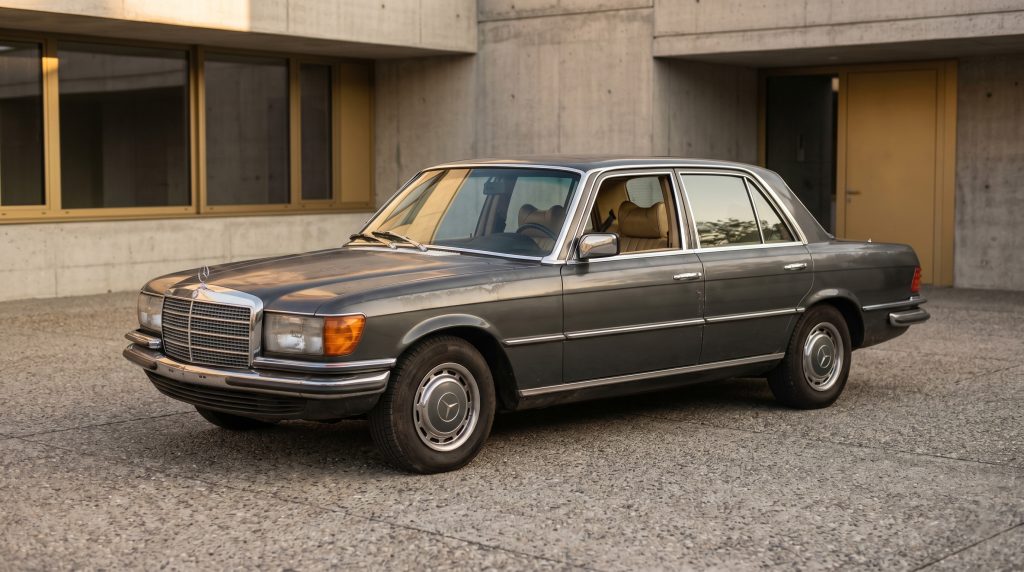
A 1979 Mercedes-Benz 300SD does the opposite. The Bring a Trailer listing for this one — 76,000 miles, original owner in California until 2026, Anthracite Gray Metallic over Bamboo upholstery, sunroof, 14-inch Bundt wheels, cruise control, automatic climate control, Sony CD stereo, and a 3.0-liter OM617A turbodiesel inline-five rated at 110 horsepower — is a reminder that old luxury was never about erasing friction. It was about making friction feel deliberate.
That distinction matters.
The W116-era S-Class was Mercedes trying to formalize authority without turning it into theater. The shape is severe, almost architectural: long hood, upright glass, clean chrome, no decorative nonsense. It looks expensive because it looks certain. The 300SD variant adds a diesel rhythm to that certainty. It is not fast in the modern sense, and that is exactly why it feels premium in its own language. It asks you to trade urgency for composure.
That trade is the whole car.
The diesel engine is the obvious example. In the age of horsepower marketing, 110 hp sounds quaint, even funny. But the OM617 is a legend for a reason. It was built for sustained work, not short bursts of performance. It is a powerplant that values durability, steady torque, and mechanical patience over theatrical acceleration. The result is not excitement in the obvious sense. It is a form of trust. You learn the car’s pace, and the car rewards you by being unbothered by time.
That is why old Mercedes luxury can feel richer than modern perfection. The luxury is not only in the leather or the chrome. It is in the density of the experience. The door closes with a heavy, authoritative thud. The controls have resistance. The cabin is quiet, but not antiseptic. You are always aware that a machine is present, and that it has a personality.
The Bring a Trailer photos make that clear. This car is not scrubbed into oblivion. The Bamboo interior has the soft creases and lived-in surface that tell you it was used, not staged. The brightwork looks presentable without pretending to have just left Sindelfingen. The engine bay is tidy, but still visibly old-school. In a modern car, that kind of age would read as neglect. In an old Mercedes, it reads as continuity.
That is the premium part: continuity, not perfection.
The listing’s details reinforce the point. This car stayed with its original owner until this year, which means it did not pass through the usual chain of casual neglect and cosmetic overcorrection. It has 76k miles, not 7k, and that matters because the mileage tells you the car has been lived with long enough to become itself. Even the duplicate title note adds a small dose of reality. Old prestige is rarely pristine. It is documented, accumulated, and a little asymmetrical around the edges.
There is also something deeply analog-modern about the whole object.
Not in the fake-retro sense. In the systems-minimalist sense.
The 300SD is a machine with a clear user interface. You do not need a software layer to understand the basics of what it wants from you. The climate control has knobs. The cruise control is a function, not a philosophy. The stereo is a later Sony unit, which adds a slightly hacked-together truth to the cabin: the car has evolved, but it has not been reimagined into abstraction. It is still a Mercedes, still square-shouldered, still legible. The technology remains visible enough to be respected.
That is why imperfection can feel more premium than polish. Polish often removes evidence. Imperfection preserves it. A tiny crease in a seat, a little dulling in the trim, the unavoidable softening that comes from years of human contact — these are not defects when the object is fundamentally well-made. They are proof that the object has kept working without losing its identity.
A lot of modern luxury is designed to be frictionless because friction is expensive to maintain. But friction is also what teaches you scale, texture, and consequence. The 300SD makes you slow down just enough to notice the weight of its steering, the rhythm of its diesel, the way its materials feel in the hand. It is not trying to win your attention through stimulation. It earns it through presence.
That is why this car fits the 8ravens analog-modern sensibility so neatly. Analog modern is not nostalgia for old things just because they are old. It is a preference for objects that still reveal how they work. It is a belief that a system is more satisfying when it has texture, readable parts, and a little moral resistance. The 300SD has that in abundance. It is a luxury with edges intact.
The deeper appeal of slow prestige is that it refuses the modern fantasy of perfect throughput. It says the richer experience may be the one that asks something of you: patience, care, attention, maybe even a little empathy. In return, it gives you character. Not fake character, not curated patina, but the real thing — the kind produced by years of sitting still, warming up, shutting down, and starting again.
The 300SD is not luxurious because it is flawless. It is luxurious because it has survived long enough to become interesting.
That is the lesson old luxury keeps teaching: the best objects do not just work. They age in a way that still lets you feel the work.
The 300SD makes even more sense next to the Lincoln Mark III as mechanical theater, our Concorde piece about prestige systems nobody really replaced, and the practical question of what it actually costs to live with an old machine in 2026.
Sources
- Bring a Trailer listing — 1979 Mercedes-Benz 300SD: https://bringatrailer.com/listing/1979-mercedes-benz-300sd-41/
- Mercedes-Benz W116 S-Class: https://en.wikipedia.org/wiki/Mercedes-Benz_W116
- Mercedes-Benz OM617 engine: https://en.wikipedia.org/wiki/Mercedes-Benz_OM617
- Mercedes-Benz 300SD: https://en.wikipedia.org/wiki/Mercedes-Benz_300SD
If you want the broader ownership argument behind why old luxury now feels morally different, read Why Buying Things Feels Like a Fight Now.
Pingback: Why Buying Things Feels Like a Fight Now