
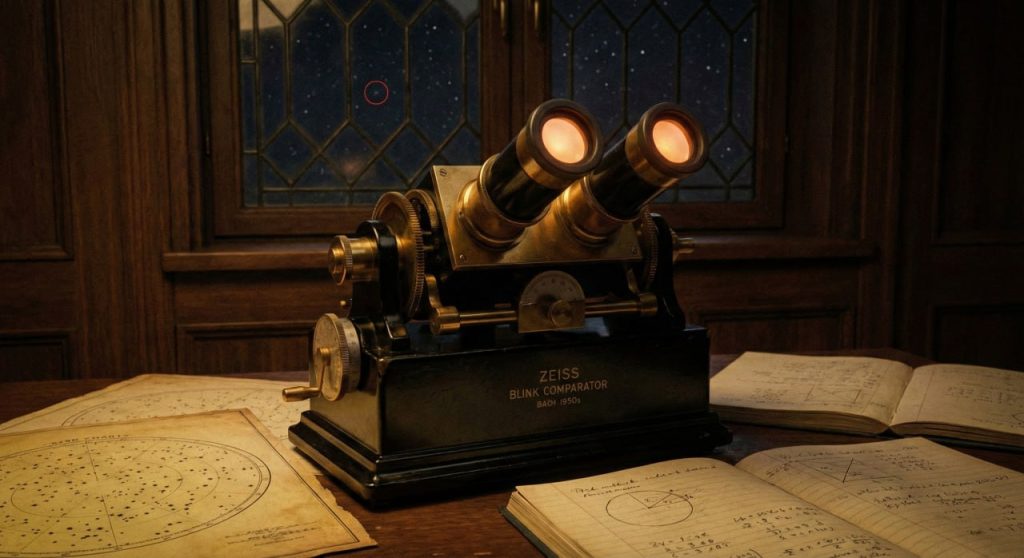
In 1930, a 24-year-old Kansas farm boy named Clyde Tombaugh did something no human had done before: he discovered a new planet. But here’s what makes this story remarkable – he did it by hand.
Using a device called the Zeiss Blink Comparator, Tombaugh would stare at two photographs of the same patch of sky, taken days apart. By rapidly switching between the images, any object that moved would appear to “blink” against the fixed background of stars.
The Human Processor
Each plate contained approximately 300,000 stars. Tombaugh examined them methodically, night after night, searching for that one tiny dot that didn’t belong. The discovery of Pluto wasn’t luck – it was systematic debugging at its finest.
He’d look for a star that shifted position between two plates taken days apart. The Blink Comparator let him see this movement by flipping between images. It was tedious, methodical work – the kind computers do instantly today, but done by human patience and trained eyes.
The Discovery
On February 18, 1930, Tombaugh found it. A tiny dot that had moved. He’d found Planet IX, later named Pluto.
The search had taken nearly a year. Observatory director Vesto Slipher had tasked Tombaugh with finding a “Planet X” – a hypothesized ninth planet beyond Neptune. Most astronomers thought it was a fool’s errand. The math didn’t quite add up. But Tombaugh’s plates didn’t lie.
What makes this story special isn’t just the discovery – it’s the method. Tombaugh wasn’t a seasoned astronomer with decades of experience. He was a 23-year-old who’d only recently learned to use the Blink Comparator. His youth and fresh eyes were exactly what the search needed.
Legacy
Tombaugh went on to discover dozens of asteroids and comets. He became one of the most prolific observers in astronomical history. But his first discovery – Pluto – remained his most famous.
In 2015, NASA’s New Horizons spacecraft flew past Pluto, giving us our first clear images of the tiny world Tombaugh had spotted 85 years earlier. The man who discovered it lived to see the visit – he died in 1997, but his ashes were carried aboard the spacecraft.
Clyde Tombaugh proved that patience and systematic method could find what many thought impossible. Sometimes the best debugging tool is a human eye and a willingness to look at the same problem from a different angle – literally.