
The day Britain stopped treating driving like a hobby
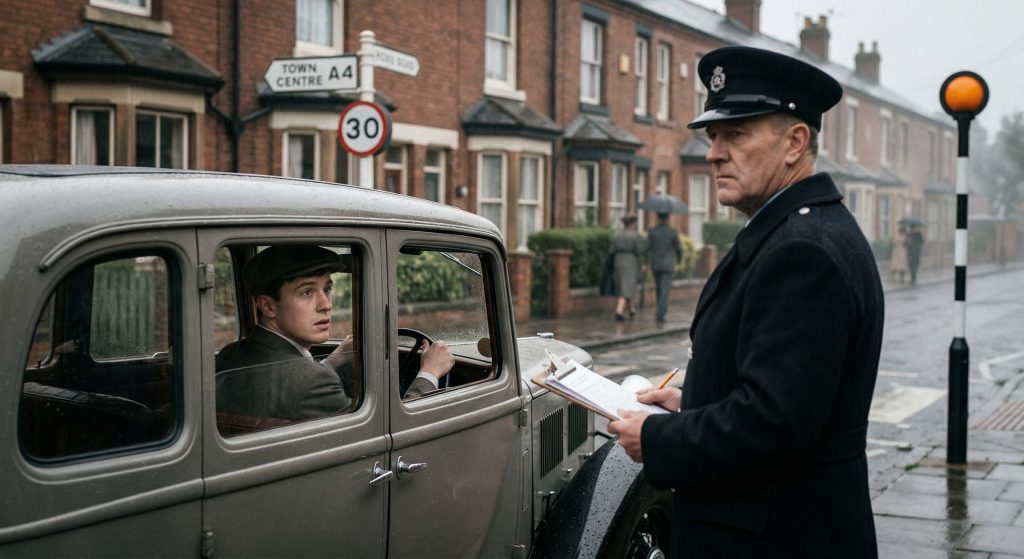
By the early 1930s, Britain had a problem. There were only around 2.3 million motor vehicles in Great Britain when the first edition of *The Highway Code* appeared in 1931, yet more than 7,000 people were dying in collisions each year. That is the key context. The state was not introducing a test because it loved paperwork. It was responding to the basic reality that amateur motoring had scale now, and scale turns freedom into risk. So in 1935, Britain changed the deal. Compulsory driving tests came into force on 1 June 1935 for drivers and riders who had started driving on or after 1 April 1934. The first year saw around 246,000 candidates apply. The pass rate was 63 percent. There were no proper test centres at first; candidates met examiners at places like railway stations, post offices, and town halls. The first successful candidate, R. Beere, paid 7 shillings and 6 pence. This is the part where history articles usually become quaint. They linger on the old prices, the old certificates, the old uniforms, and the absurd charm of examiners waiting in public squares. But the interesting part is not the costume drama. The interesting part is what the test meant. The driving test mattered because it turned driving from a private act into a public qualification. That sounds obvious now because the idea is so deeply baked into modern life. Of course, you need to prove you can drive. Of course, there are standards. Of course, the state gets to decide whether your steering, judgement, signalling, and observation are acceptable. In 1935, that was not just administration. It was a philosophical shift. The test announced that operating a car was not merely a matter between a person and a machine. It was a matter between that person and everybody else using the street. The road was no longer a place where confidence could masquerade as competence for very long. It became a space where competence had to be demonstrated.A licence became a social contract
That distinction changed motoring culture in ways that are easy to miss because they now feel normal. First, the test created the idea that driving should be learned deliberately. Once an exam exists, practice stops being vague and starts being directed. Lessons, drills, revision, mirrors, signals, hazard awareness, route familiarity, examiner expectations: all of that grows around the test. It is not just a filter. It is a machine for producing a certain kind of driver. Second, it helped standardise behaviour. Britain did not simply end up with more drivers; it ended up with drivers trained toward a common script. The Highway Code, the practical test, the theory test, and eventually the hazard perception all worked together to make driving less improvisational and more legible. A motorist was no longer just someone who could physically manipulate a car. A motorist was expected to behave in recognisable, examinable ways. Third, it changed public expectations. Before formal testing, the romantic image of the driver was closer to a pilot, mechanic, or adventurer: somebody bold enough to master a new machine. After testing, the ideal driver looks different. Less daredevil, more reliable operator. Less swagger, more judgment. The test did not eliminate bravado, obviously. Cars have always attracted ego. But it made ego answer to procedure. That is a bigger cultural change than it sounds. The British driving test did not merely ask, “Can you move this car?” It gradually evolved into asking, “Can you be trusted around strangers?”Britain’s road manners were engineered, not inherited
That change sits inside a broader 1930s redesign of British motoring. The driving test did not arrive alone. The same period saw L-plates, urban 30 mph limits, stronger road-safety thinking, and a more serious effort to impose order on roads that had become chaotic mixtures of cars, pedestrians, cyclists, buses, lorries, horses, and habit. This is why the test matters as culture, not just policy. Britain likes to flatter itself that its road manners are simply national character rendered in metal and tarmac. Queueing with indicators. Quiet little waves of apology. The restrained violence of lane discipline. But a lot of that civility was not organic. It was designed. Codified. Coached. Examined. Enforced. The test helped create the expectation that a driver should be predictable. Predictability is underrated because it is boring. But boring is what makes mass motoring work. You do not actually want thousands of creative interpretations of right-of-way, mirror checks, overtakes, pedestrian priority, or junction etiquette. You want conformity in the places where improvisation kills. That is what the driving test helped manufacture: not genius, not passion, not automotive romance, but reliable repetition. Which is to say, civilisation.The real cultural shift: from mechanical confidence to managed risk
There is also a deeper modern angle here. Early motoring was hardware-first. The machine was a marvel. The challenge was physical control: clutch, gears, timing, road surface, visibility, nerve. You were dealing with raw mechanical reality. The test represents the moment the software layer started to matter just as much. Rules, signs, categories, observation routines, staged learning, risk awareness, and formal proof: same car, different civilisation. That is why this is such a clean Analog Modern story. The old romance of the motorcar never vanished. The steering wheel still promised freedom. The engine still sounded like a possibility. But the guts of motoring became increasingly modern: standardised, procedural, data-backed, system-aware—a restomod in policy form. The body stayed romantic; the internals got rational. Britain’s driving test was one of the clearest signs that mass car culture had entered that new phase.How Britain compares with stricter licensing cultures
If the British test now feels normal, it is worth remembering that other countries push the idea much further. Among ordinary passenger-car licensing systems, some of the more demanding examples are not necessarily the ones with the hardest final practical test. They are the ones who treat licensing as a structured process rather than a single hurdle. Norway is a good example. The official pathway for category B includes a mandatory 17-hour Basic Traffic Course before lessons and practice, with traffic awareness, human factors, first aid, and night-driving components. It also uses stepwise training, end-of-step assessments, and mandatory safety training on a practice range. That is not just testing. That is staged risk management. Finland takes a similarly deliberate approach. For a first passenger-car licence, the system includes theory instruction, at least 10 driving lessons, dedicated risk training with both theory and practical components, and then separate theory and driving tests. Again, the pattern is clear: the modern state is not only checking whether you can operate the car. It is trying to shape how you understand danger before you earn independence. Germany adds another layer of seriousness by forcing exposure to different conditions before the final exam. Category B typically involves mandatory theory classes plus category-specific lessons, then compulsory practical sessions covering rural roads, autobahn driving, and night or dusk driving. The message is simple: competence on one road in daylight is not enough. Singapore is another strong case, though in a more procedural style. The system requires passing a Basic Theory Test and then a Final Theory Test before a learner can move on to the practical exam. It is less romantic than Norway’s safety-course model, but just as clear in intent: a licence is not a souvenir. It is a qualification. Japan is often mentioned whenever people discuss exacting licensing cultures, and not by accident. But here the careful version matters. Japan is famous for disciplined, practical assessment and a reputation for exactness, especially in course-based testing and conversion pathways. It absolutely belongs in the conversation. But if the goal is cleanly comparable sourced examples, Norway, Finland, Germany, and Singapore are easier to document in one pass. The broader point is more interesting than any one national ranking. The countries that take licensing seriously tend to treat the novice driver as a systems problem, not an individual hero story.Does all that strictness produce safer roads?
The tempting story is simple: harder test equals better driver equals safer country. Real life is more irritating than that. People love the idea that strict testing automatically produces great drivers and great drivers automatically produce safe roads. It is tidy. It is flattering. It is also incomplete. If you want a defensible proxy for national road-safety performance, one of the simplest is road traffic deaths per 100,000 people. Using World Bank data, countries such as Norway, Singapore, and Switzerland sit at the low end of that scale among developed nations, with Sweden and the UK also performing strongly. In Europe, the European Commission’s preliminary 2024 figures still put Sweden at the top of the EU table with 20 deaths per million inhabitants, followed by Denmark at 24, against an EU average of 44. That is useful data. It is also not a scoreboard of “best drivers.” Fatality rates reflect far more than driver skill. Road design matters. Speed enforcement matters. Vehicle safety matters. Emergency medicine matters. Weather matters. Whether people travel mainly by car, train, motorcycle, bicycle, or foot matters. Whether a country’s traffic deaths happen on rural roads, urban streets, or motorways matters. So does stricter testing correlate with safer roads? Sometimes, yes. Cleanly, no. The sharper answer is this: strict testing is one part of a serious road-safety system. It helps establish norms. It can improve filtering. It can reduce the number of truly unprepared drivers entering the road network. But by itself it is not enough. The evidence is revealing here. A 2021 systematic review found that driver education improved secondary outcomes such as performance, self-perceived ability, and some driving behaviours, but found **no evidence that driver education alone effectively reduced crashes or injuries**. That is a brutal result if you believe teaching always translates neatly into safety. But there is an important distinction. A Cochrane review found that **graduated driver licensing** — systems that stage exposure and restrict novices from higher-risk situations — does reduce crashes among young drivers. Among 16-year-olds, the median decrease in overall crash rates in the first year was 15.5 percent, with injury-crash reductions around 21 percent in the reviewed studies. That tells us something important. The licensing systems that seem to work best are not merely strict. They are structured. They combine instruction, staged exposure, restrictions, assessment, and broader safety policy. In other words: they do not just ask whether a person can pass a test. They design the environment around the novice so that early mistakes are less likely to become fatal.Why the UK test still matters
And this is why the British case still lands. Britain was not first. It was influential because it took a modern bureaucratic idea and made it part of the moral architecture of everyday driving. The British driving test did not single-handedly civilise the road. It did not, on its own, explain every later improvement in road safety. Britain’s lower modern fatality rates owe plenty to better cars, safer roads, medicine, enforcement, signage, and decades of institutional learning. But the test still deserves more credit than it usually gets. What changed was the baseline assumption. It made competence a condition of legitimacy. It made the road a shared space governed by standards rather than pure nerve. It helped push motoring culture away from the idea that driving was a private thrill and toward the idea that it was a public responsibility. That is why 1935 matters. Not because Britain invented the driving test. Not because the first exam was perfect. Not because an examiner in a town square solved the motor age. It matters because Britain chose, formally and visibly, to stop treating the ability to drive as self-certifying. Once that happened, motoring could never go fully back to being a gentleman’s adventure or a mechanic’s party trick. It had become something modern: monitored, teachable, standardised, and answerable to the people outside the windscreen. That is the real legacy of the UK driving test. It did not just judge drivers. It rewrote what British society expected one to be. —Sources
- GOV.UK, *History of road safety, The Highway Code and the driving test*
- DER SPIEGEL, *120 Jahre Führerschein – Der Lappen, der die Welt bedeutet*
- Wikipedia, *Driver’s license*
- AAA Northeast, *The History of the Driver’s License*
- Convention with Respect to the International Circulation of Motor Vehicles (Paris, 1909), archive copy
- Norway official licensing page, *Passenger car – B*
- Finland official licensing page, *Obtaining a driving licence for a passenger car*
- Germany explainer, *Category B – driving licence and BF17*
- Singapore Police theory-test resources
- Singapore Police handbook PDF
- World Bank API, road traffic deaths per 100,000 people
- European Commission, *EU road fatalities drop by 3% in 2024, but progress remains slow*
- PMC, *Is driver education contributing towards road safety? a systematic review of systematic reviews*
- Cochrane, *Graduated driver licensing for reducing motor vehicle crashes among young drivers*
- PubMed, *Graduated driver licensing and motor vehicle crashes involving teenage drivers: an exploratory age-stratified meta-analysis*
This works well next to the evergreen buyer’s guide for affordable classics, the LPG kit piece about practical motoring compromises, and the Zoot Suit Riots as a more explosive example of institutions policing behavior.