
Fuel prices have a funny way of resurrecting old ideas.
Every time petrol gets painful enough, drivers start looking again at the same alternatives: smaller cars, hybrids, diesel regret, and the old survivor that never fully disappears — LPG. Also known as autogas, LPG conversion has been around for decades, and in some countries it never stopped being normal. In others, it became one of those “my uncle did that once” solutions that sound vaguely sketchy until fuel prices spike and everyone reaches for a calculator.
So is installing an LPG kit on a gasoline car still worth it in 2026?
The short answer is yes — sometimes. But this is not a miracle mod, and it is definitely not universal. LPG can still make strong financial sense if you have the right kind of petrol car, drive enough every year, and live somewhere with good autogas availability. If any of those three pieces are missing, the numbers get a lot less romantic.
The reason people keep coming back to LPG is simple: it is usually much cheaper per liter than petrol. The catch is also simple: your car will consume more of it. LPG contains less energy per liter than petrol, so a converted car typically uses around 15 to 20 percent more fuel by volume. That sounds bad until you do the real math. In the right market, even after that penalty, LPG can still cut fuel costs per 100 kilometers by a meaningful margin.
That is the key to the whole story. LPG is not about efficiency in the clean, engineering-purity sense. It is about reducing running costs without replacing the car.
What an LPG conversion actually is
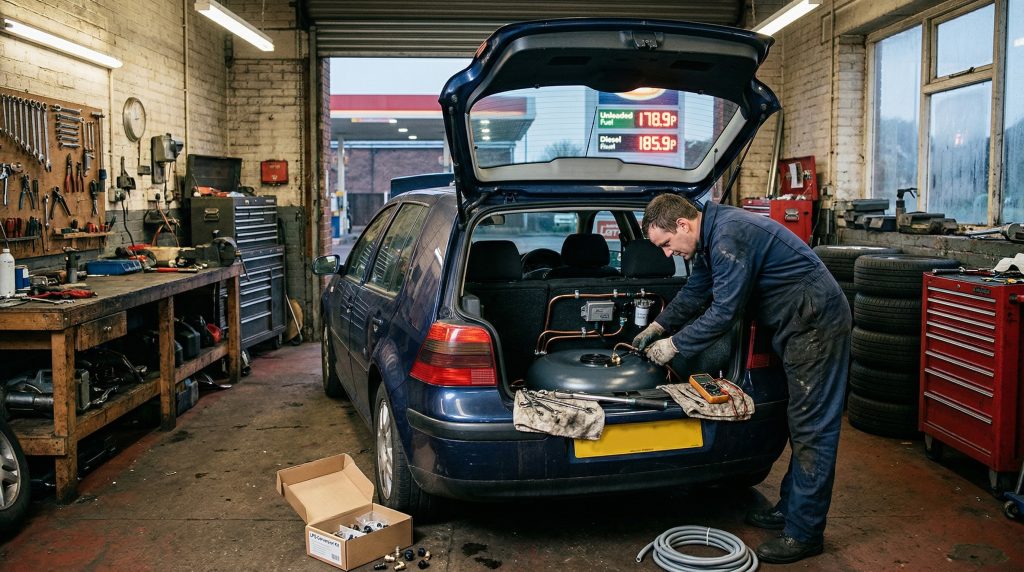
An LPG conversion turns a normal petrol car into a bi-fuel car. You keep the original petrol system, but a second system is added so the engine can also run on LPG. In practice, that means a tank, a filler connection, lines, valves, injectors, electronic control components, and calibration work that tells the car how to behave on gas.
Most converted cars still start on petrol and then switch to LPG once the engine warms up. That means you are not deleting the original fuel system. You are adding another one. That is both a strength and a weakness. On the positive side, you get flexibility and extended total range. On the negative side, you also get more complexity.
For the average driver, the important point is this: LPG conversion is mainly a gasoline-car story, not a diesel one. If you own a petrol car and want lower fuel costs without buying something newer, LPG is relevant. If you own a diesel, this is mostly not your lane.
Why LPG is suddenly interesting again
LPG never vanished, but fuel-price volatility keeps dragging it back into the conversation.
In Spain, for example, the gap between petrol and LPG remains large enough to matter. A recent reference point from late March 2026 put petrol at about €1.58 per liter, while LPG was around €0.91 per liter. That is a serious spread. Not enough to turn your hatchback into a free-energy device, but enough to trigger a real economic question.
The psychological shift is just as important as the raw price gap. When petrol hovers at an annoying but tolerable level, most people do nothing. When it climbs high enough to make every refill feel personal, older alternatives start to look rational again. LPG benefits from that because it is one of the few ways to lower running costs without taking on the cost of another car.
That matters in 2026 because a lot of drivers are in an awkward middle ground. They do not want to buy an EV. They may not trust diesel’s future. Used hybrid prices can still feel inflated. And their current petrol car may still be mechanically fine. In that narrow but very real slice of the market, LPG starts looking less like a relic and more like a practical hack.
The basic math: where the savings come from
The entire LPG value proposition lives inside one equation:
- LPG costs less per liter than petrol
- but the engine uses more LPG than petrol for the same trip
So the question is not “is LPG cheaper?” It obviously is, at the pump. The real question is whether the cheaper fuel price outweighs the higher consumption enough to recover the cost of the conversion.
In many cases, the answer is yes.
A realistic rule of thumb is that LPG consumption rises by around 15 to 20 percent compared with petrol. If a car normally uses 7.5 liters of petrol per 100 km, it might use roughly 8.8 to 9.0 liters of LPG for the same driving pattern. Even so, if LPG is cheap enough relative to petrol, the total cost per 100 km still comes out lower.
This is why LPG is a mileage game. If you drive very little, you will save slowly and may never earn back the installation cost before the car dies, gets sold, or becomes someone else’s problem. If you drive a lot, the payback period starts to look very reasonable.
What the savings actually look like
Using a Spain-style pricing example for 2026:
- Petrol: €1.58/L
- LPG: €0.91/L
- LPG consumption penalty: +18%
Here is how that works in practice.
A small petrol car using 6.0 L/100 km on petrol would cost about €9.48 per 100 km. On LPG, assuming 18 percent higher consumption, it would use about 7.1 L/100 km, which works out to roughly €6.44 per 100 km. That is a saving of about €3.04 per 100 km.
A family hatch using 7.5 L/100 km on petrol would cost about €11.85 per 100 km. On LPG, that becomes about 8.9 L/100 km, or roughly €8.05 per 100 km. Savings: about €3.80 per 100 km.
A larger, thirstier engine using 10.5 L/100 km on petrol would cost about €16.59 per 100 km. On LPG, that becomes about 12.4 L/100 km, or around €11.28 per 100 km. Savings: about €5.31 per 100 km.
That leads to a useful pattern: the more fuel your car normally burns, the more attractive LPG can become, because the absolute savings per 100 km increase.
Now the unpleasant-but-necessary part: conversion cost.
If you pay around €1,800 for a simple conversion on a small car, your break-even point might sit around 59,000 km. A family hatch with a €2,000 conversion could break even around 52,000–53,000 km. A larger engine with a €2,500 installation might break even around 47,000 km, simply because it saves more money per kilometer.
That means annual mileage changes everything.
At 10,000 km/year, LPG can take a long time to pay back. At 20,000 km/year, it starts to look much more reasonable. At 30,000 km/year, the argument gets strong fast.
That is the real-world answer people usually want: LPG is not for everyone, but for high-mileage petrol drivers, the savings can still be absolutely real.
How much an LPG conversion costs in 2026
This is where people get trapped by lazy internet answers.
There is no single “LPG conversion costs X” number that applies everywhere. The price depends on engine type, number of cylinders, whether the car is port-injected or direct-injected, labor rates, local regulation, tank choice, and whether the installer is a proper specialist or a future headache with a website.
Still, useful ranges do exist.
In Spain, a realistic ballpark for many normal petrol cars is roughly €1,500 to €2,500, with more complex engines going higher. Several Spanish specialist and media references from the last few years cluster in that range.
In Italy, one of Europe’s most mature LPG markets, simple conversions can be cheaper, with many estimates sitting around €800 to €2,400. Italy benefits from market familiarity, installer density, and a long LPG tradition.
In Germany, labor costs and more complex installations can push conversions into the €1,800 to €4,000 range. In France, practical estimates often land somewhere around €1,000 to €3,000. In the UK, simple 4-cylinder jobs can start low, but realistic market pricing often ends up around £1,000 to £2,000 or more depending on the car and specialist. Poland tends to be one of the cheaper and more LPG-native markets in Europe, while Turkey remains a huge LPG country but with fast-moving pricing because inflation distorts almost every casual comparison.
The most honest general rule for Europe is this: for a normal 4-cylinder petrol car, €1,500 to €3,000 is a fair starting expectation, and direct-injection engines often make the answer more expensive and less elegant.
Which cars are actually good candidates
Not every petrol car is a smart LPG project.
The best candidates are boring in the best possible way: simple petrol engines, solid mechanical condition, mainstream models, and engines with a long, well-documented conversion history. Naturally aspirated port-injection engines are usually the easiest and least controversial place to start. If your goal is to save money, boring is good.
Things get more complicated with direct-injection petrol engines. These can absolutely be converted, but the systems are usually more expensive, the calibration matters more, and some setups still require a bit of petrol use under certain conditions. That does not automatically kill the idea, but it makes the case less clean.
Turbo petrol engines also sit in the “possible, but don’t cheap out” category. The margin for a bad installation is smaller.
The poor candidates are exactly what you would expect: tired engines, neglected cars, engines with known valve-seat issues, low-value cars you may not keep long, or vehicles used almost entirely for short urban trips. If the engine spends too much of its life warming up and switching over, the savings fall. If the car is worth very little, tying a couple thousand euros to it may simply not be rational.
This is one of the most important points in the whole article: LPG conversion is not a universal fuel hack. It is a compatibility-and-usage decision.
The real pros of LPG conversion
The obvious pro is lower running cost. That is the reason almost everybody looks at it in the first place.
If the fuel-price gap is wide enough and you drive enough, LPG can cut fuel spend substantially without forcing you into a car purchase. That alone gives it an appeal hybrids and EVs do not always match, because those usually require replacing the vehicle rather than modifying one you already own.
The second big advantage is flexibility. A converted car still has petrol, which means you are not trapped by infrastructure in the same way as a single-fuel solution. If there is no LPG nearby, you drive on petrol and move on with your life. That also gives many bi-fuel cars excellent combined range.
There is also a practical emissions story, though it should be framed carefully. LPG is not a moral purity fuel and it is certainly not some zero-emission fantasy, but it is generally cleaner-burning than conventional petrol and diesel in several respects. For drivers who want a less dirty combustion option without fully changing vehicle type, that matters.
And in certain parts of Europe, LPG has one more quiet advantage: it is normal. There are real installers, real stations, real users, and real market familiarity. That makes a huge difference. Technologies are always better when they are boring enough to be routine.
The real cons
The first con is the one people try hardest to ignore: you have to spend money first.
A conversion is not free, and it is not cheap enough to wave away as an impulse upgrade. If your mileage is low, or your ownership horizon is short, you may never get that money back in a meaningful way.
The second con is the consumption penalty. Your car will usually use more liters of LPG than petrol. That does not negate the savings, but it does kill the fantasy that you are somehow making the engine magically more efficient. You are not. You are just using a cheaper fuel.
Then there is the packaging issue. The neatest solution is usually a toroidal tank in the spare wheel well, but that often means losing the spare wheel and relying on a repair kit or improvisation. On some cars, packaging is worse, and boot space suffers more noticeably.
Maintenance also gets more complicated. Not catastrophically, but definitely. You are adding another system, which means more parts, more things to inspect, more opportunities for a poor install to turn into an annoying ownership story. Filters, calibration, injectors, and periodic inspections are all part of the reality.
Installer quality matters so much that it deserves to be repeated. A good kit badly installed is still bad. Many LPG horror stories are really workshop horror stories wearing LPG clothes.
Finally, resale is mixed. In countries where LPG is common, it can help the right car. In countries where it is niche, confusing, or associated with cheapness, it can narrow the buyer pool.
Where LPG is still common
This is where the geography becomes the story.
LPG is still genuinely relevant in Europe, especially in countries like Poland, Italy, Turkey, Germany, France, and Spain, plus several Eastern European and Balkan markets. Those countries matter because they have some combination of:
- strong price incentive
- better station coverage
- a mature installer network
- cultural familiarity with LPG as a normal choice rather than a fringe experiment
Poland and Italy are especially important because they represent the “LPG as normal life” model. Turkey remains one of the world’s major LPG markets. Germany and France keep the system practical through infrastructure and scale, even if the economics are not always as dramatic as in the cheapest-LPG countries. Spain sits in an interesting middle position: not as culturally LPG-dominant as Poland or Italy, but much more relevant than outsiders might assume.
At a European level, LPG is still nowhere near dead. There are millions of LPG vehicles on the road and tens of thousands of stations across Europe. That is enough to make one point very clearly: autogas may feel old, but in the right places it is still a real mass-market solution.
Spain: does LPG make sense here?
Spain is one of the more interesting cases because it lives between two realities.
On one hand, Spain is not the first country people think of when they hear “LPG culture.” It does not carry the same instant association as Poland, Italy, or Turkey. On the other hand, the infrastructure is real, the fuel-price gap can be attractive, and the economics can absolutely work for the right driver.
That means Spain is a good market for LPG if you are the kind of driver who:
- owns a suitable petrol car
- expects to keep it for years
- does enough mileage to recover the installation cost
- and has workable station access in your area or on your normal routes
For somebody doing regular intercity driving or a heavy commute, LPG can be a credible cost-control strategy. For a low-mileage city car that mostly does short trips and sits parked the rest of the week, the case gets much weaker.
Spain also brings an additional layer of practicality because drivers often care about legality, inspection, and administrative sanity more than fuel nerds admit. That means the installer and homologation process matter as much as the raw fuel math. A good conversion in Spain is not just a technical job. It is a paperwork job done properly.
The USA angle: why LPG never became mainstream the same way
LPG matters in the United States, but mostly as a niche story, not a mainstream consumer one.
That difference is not hard to explain. Europe has historically had higher fuel prices, smaller cars, denser urban patterns, and a stronger habit of squeezing more life and efficiency out of the car already in the driveway. The US market has often had cheaper fuel, larger vehicles, and a consumer logic that leans more naturally toward replacing the vehicle rather than retrofitting it.
That changes the economics.
For many American readers, the practical comparison is not “petrol car vs LPG conversion” so much as “LPG conversion vs buying a hybrid.” That is a very different decision tree. In the US, if someone wants dramatically lower fuel costs, the cultural instinct is often to buy a Prius, a hybrid crossover, or something similarly efficient rather than convert an existing petrol car.
There are still American niches where LPG makes sense: fleets, utility use, areas with existing propane familiarity, and specific commercial or rural applications. But for the average private owner, it remains more unusual, less visible, and less supported by everyday infrastructure than it is in Europe.
That does not make the US angle irrelevant. It actually makes it useful. It shows that LPG is not just about the technology itself. It is about local economics, local infrastructure, and local habits. In Europe, LPG can be a practical retrofit. In the US, it is much more often a specialist answer to a narrower question.
So, is LPG conversion worth it in 2026?
For the right driver, yes.
If you have a suitable petrol car, drive enough every year, plan to keep the car long enough to recover the install cost, and live somewhere with solid LPG access, the numbers can still work very well. It is one of the few ways to meaningfully reduce running costs without replacing the vehicle outright.
But the “right driver” part matters. LPG is not a magic loophole for everyone with fuel anxiety. It is not especially compelling for low-mileage drivers, people with marginal engine candidates, or anyone who may sell the car before the break-even point arrives. It is also not a substitute for buying a more efficient car if you were already planning to replace yours.
The smartest way to think about LPG in 2026 is not as a universal answer, and not as an outdated joke. It is a tool. In the right circumstances, it is still a very clever one.
If your petrol car is compatible and your mileage is high enough, LPG may still be one of the cheapest ways to keep driving without letting fuel prices eat you alive.