
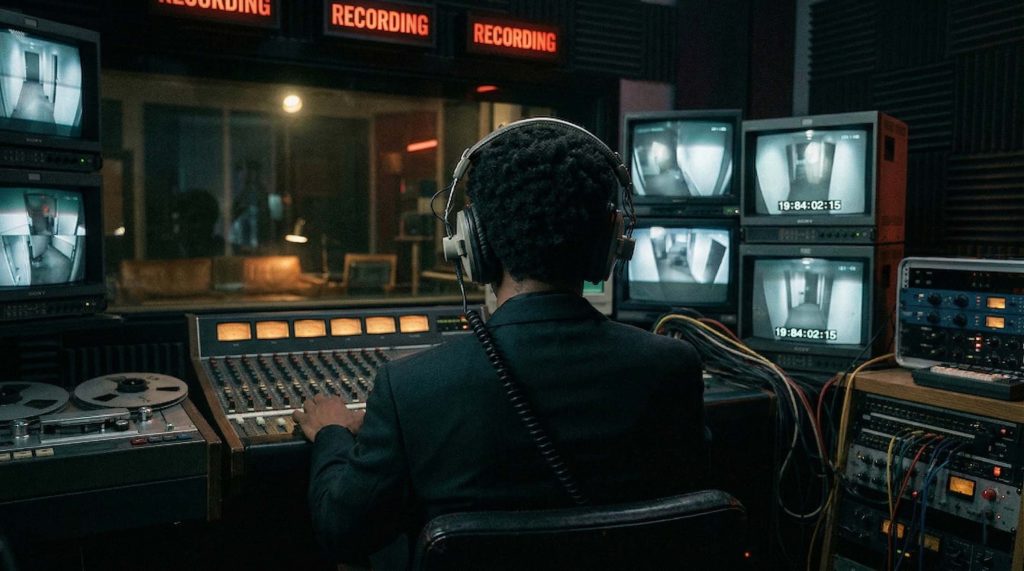
Most people remember “Somebody’s Watching Me” as a voice before they remember it as a person.
They remember the chorus, that nervous little shiver of a hook, and then the second recognition hits: wait, that’s Michael Jackson. What they usually do not remember, at least not immediately, is that the record belongs to Rockwell — not some faceless studio prankster or disposable novelty act, but Kennedy Gordy, son of Motown founder Berry Gordy, a songwriter trying very hard not to be dismissed as his father’s son.
That tension is the whole story.
Somebody’s Watching Me, by Rockwell, was the number two song on the Billboard chart this week (April 7) in 1984
“Somebody’s Watching Me” was one of the strangest mainstream hits of the 1980s: a paranoia record that sounded both playful and unwell at once, part synth-pop, part R&B, part haunted-house theater. It arrived in early 1984, went to No. 2 on the Billboard Hot 100, hit No. 1 on the R&B chart, and embedded itself so deeply in pop memory that it still resurfaces whenever culture wants to signal surveillance, anxiety, creepiness, or Halloween-season dread.
The joke version of the story is simple: Berry Gordy’s kid got Michael Jackson to sing on a novelty single and then vanished.
The real version is better and harsher.
Access is not the same thing as immunity
Rockwell had access, yes. It would be absurd to pretend otherwise. Being Berry Gordy’s son meant being born inside one of the great American pop machines. But access is not the same thing as immunity. It can open the door and poison the room at the same time.
By Rockwell’s own account, he avoided using the Gordy name because he did not want the record dismissed as a family favor. Even that instinct tells you something important: he knew exactly how the optics worked. He understood that dynasty privilege in pop does not just produce opportunity. It also produces suspicion.
That suspicion became part of the song’s aura. Before anyone really parsed the lyrics, the record already carried a kind of offstage drama: Who is this guy? How did he get here? Is the song real, or assembled for him? And once listeners recognized Michael Jackson’s unmistakable chorus, the authorship problem became even messier. Rockwell had made a hit, but the biggest star in the world had entered the frame and bent gravity around himself.
How Michael Jackson ended up on the record
The collaboration appears to have been less cynical than legend makes it sound. In Rockwell’s own telling, he played the demo for the Jackson family on a boombox. Michael kept calling more relatives into the room to hear it. Then he pulled Rockwell aside and asked who would handle the background vocals. Rockwell answered with the obvious, slightly insane idea: why don’t you do it?
Jermaine Jackson also ended up on the track, which made the record feel even more like a junction point between two interlocking dynasties: the Gordys and the Jacksons, Motown royalty and its most explosive alumni.
This is where the song becomes very 8ravens: not in the nostalgia, but in the machinery. “Somebody’s Watching Me” is a record about being observed that was itself made inside one of the most overdetermined observational systems in American entertainment. Everybody was already watching Rockwell: his father, the label, the Jackson orbit, the press, the audience waiting to decide whether he was talented or merely connected.
He wrote a song about paranoia from inside a real surveillance chamber — not digital surveillance, obviously, but family scrutiny, celebrity adjacency, and pop-industrial attention.
Why the song aged so well
That is partly why the record aged so well. In 1984, the lyric played like exaggerated comic unease: the shower line, the mail, the sense that even private space had become unstable. It worked as an MTV mini-thriller. But decades later, the song sounds uncannily contemporary because the premise no longer feels absurd.
We live in a civilization that completed the joke.
Cameras are everywhere, phones are tracking devices we buy voluntarily, algorithmic attention has made public and private life porous, and celebrity culture has trained everyone to imagine themselves as both observer and observed. Rockwell’s hit was broad enough to be fun and specific enough to survive the transition from Cold War and media-age unease into full-spectrum digital self-surveillance.
That durability is also musical. The record sits in a beautifully unstable place between genres. It is synth-funk, new wave, R&B, and pop-theater at once. The groove is tight, but the atmosphere is twitchy. The chorus does not resolve the anxiety; it amplifies it.
And Michael Jackson’s contribution matters precisely because it does not feel like a guest verse stapled on for marketing. His voice functions like a phantom in the architecture of the song. It is both the catchiest thing in the room and the element that destabilizes memory. People remember the hook. The hook remembers Michael. Michael’s presence then partially eclipses Rockwell, even though Rockwell wrote the thing.
Was Rockwell really a one-hit wonder?
Strictly speaking, Rockwell was not a pure one-hit wonder. “Obscene Phone Caller,” the follow-up single, reached No. 35 on the Hot 100. That is not imaginary. It counts. He also released more albums, including Captured in 1985 and The Genie in 1986.
So if you want to be pedantic, the label is sloppy.
But pedantry is not memory, and culturally, he functioned as a one-hit wonder almost immediately. Why? Because the hit was too conceptually complete. “Somebody’s Watching Me” was not just a successful single; it was an identity trap. It had a giant premise, an unforgettable chorus, a dramatic video, a globally recognizable guest voice, and a title so clean it can be repurposed forever by Halloween playlists, film sync teams, lazy copywriters, and anyone needing instant shorthand for paranoia.
Once a song like that lands, it can turn its singer into a supporting cast member in his own story.
What happened after the hit
Rockwell’s follow-up records faced a structural problem. The breakthrough hit had a clear emotional engine: fear of exposure. Trying to extend that into a career risked turning persona into a gimmick. “Obscene Phone Caller” echoed the same paranoid theme, but with less mystery and less shock. By Captured and then The Genie, the narrative had already hardened around him. He was the guy from that song.
The industry is not kind to artists trapped in single-concept visibility, especially if the public already suspects the machinery around them is more interesting than the artist himself.
And then there is the Michael Jackson problem, which is really the Michael Jackson era problem. In 1984, Jackson was not merely famous; he was an atmosphere. The New York Times noted at the time how younger pop-soul acts, including Rockwell, were working in the wake of Thriller and adapting ideas from Jackson’s style and sound. That context matters. Rockwell did not just borrow a famous voice; he emerged at the exact moment when Michael Jackson’s presence could dominate the perception of almost anything it touched.
To collaborate with him was to receive a gift and a curse in the same package.
So what happened to Rockwell after the hit? The unromantic answer is: the rest of the career did not scale to the size of the single, and he eventually withdrew. In later interviews, he described losing the fun of it, feeling that music had become more job than joy, and wanting to experience ordinary life away from the glare.
That can sound like a polite exit line, but it also makes intuitive sense. If your signature song is about being watched, and your real career becomes a referendum on family privilege, celebrity adjacency, and whether the audience thinks you truly earned your place, disappearing starts to look less like failure and more like a logical final verse.
The hit that ate its author
That is why Rockwell is more interesting now than he seemed at the time. In 1984, he could be filed away as an eccentric beneficiary of two powerful family systems: the Gordys and the Jacksons. From here, he looks more like an accidental theorist of mediated life. He made a song about ambient scrutiny before ambient scrutiny became our default condition. He also became a case study in how pop culture misattributes authorship when fame enters the room.
Michael Jackson did not steal the record. Berry Gordy did not simply manufacture it. But both men, by proximity alone, became part of the song’s permanent shadow.
And that shadow may be the real reason “Somebody’s Watching Me” never died.
It offers two pleasures at once. First, it works as pure pop design: sharp hook, nervous groove, elegant premise. Second, it contains a meta-story listeners may not consciously know but can somehow feel — a song about surveillance made by a young man who could not escape being watched, judged, inherited, and compared. That is more than novelty. It is pop music doing something it rarely gets enough credit for doing: compressing an entire social system into four minutes.
The cruel little punchline is that Rockwell succeeded too well. He did not just make a memorable hit.
He made one of those records that devours its own author and lives on anyway.
That tension between pop, paranoia, and distribution keeps showing up elsewhere in the archive too: Madonna’s “Like a Prayer” as controversy-powered routing, our piece on Sinéad O’Connor, Madonna, and pop’s surveillance machine, and the wonderfully stupid way “867-5309/Jenny” escaped music and started behaving like phone infrastructure.
Sources
- Rolling Stone — “How ‘Somebody’s Watching Me’ Singer Rockwell Created a Paranoid Pop Classic”
- The New York Times — “It Takes Star Quality to Share the Jackson Limelight” (April 1, 1984)
- RIAA Gold & Platinum search results for Rockwell / “Somebody’s Watching Me”
- Wikipedia source map — “Somebody’s Watching Me”
- Wikipedia source map — Rockwell (musician)
For the portable-audio side of that same cultural shift, read How the Walkman Taught Us to Curate Reality.