
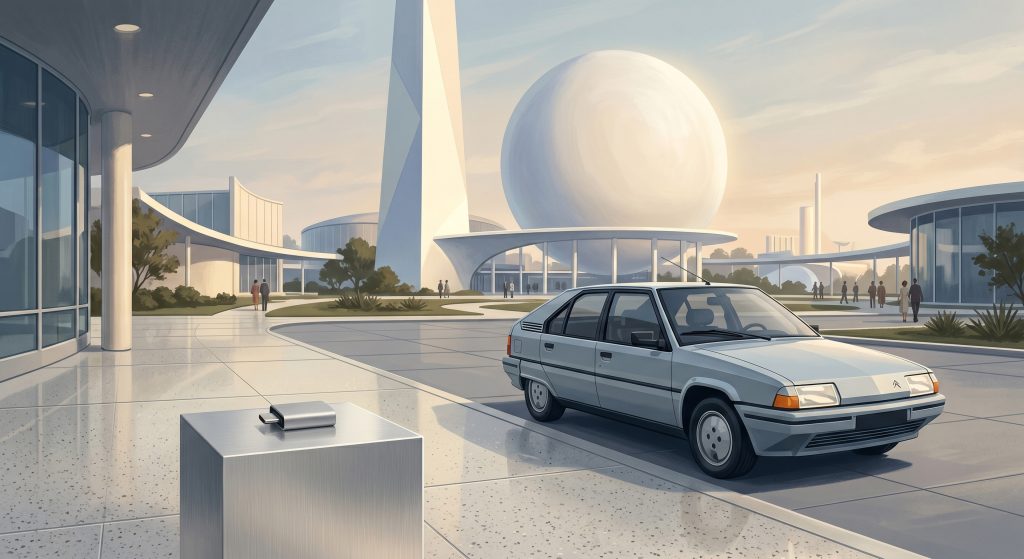
The cleanest version of tomorrow is usually a demo.
That was the real trick of the 1939 New York World’s Fair. It sold the future not as chaos, but as a guided experience with good lighting. More than 45 million visitors walked through Flushing Meadows across two seasons, under a banner theme of “The World of Tomorrow.” They saw the Trylon and Perisphere rising like an architectural logo for modernity, rode the world’s longest escalator into the Perisphere, and looked down on Henry Dreyfuss’s Democracity: a tidy future-city arranged for smooth living, frictionless movement, and middle-class confidence. General Motors’ Futurama did the same thing with highways and urban planning. The point was not prediction in the scientific sense. The point was packaging. Tomorrow had to be made legible before it could be made real.
That same instinct keeps showing up in smaller, stranger objects.
Jeff Geerling’s recent video on a tiny WisdPi USB-C 10G adapter is a perfect modern example. On paper, nothing about 10-gigabit networking should feel domestic. It belongs to server rooms, rack ears, fan noise, and hardware that looks like it invoices by the hour. But this adapter collapses that whole visual language into something almost suspiciously normal: a 59 x 29 x 13 mm aluminum block, 37.7 grams, hanging off a short 132 mm USB-C cable. It uses a Realtek RTL8159 chipset, a USB 3.2 Gen 2×2 interface with 20 Gbps of host bandwidth, and WisdPi claims 9.4 Gbps+ throughput if the host port is fast enough. In Jeff’s framing, that is the story. Not just speed. Scale.
Serious infrastructure has finally started to look like a consumer accessory.
That matters more than it sounds. For decades, future-tech arrived with an intimidation tax. Even when the capability was useful, the object itself signaled that it belonged to professionals, enthusiasts, or the terminally tolerant. Big power bricks. Loud cooling. Sharp-edged boxes with enterprise beige or black-box anonymity. The fairground version of tomorrow had always promised elegance, but the shipped version usually looked like punishment.
This is what makes the tiny 10G box interesting. It is not only that the networking got faster. It got socially smaller. It can sit beside a Framework laptop or a MacBook without making the whole desk feel like an IT department annex. That is exactly what the World’s Fair understood in 1939: the future has to fit into ordinary life before people will truly accept it.
The Citroën BX made the same argument on wheels.
Launched in 1982, designed by Marcello Gandini at Bertone, and kept deliberately lighter and cleverer than the class norm, the BX was one of those rare family cars that looked like it had arrived from a parallel timeline where middle-market objects were allowed to be interesting. Its wedge profile still feels alert. Not retro-cute, not soft, not apologetic. Just cleanly committed to the idea that tomorrow should have sharper lines.
But the more important part was underneath. The BX kept Citroën’s trademark hydropneumatic self-levelling suspension, one of those brilliantly irrational-seeming technologies that only makes sense once you live with it. It let a practical hatchback ride with a weird kind of composure, as if comfort and engineering eccentricity did not have to be enemies. At the same time, the BX was also a post-1970s compromise machine: Peugeot-sourced mechanical common sense paired with unmistakably Citroën thinking. In other words, the future, but made registerable.
That is why the specific 1989 BX 19 GTI in today’s Catawiki listing feels so on-theme. It is not some museum-frozen concept statement. It is a real survivor: 122 hp, 1,905 cc, manual transmission, 179,205 km, Dutch family ownership since 1993, with a 2023 timing-belt renewal and an APK valid until March 2027. The seller notes that the suspension works properly, just a bit firmer than ordinary BX models. Even the detail about the original upholstery surviving because the owner fitted seat covers in 1993 is strangely perfect. This is how tomorrow actually survives: not as fantasy, but as maintenance.
That is the same move in all three: make the future legible, then livable.
The World’s Fair was future theater on a monumental scale. The Trylon and Perisphere were temporary structures with plaster-board skins over steel frames, designed to be iconic first and durable second. They were symbols, and symbols are allowed to cheat. The BX was a more honest proposition: tomorrow packaged as a car you could finance, drive in the rain, and park outside your building. Jeff’s tiny 10G adapter pushes the same logic further still. It strips away even the theatrical bodywork. Now the future is just a small metal dongle that quietly erases an old boundary.
In each case, the breakthrough is not merely technical. It is editorial.
Someone had to decide which parts of the future to keep and which parts to cut so normal people could live with it. At the fair, that meant moving sidewalks, corporate pavilions, and model cities seen from above — complexity flattened into reassurance. In the BX, it meant putting hydropneumatic weirdness inside a usable family hatchback instead of a rolling philosophical statement like the old Citroëns. In Jeff’s video, it means taking 10GbE — a technology with years of rack-room baggage — and shrinking it until it looks closer to a premium laptop accessory than a piece of infrastructure.
That is how most real futures arrive. Not in one clean unveiling, but in pieces. A fairground promise. A family car with a better idea under the skin. A tiny network adapter that makes pro hardware look domesticated at last.
The future rarely ships as the full Futurama. It ships as the parts that learned how to fit on a desk, in a driveway, or in a life.
If you enjoy that feeling of a promised future leaking into ordinary life, keep going with Concorde and the future of speed we still have not replaced, The Machine After the Handoff, and the first international communications system that had to invent governance before the internet existed.
Sources
- 1939 New York World’s Fair — Wikipedia
- Trylon and Perisphere — Wikipedia: https://en.wikipedia.org/wiki/Trylon_and_Perisphere
- Jeff Geerling — How did they make it this small??: https://youtu.be/zYZbZJZfCFI
- WisdPi — 10G USB Network Adapter | USB3.2+ Realtek RTL8159 10G RJ45: https://www.wisdpi.com/products/usb-c-to-10gb-ethernet-adapter
- Citroën BX — Wikipedia: https://en.wikipedia.org/wiki/Citro%C3%ABn_BX
- Octane Magazine — Citroen BX 16V buying guide, history and review: https://www.octane-magazine.com/articles/citroen-bx-16v-buying-guide-history-and-review/
- Catawiki — Citroën – BX 19 GTI – NO RESERVE – 1989: https://www.catawiki.com/en/l/103107542-citroen-bx-19-gti-no-reserve-1989