
Source video: Turning a $400 Abandoned Citroën ZX into a Cyberpunk Restomod
Video link: https://www.youtube.com/watch?v=IL2ETPKMAhQ
There are plenty of restomod builds that chase performance, rarity, or nostalgia. This one chases something stranger—and, honestly, more interesting.
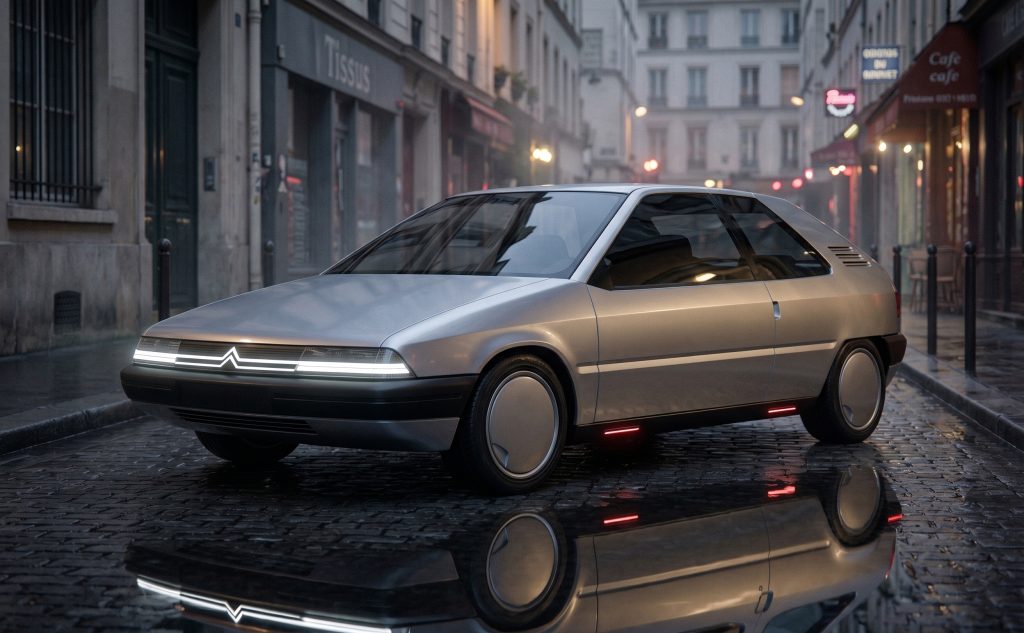
In Turning a $400 Abandoned Citroën ZX into a Cyberpunk Restomod, designer Young takes a neglected Citroën ZX—known in China as the Fukang—and rebuilds it not as a practical road car, but as a static concept from an alternate future. The stated goal is not to make the ZX “better” in the conventional YouTube sense. It is to uncover the futuristic DNA Young believes the original car carried all along, but never fully expressed.
That makes this project catnip for anyone who loves the line where old design meets unrealized possibility.
Not a restoration. Not a tuner build. A recovered timeline.
What makes the video compelling is that it refuses the obvious paths.
A cheap abandoned 1990s hatchback usually gets framed one of three ways online: a budget rescue, a drift toy, or a meme project. Young does something much smarter. He treats the ZX as if it were the incomplete sketch of a lost Citroën future.
That framing changes everything.
Instead of asking, “How do we modernize this old car?” the build asks, “What if Citroën’s late-20th-century futurism had never been interrupted?” That is a much more 8ravens question. It is not about retro cosplay. It is about alternate continuity.
And if you know Citroën, that idea lands hard.
This is the company that gave the world the DS, the SM, the CX, and the BX—cars that often looked like they had arrived from a slightly misaligned timeline. Even when Citroën built ordinary family transport, there was usually some residue of conceptual weirdness left in the shape. The ZX was more restrained than the company’s true icons, but Young’s thesis is that the restraint masked an underlying design logic waiting to be exaggerated.
The front end: where old Citroën meets concept-car theater
The strongest move on the car may be the front.
Young integrates a modern Citroën logo into a wide horizontal lighting graphic, effectively stretching the badge into the headlamps and using it as a bridge between eras. It is a simple gesture, but it works because Citroën has always been a brand where the logo behaves like graphic architecture rather than mere decoration.
That alone would have been enough to sell the idea. But the build keeps going.
The team wanted a continuous clear front cover—something that would flatten the face into a cleaner, less biological object. Early attempts with 3D printing and epoxy failed, reportedly because of bubbling and yellowing, before they switched to heat-shaped polycarbonate boards. That bit matters because it captures the reality of many great design builds: the final look often depends less on vision than on stubborn material problem-solving.
The result is exactly the kind of detail that makes a car feel conceptually futuristic rather than merely modified. Modern cars often try to look aggressive. This ZX tries to look unfamiliar.
That is a much rarer ambition.
The side view fixes the ZX’s biggest weakness
Most memorable cars survive in profile. Young seems to understand that instinctively.
One of the cleverest changes in the build is the rebalancing of the ZX’s proportions to visually reduce the front overhang and stretch the rear. This does not literally turn the car into something mid-engined or exotic. What it does is far more useful: it changes the car’s stance from ordinary compact hatchback to something with directional intent.
The blacked-out B-pillar helps too, because it extends the horizontal read of the body and visually cleans up the greenhouse. The hidden turn signal recess in the front door is a small detail, but it participates in the same language: fewer interruptions, more flow, more controlled surfaces.
This is where the project starts to feel less like a tuner exercise and more like industrial design. The goal is not adding features. The goal is deleting noise.
The rear is where the cyberpunk label finally earns itself
Plenty of builds use “cyberpunk” as shorthand for LED strips and dark paint. This one gets closer to the real thing.
The merged C- and D-pillar treatment is the moment where the car stops being a modified ZX and starts becoming a speculative object. Young folds the rear structure into one thick, vented pillar inspired by the Citroën BX, then pushes the rear glass inward to create a strange sense of depth. That recessed rear deck is one of the smartest ideas in the entire build.
Young jokes that the flat shelf could hold anything from a drone launch pad to a weapons cache. The joke works because the design actually supports the fantasy. Good futuristic styling is not just about looking sleek. It has to imply a different use-case, a different world, or at least a different owner psychology.
That is what this rear section does.
It suggests a version of the ZX designed not for French suburbia in the 1990s, but for a techno-continental future where practical hatchbacks evolved into urban tactical objects.
Ridiculous? Yes. Also effective.
Wheels matter more than people admit
The closed-off concentric wheels are another excellent call.
Young describes them as a way of emphasizing motion and creating the kind of “unfamiliarity” that reads as futuristic. He is right. Wheels are often where a supposedly radical build accidentally becomes ordinary again. Too conventional, and the whole illusion collapses. Too cartoonish, and the car turns into fan art.
These sit in the sweet spot. They help detach the car from recognizable period-correct tuner culture and move it into concept territory.
Likewise, the continuous rear light bar—3D printed to complete the back end—finishes the car with exactly the kind of impersonal, machine-face lighting signature that modern EVs and concept cars love. It is not emotional in the old sense. It is colder than that. More synthetic. More deliberate.
What the build understands about futurism
The best line in the whole project may be Young’s idea that futurism depends on “unfamiliarity disconnected from today.”
That is a sharper design principle than most major manufacturers seem to be using right now.
So much contemporary car design mistakes futurism for over-detailing: fake vents, hostile surfacing, giant screens, and lighting signatures that all blur together after six months. This ZX build takes the opposite approach. It uses retro cues, simplified volumes, and selective abstraction to imagine a future that did not happen—but still feels coherent.
That is why the car works.
It is not “future” in the corporate CES sense. It is future in the Moebius-comic, lost-concept, late-Cold-War-European sense. It feels like an object from a parallel branch of industrial design where Citroën kept doubling down on geometric experimentation instead of getting slowly normalized by the market.
That is exactly the kind of alternate-history machine that 8ravens tends to love: not just a custom car, but a visual argument.
The price makes the philosophy even better
The video says the channel Black Ma funded the build at around $20,000, starting from a roughly $400 abandoned base car.
On paper, that sounds irrational. In spirit, it is the only rational way this project could exist.
If the goal were practicality, you would never do this. If the goal were resale value, you would definitely never do this. If the goal were daily driving, the video explicitly says that was never the point.
The point was to materialize a childhood dream and turn a forgotten mass-market Citroën into an artifact from an impossible future.
That is not normal car culture math. It is concept-car math. And concept-car math is almost always emotionally correct even when financially absurd.
Why this build matters beyond Citroën nerds
Even if you are not a Citroën obsessive, the project still lands because it demonstrates a design truth worth remembering: some old cars are not valuable because they were perfect. They are valuable because they contained unfinished ideas.
The ZX is not usually spoken about as a holy object. It is not a DS. It is not an SM. It is not one of the canonical Citroëns people put on posters.
But builds like this make a strong case for re-reading automotive history through dormant potential rather than prestige alone.
Sometimes the most interesting restomod is not the one that improves a legend.
It is the one that finds the dream hiding inside an ordinary car and turns the volume all the way up.
Final verdict
Turning a $400 Abandoned Citroën ZX into a Cyberpunk Restomod is one of the more interesting car-design videos of the year because it is not really about fabrication flexing. It is about design interpretation.
Young looked at a forgotten Citroën hatchback and saw a suppressed future. Then he built that future anyway.
That is the kind of madness we should protect.
If this recovered-timeline logic clicks for you, it belongs beside the Citroën DS as the company’s older hydraulic fever dream, the Autoforma Volvo P1800 ES restomod as a cleaner northern version of the same instinct, and Concorde as another design object modernity still has not properly replaced.