
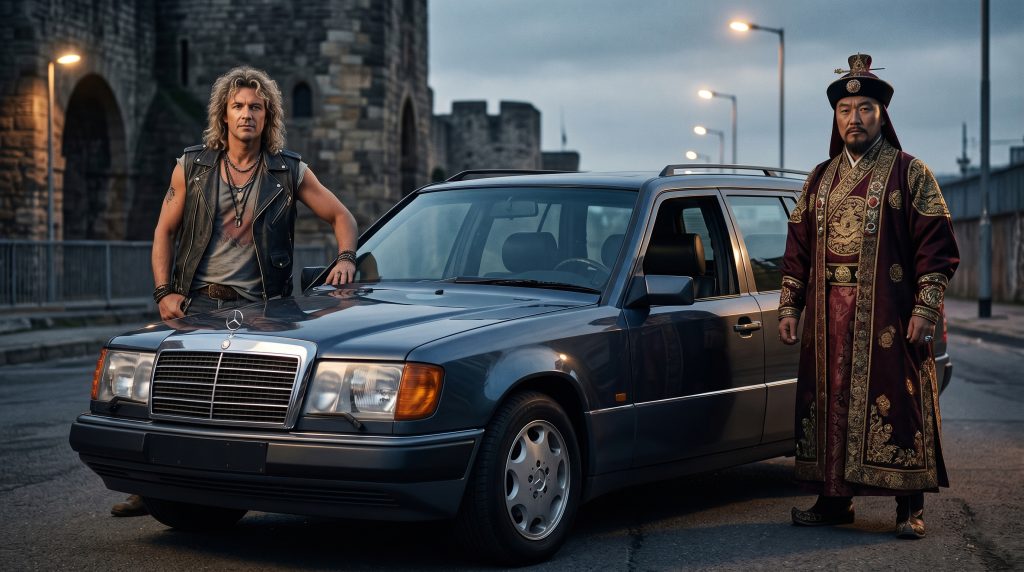
Subhead: Temür Khan, Van Halen, and the Mercedes-Benz W124 300TE on what survives when a beloved system keeps its badge but gets a new steward.
Temür Khan and Van Halen’s 1986 lineup shift are paired here because they share the date in the historical calendar, (Van Halen’s Why Can’t This Be Love was number four in the Billboard chart this week four decades ago, and exactly 729 years have passed since Temür Khan’s coronation), not because they belong to the same world: one is a coronation on the calendar of empire, the other a reset year for a rock band that had to prove it could still sound like itself after the frontman changed. That odd coincidence is exactly why the comparison works. What happens when a beloved system does not disappear, does not rebrand, does not admit defeat, but quietly installs new hands on the controls?
The answer is never “nothing.” Continuity is not a neutral state. It is a decision. The badge stays because it still carries trust, memory, and market power. The system stays because people need the system to keep working. But the steward changes the texture of everything: the pace, the tolerances, the priorities, the hidden compromises. A handoff is not a freeze frame. It is a reprogramming.
Temür Khan is a clean historical example because he inherits rather than invents. He was Kublai Khan’s grandson and became the Yuan emperor in 1294, ruling until 1307. The empire he received was already an empire of inherited scale and inherited strain. The Mongol world had been divided for years; the throne still implied universal authority, but the map no longer behaved like the slogan. Temür did not found the state, and that is exactly why he matters here. He shows how legitimacy can outlive the founder and still feel real. The crown remains recognizable even when the emperor wearing it is not the one who made the machine.
That is what makes succession interesting: the new steward does not arrive in a vacuum. He arrives with a promise. Temür’s problem was not only how to rule, but how to keep the old structure feeling continuous while the underlying reality had already shifted. Every successor inherits an operating system written by someone else. The prestige is inherited, too. So is the fragility. If the machine keeps running, people call it continuity. If it stutters, they call it a decline. Either way, the badge is doing a lot of unpaid work.
Van Halen in 1986 is the same story in louder clothes. When David Lee Roth left in 1985 and Sammy Hagar came in, the band did not die; it negotiated a new identity under the same name. That matters. “Van Halen” remained the badge on the door, but the stewarding philosophy changed. The band’s first Hagar-era album, 5150, arrived in 1986 and went to No. 1. The new logo even kept the old initials and stretched them into a different shape, as if to say: yes, this is still the same machine, but it has been recalibrated for a different driver.
Fans always ask the same question at moments like this: Is it still the thing I loved? The honest answer is both yes and no. It is still Van Halen because the core machinery remains in place. Eddie’s guitar identity is still the load-bearing beam. The name, the chemistry, the catalogs, the live ritual—those are still there. But the band is not unchanged. It sounds different, behaves differently, and sells a slightly different version of itself. The badge promises continuity, but the internal code has been rewritten. That is not fraud. That is stewardship.
And this is where the Mercedes-Benz W124 300TE becomes more than a car. It becomes the perfect machine analogy because it understands the difference between a logo and a philosophy. The S124 estate version went on sale in 1985, and the 300TE sat inside that working-wagon branch of the W124 family: same Mercedes badge, same Bruno Sacco-era restraint, but a platform asked to do harder daily labor than the sedan. It was not merely an ornament on wheels. It had to carry more load, more family life, more miles, and more pressure without surrendering the composure people expected from the brand. The same badge, yes. The same company, yes. But the job description expanded. The engineering had to become quietly tougher, not flashier.
That is the hidden genius of a good handoff. A weak steward tries to preserve the image and loses the function. A strong steward preserves the function and allows the image to evolve just enough to survive new conditions. The W124 300TE does not ask you to admire a revolution. It asks you to notice discipline. The car stays Mercedes because it still behaves like a Mercedes, but the estate version teaches the badge a different lesson: luxury is not only shine. Sometimes, luxury is the ability to absorb abuse and keep the doors aligned.
That is why the badge matters so much in all three cases. In Temür Khan, the badge is dynastic legitimacy. In Van Halen, it is cultural memory. In the W124, it is the engineering reputation. The steward inherits not just a product or a throne, but a theory of continuity. The job is not to erase the previous owner. The job is to prove that the old promise still works under new constraints.
And that is the point the handoff reveals. A beloved system is not loved because it never changes. It is loved because, under pressure, it changes without breaking its own grammar. The new steward does not get to invent trust from scratch. He gets to spend the inherited trust carefully. He can turn the wheel, but he cannot pretend the badge arrived with him.
What survives, then, is not sameness. What survives is recognizability under stress. That is the real afterlife of a handoff: the audience still knows what it is looking at, even as the machine quietly learns new habits.
This one also belongs with machines that refuse to die, the futures fair that kept shipping its ideas in fragments, and our look at pop stardom as an image-management system—different topics, same handoff problem.
Sources
- Temür Khan, Wikipedia: https://en.wikipedia.org/wiki/Tem%C3%BCr_Khan
- Van Halen, Wikipedia: https://en.wikipedia.org/wiki/Van_Halen
- Mercedes-Benz W124, Wikipedia: https://en.wikipedia.org/wiki/Mercedes-Benz_W124
- Mercedes-Benz 124 series manuals/model directory (300TE listing): https://mbmanuals.com/series/124/