
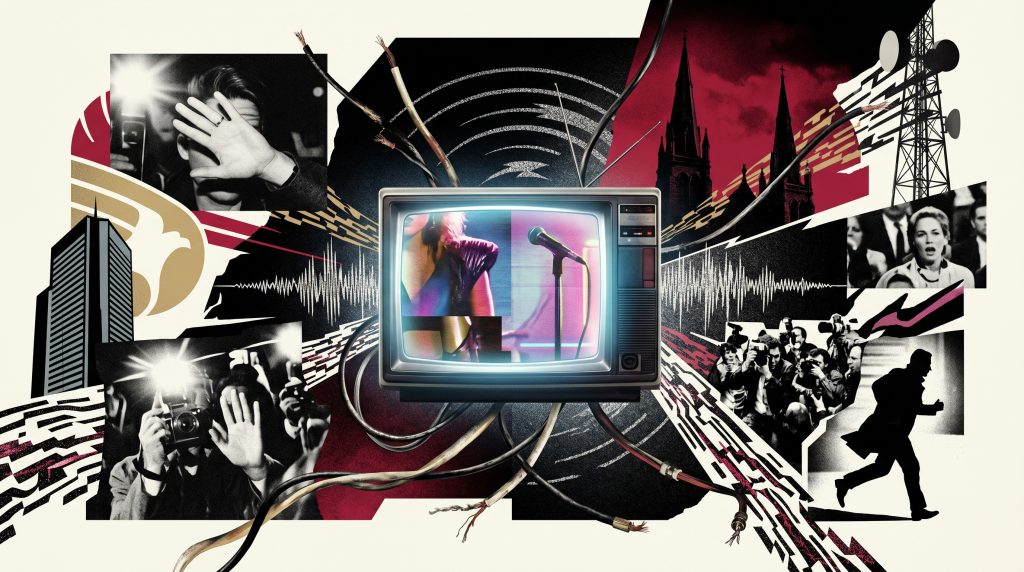
March marked 37 years since Madonna released “Like a Prayer” on March 3, 1989, and the song still feels uncomfortably current. It became her seventh No. 1 hit on the US Billboard Hot 100 and stayed there for three weeks. That chart fact matters, but it is the cleanest part of the story. What made “Like a Prayer” durable was not just that it was a hit. It was that it moved through a media system that turned outrage into routing.
In the late MTV era, controversy was not a side effect. It was a distribution technology.
That sounds a little too neat until you remember how cable pop actually worked. MTV was a gatekeeper with a schedule, not a feed with infinite recall. Rotation mattered. Timing mattered. Scarcity mattered. A video that got played after breakfast, again at dinner, and then discussed on the local news was not merely being “covered.” It was being moved through a chain of institutions that all wanted a piece of the same shockwave. In that world, outrage was not noise. It was a handoff.
“Like a Prayer” was built for that handoff because it sat at the intersection of three systems at once: the record business, the video business, and the moral-policing business. The song itself is immediate pop, built on a gospel pulse and a hook that lands on contact. The video made the record impossible to ignore. Madonna sings in a church, witnesses a racist attack, kisses a Black saint, and stages Catholic imagery as both provocation and plea. That was enough to trigger the old machinery: church outrage, Vatican condemnation, family-group protests, and wall-to-wall coverage that treated the clip as a culture event rather than a music-video release.
Then came the Pepsi problem, which is where the scandal machine became impossible to miss. Pepsi had tied the song to a commercial campaign; once the video detonated, the company backed away. The ad was pulled, the partnership collapsed, and the whole episode became proof that an artist could route a song through corporate media and still have the backlash reroute it back into public conversation. The tie-in was supposed to normalize the record. Instead, it made the record legible to people who would never have found it through radio alone.
That is the pre-algorithm version of a recommendation engine.
Today, we are used to outrage being optimized by platforms that know exactly how long you linger on a clip and what you will click next. In 1989, the system was slower, but no less effective. The recommendation layer was made of editors, programmers, talk-show hosts, clergy, and newspaper front pages. MTV played the video because it was hot. News programs replayed the controversy because it was hot. Religious groups denounced it because they needed to be seen denouncing it. Every reaction added another reason for everyone else to watch. The scandal was not outside the distribution chain. It was the distribution chain.
That is why the moral panic mattered as infrastructure. A panic is an inefficient form of curation: it points to a thing, declares it dangerous, and in doing so tells everyone where to look. The more respectable the condemner, the more valuable the signal. A church statement, a Pepsi retreat, a television segment, a tabloid headline — each one widened the audience while pretending to resist the audience shift. The irony is old and simple: institutions that say they are protecting culture often end up delivering it.
Madonna understood this with almost mechanical clarity. She was never only selling a song; she was testing how much friction a pop object could absorb and still remain radio-friendly. “Like a Prayer” worked because it did both jobs at once. It sounded like a hit, which mattered. But it also carried a symbolic charge, which mattered more. The song’s gospel shimmer made it feel bigger than gossip. The video’s religious imagery made it feel like a public argument. Put together, they formed a loop: the record created the controversy, and the controversy created the visibility that helped the record become a bigger record.
That loop is what late MTV did better than almost any institution before it. The network turned visual disagreement into repeated exposure. A clip that caused problems was more likely to be discussed, excerpted, replayed, and defended. You did not need everyone to approve. You only needed enough people to be unable to look away. In a pre-feed world, being in the argument was a kind of placement.
There is a reason this episode still feels instructive now. Our current attention economy likes to think it invented spectacle, but the old cable era already knew the basic rule: visibility is often purchased with conflict. The difference is that conflict used to be expensive. It required broadcasters, brands, and gatekeepers to absorb the backlash in public. That made the system slower, but also more tangible. You could see the cables.
“Like a Prayer” is a perfect example because it sits at the point where pop, corporate sponsorship, religious offense, and TV scheduling all became one machine. It was not just a song that offended people. It was a network event. And like the best network events, it did not merely reflect the culture. It redistributed attention through it.
That is the scandal machine: not gossip, but routing. Not noise, but infrastructure. Madonna did not just survive the backlash. She turned it into bandwidth.
If you want the wider version of this argument, it pairs neatly with Rockwell’s surveillance-pop masterpiece, the Sinéad O’Connor / Madonna contrast between raw feeling and image architecture, Stonewall as a case where public exposure became part of the punishment, and Amy Grant’s cleaner but equally revealing route into mainstream distribution.
Sources
- Madonna — “Like a Prayer (song)” (Wikipedia): https://en.wikipedia.org/wiki/Like_a_Prayer_(song)
- Billboard Hot 100 chart archive: https://www.billboard.com/charts/hot-100/
- Madonna — “Like A Prayer (Official Video)”: https://www.youtube.com/watch?v=79fzeNUqQbQ
- Madonna official channel: https://www.youtube.com/@Madonna