
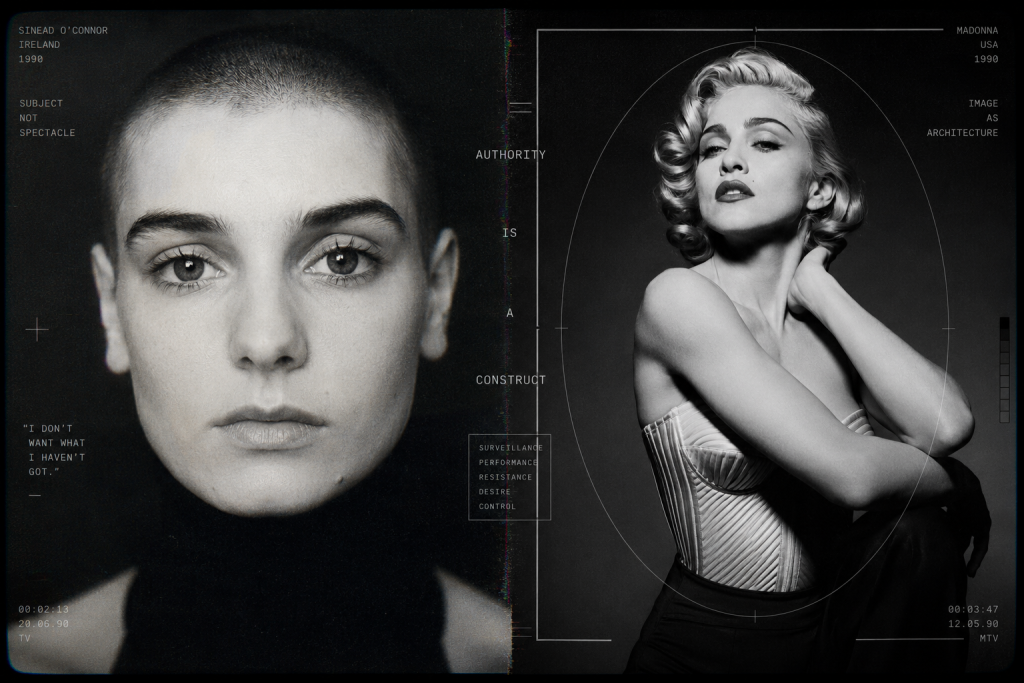
In 1990, pop’s emotional authority split in two.
Sinéad O’Connor made feeling look like truth, breaking through the frame. Madonna made the frame itself look like power. One stripped the image down until vulnerability became almost unbearable to watch. The other treated image as a structure to be designed, controlled, quoted, and mastered. They looked like opposites, and in obvious ways, they were. But they were solving the same problem.
How does a woman look real inside a visual machine built to package, reward, monitor, and punish her?
That question mattered in the MTV era because female authority had to become visible before it could become legible. Billboard measured dominance. MTV turned visibility into emotional sorting. A hit was no longer just a song on the radio. It was a face, a posture, a body, a sequence of images that had to carry personality, power, desire, intelligence, vulnerability, and market logic all at once. The system did not simply broadcast women. It interpreted them. Then it trained audiences to do the same.
Visibility, in other words, was never neutral. It was access, but it was also exposure. The more clearly a woman projected authority inside that machine, the more quickly that authority could be questioned, moralized, or turned against her.
Sinéad O’Connor and Madonna understood that pressure better than most. Their contrast is not authenticity versus artifice, or sincerity as opposed to performance. That is the lazy reading. The sharper one is this: they built two different technologies of emotional legitimacy inside the same surveillance structure.
Sinéad: authority through refusal
If Madonna’s power often arrived through abundance, Sinéad’s arrived through subtraction.
“Nothing Compares 2 U” remains one of the most striking pieces of anti-spectacle ever pushed through mainstream pop. The video does not compete on scale. It does not seduce through visual overload. It does not decorate itself into authority. It narrows the field until the face becomes the event.
The shaved head matters here, not as a signature quirk but as a refusal of conventional glamour. It removes an entire layer of soft-focus femininity that the visual pop system expected to use as shorthand. The close-up matters because it denies escape. The stillness matters because it rejects the usual grammar of kinetic pop charisma. And then there is the tear: one of the most famous tears in music-video history, partly because it seems to arrive not as an effect but as a cost.
That is what gave Sinéad her authority. She made vulnerability read as expensive.
Not weak. Not decorative. Expensive.
Her emotional force came from the feeling that something real had broken through the frame faster than the frame could contain it. Even if that impression was, in its own way, still mediated, it carried the charge of exposure. She looked like someone refusing to cooperate with the normal terms of pop legibility. Refusing glamour became a moral force. Stillness became confrontation. Anti-image became image.
That is the paradox. Sinéad did not escape spectacle. She turned refusal into a new kind of spectacle. The system could still package her, but it had to do so around austerity, pain, and seriousness rather than conventional seduction. That made her authority unusually intense, but also unusually unstable inside a culture that prefers female feeling either softened into sentiment or contained within safer formats.
Madonna: authority through image mastery
Madonna solved the same problem in the opposite direction.
Where Sinéad stripped away, Madonna designed. Where Sinéad made emotional exposure feel costly, Madonna made control feel charismatic. “Vogue” is the clearest demonstration of that logic: black-and-white glamour, immaculate pose-work, choreography as intelligence, citation as power. Nothing in it suggests accidental presence. Everything is arranged. That arrangement is the point.
Madonna understood earlier and more fluently than most of her peers that image was not decoration layered onto a song. It was architecture. A pop star did not merely appear inside a frame; she could author the frame, manipulate its codes, raid cultural memory, and turn references into force.
In “Vogue,” pose is not just style. It is a system. Gesture becomes language. Glamour becomes structure. Old Hollywood is not passive nostalgia but an active reference machine, a library Madonna can enter, reorganize, and wear. The effect is neither confession nor transparency. It is authorship.
This is why reinvention worked for her. In weaker artists, constant reinvention can read as instability or emptiness. In Madonna, it read as strategic authorship because the shifts were not random. They were evidence of control. She was not lost in the media. She was literate in it. More than literate: she was operational.
That fluency created its own form of emotional authority. Madonna did not ask the viewer to believe she had stepped outside the performance. She made performance itself look sovereign. The message was not that the frame had fallen away. The message was that she knew exactly how the frame worked and could bend it to her will.
Which is why critics so often misread her as merely calculating. Calculation, in this case, was not the absence of feeling. It was a different public arrangement of feeling, rooted through design, discipline, and self-authored iconography.
Same problem, opposite solutions
Put Sinéad and Madonna side by side, and the contrast is obvious. One gives you close-up pain, stillness, refusal, anti-glamour. The other gives you choreography, citation, polish, and deliberate visual command.
But the surface contrast can hide the deeper symmetry.
Both women were trying to answer the same impossible question: how do you appear emotionally legible inside a visual system that mistrusts women, whether they are too raw or too constructed?
Sinéad’s solution was to strip the image down until emotion looked like truth breaking through mediation. Madonna’s solution was to master mediation so completely that the image itself became proof of agency.
Neither solution was simple. Neither was naive.
Sinéad’s “rawness” was not untouched innocence. It was a powerful visual strategy built from refusal, austerity, and emotional concentration. Madonna’s polish was not emptiness. It was authorship expressed through design. One used confession as a format. The other used design as a format. Both were working with format because there is no public self outside format, especially not in a high-surveillance pop system.
Female authority under surveillance
This is where the punishment logic becomes impossible to ignore.
Sinéad was often treated as too exposed, too disruptive, too morally charged, too unwilling to make herself digestible. Her authority exceeded comfort because it did not flatter the system that carried it. She was legible, but in a way that made the machinery nervous.
Madonna triggered the opposite suspicion. She could seem too calculating, too fluent, too visibly aware of how the media worked. Her command over images often produced admiration, but it also provoked resentment. A woman who controlled the frame too well was still treated as a suspect, as if her fluency itself needed correction.
That is the trap. Women in public are asked to be visible, but not threatening. Emotional, but not excessive. Designed, but not overly designed. Strategic, but not so strategic that the strategy becomes visible. The line keeps moving because the line is the mechanism.
In that sense, Sinéad and Madonna were punished not because they failed the system, but because they revealed it. Each made the surveillance machine easier to see from a different angle. Sinéad exposed how costly visibility could feel when stripped of glamour. Madonna exposed how much power could be generated by understanding the codes of spectacle better than the system expected a woman to understand them.
The same split is still with us
Replace MTV with feeds, tabloid culture with algorithmic discourse, and pop stardom with creator culture, and the structure barely changes.
Today’s “raw” creator and today’s hyper-curated personal brand are still trapped inside the same old argument. Authenticity is still performed under pressure. Polish is still treated as suspicious, especially when women exercise it too deliberately. Social platforms have accelerated the cycle, but they have not changed the underlying logic. They have only made surveillance ambient, participatory, and constant.
The creator who shows too much feeling can be framed as unstable, attention-seeking, manipulative, or unserious. The creator who presents too much control can be framed as fake, cold, over-branded, or inhuman. Either way, authority is granted conditionally and then re-audited in public.
That is why the Sinéad-Madonna split still feels modern. It was never just about two stars with different aesthetics. It was about two models of female authority under conditions of extreme visibility. One model says: I will become believable by stripping away the ornamental script and letting exposed feeling carry the weight. The other says: I will become undeniable by understanding the script better than anyone else and turning it into an instrument.
Both models still exist. Both still work. Both still trigger suspicion.
What 1990 actually showed us
The real contrast between Sinéad O’Connor and Madonna is not raw truth versus fake image.
There are two different ways of building emotional authority in public under surveillance.
Sinéad made anti-spectacle into spectacle and transformed exposed feeling into moral force. Madonna made image into architecture and transformed control into charisma. One made truth appear to break through the frame. The other made mastery of the frame look like the truth of another kind.
That was the lesson in 1990, and it has not gone away. The machine still asks women to make themselves legible inside systems designed to watch them. It still rewards visibility while punishing the forms of authority that visibility can create.
The tools changed. The scrutiny scaled. But the old problem remains intact: how do you look real when the frame is already judging you?
Sinéad and Madonna gave two brilliant answers. Neither offered escape. Both revealed the cost of being seen.
Sources and reference points
- Wikipedia — Sinéad O’Connor: https://en.wikipedia.org/wiki/Sin%C3%A9ad_O%27Connor
- Wikipedia — Madonna: https://en.wikipedia.org/wiki/Madonna
- Wikipedia — “Nothing Compares 2 U”: https://en.wikipedia.org/wiki/Nothing_Compares_2_U
- Wikipedia — “Vogue” (Madonna song): https://en.wikipedia.org/wiki/Vogue_(Madonna_song)
- Wikipedia — MTV: https://en.wikipedia.org/wiki/MTV
- YouTube — Sinéad O’Connor, “Nothing Compares 2 U” (official video): https://www.youtube.com/watch?v=0-EF60neguk
- YouTube — Madonna, “Vogue” (official video): https://www.youtube.com/watch?v=GuJQSAiODqI
- SAGE Journals — Content and Correlational Analysis of a Corpus of MTV-Promoted Music Videos Aired Between 1990 and 1999: https://journals.sagepub.com/doi/10.1177/2059204320902369
- Film Criticism — MTV Video Stardom as Media Power: Madonna’s (Moving) Image Control: https://journals.publishing.umich.edu/fc/article/id/1786/print/
This piece links naturally to Madonna’s scandal machine in the MTV era, Rockwell turning paranoia into a pop hook, Stonewall as another case where visibility and exposure were never neutral, and Amy Grant’s very different route through mainstream respectability.